


Use Case
Alimentos e Bebidas: Reduzir desperdício com IA
Daniel Azevedo · 1 de outubro de 2021
Nos últimos anos, a Inteligência Artificial tem sido aplicada em praticamente todos os domínios e indústrias para melhorar ou resolver problemas específicos identificados. Um exemplo é a indústria de Alimentos e Bebidas, onde modelos de IA são utilizados com diferentes objetivos:
- Finanças: através da criação de previsões de procura mais fiáveis.
- Inovação: sugerindo combinações de ingredientes e menus mais variados.
- Sustentabilidade ambiental: através da redução de desperdício, água e energia.
Este último ponto é particularmente importante, pois as estatísticas indicam que, nos EUA, 5% a 10% dos alimentos adquiridos por restaurantes são desperdiçados, o que corresponde a cortes diretos no lucro do restaurante. Este desperdício pode resultar de ineficiência na gestão da cadeia de distribuição, estimativas inadequadas dos ingredientes necessários para um determinado prato, porções superdimensionadas e menus com elevada variedade, que requerem um conjunto mais amplo de ingredientes diferentes.
Para reduzir o desperdício de alimentos e aumentar os lucros dos restaurantes, neste artigo discutimos uma abordagem para estimar o desperdício de alimentos (por ingrediente) com base nas encomendas do restaurante e respetivas receitas dos pratos.
Isto permitirá uma perceção mais clara de como cada prato contribui para o desperdício total de alimentos produzido pelo restaurante. Além disso, através de uma previsão da quantidade real de ingredientes necessários, é possível evitar a necessidade de comprar em excesso.
Dados e Modelação
Para estimar o desperdício de alimentos de um restaurante, essencialmente precisamos saber:
- As receitas utilizadas pela equipa de cozinha para preparar os pratos
- Número de pratos confeccionados no passado
- Registo das compras de abastecimento no mesmo período
Deste modo, o total de ingredientes utilizados pela equipa de cozinha pode ser estruturado como se segue (daqui em diante referido como matriz K):
Onde temos, com base nas receitas do restaurante, a quantidade esperada de cada ingrediente utilizado nos diferentes pratos que o restaurante oferece.
No entanto, para cada prato e cada ingrediente haverá um desperdício associado (que pode ser zero). Portanto, o desperdício total de alimentos pode ser representado como se segue (daqui em diante referido como matriz Ɛ):
Onde Ɛi, j corresponde à quantidade do ingrediente j do prato i que foi desperdiçada.
Portanto, para determinar o desperdício que a cozinha está a produzir, por prato e ingrediente, precisamos aprender os valores da matriz Ɛ.
Para fazer isto, podemos começar por modelar o problema da seguinte forma:

Onde,
- Nd : Número de refeições do prato d confeccionadas pelo restaurante
- Kd : Ingredientes (e quantidades) necessários para confecionar o prato d
- Ɛ__d : Desperdício de alimentos resultante da confecção de uma refeição do prato d
- Consumption: Quantidade total de ingredientes adquiridos pelo restaurante no mesmo período
Curso, Templates
Data Ignite
Conheça como a IA pode ser aplicada no seu contexto.
A partir dos dados históricos do restaurante é possível utilizar os recibos de compras para determinar a quantidade total de ingredientes adquiridos (Consumption) e o histórico de encomendas para calcular Nd. Deste modo, conhecendo as variáveis Nd, Kd e Consumption, podemos treinar um modelo de Machine Learning para aprender a matriz Ɛ, com base na equação anterior.
Após o modelo aprender a matriz Ɛ, é possível efectuar análises detalhadas:
- Analisando a matriz Ɛ por linhas, podemos identificar qual prato contribui mais para o desperdício total.
- Quando analisamos a matriz Ɛ por colunas descobrimos qual ingrediente contribui mais para o desperdício total produzido pelo restaurante.
- Dividindo a matriz Ɛ pela soma das matrizes Ɛ e K, determinamos a percentagem de desperdício, por ingrediente, de cada prato.
Com base nestes pontos, algumas ações podem ser implementadas para melhorar o lucro do restaurante e reduzir o impacto ambiental, como rever o processo de confecção dos pratos com maior desperdício, descontinuar pratos ou menus onde a percentagem de desperdício é significativa (o que resulta em margens de lucro reduzidas) ou investir mais em pratos ou ingredientes onde o desperdício é menor.
Expansão para um cenário mais complexo
Num cenário mais complexo, e talvez mais realista, o problema pode ser formulado considerando múltiplas equipas de cozinha que trabalham simultaneamente em diferentes restaurantes e partilham o mesmo abastecimento de alimentos. Neste caso, teríamos o seguinte cenário:
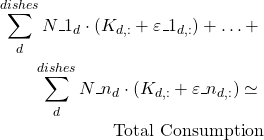
Onde N_xd corresponde ao número de refeições do prato d confeccionadas pela equipa x e Ɛ__xd_ ao desperdício resultante da confecção do prato d pela equipa x. Neste caso, cada equipa de cozinha terá uma matriz Ɛ individual que contém os valores de desperdício dessa equipa específica.
Este cenário permite análises mais complexas, como:
- Qual equipa contribui mais para o desperdício total produzido?
- O desperdício por prato é independente da equipa que o prepara, ou há variabilidade significativa no processo de confecção entre equipas?
- Para um determinado prato, qual processo de confecção de equipa é mais eficiente, isto é, produz menos desperdício para a mesma quantidade de tempo?
Melhorar a previsão
Um dos pontos de ação onde podemos usar esta formulação é fazer uma previsão mais precisa da quantidade de cada ingrediente necessária para os próximos D dias. Para fazer isto, basta aplicar diretamente a formulação com a matriz Ɛ aprendida.
Por exemplo, se esperamos ter 25 encomendas de Hamburgers e 20 encomendas de Steak and Baked potatoes nos próximos 5 dias, com base nas tabelas anteriores, o consumo esperado do ingrediente Beef seria:
25 * (K2,2 +Ɛ_2,2_) + 20 * (K0,2 +Ɛ_0,2_)
Que corresponde a:
25 * (0.15 + 0.08) + 20 * (0.3 + 0.12) = 14.15 Kg
Neste cenário hipotético, seria necessário comprar 14.15 Kg de carne, assumindo que, após treinar o modelo, se concluiu que a confecção de um prato de Hamburger e Steak and Baked potato resultaria num desperdício médio de 80g (K2,2) e 120g (K0,2) de carne, respetivamente.
Deseja discutir esta ideia?
Agende uma reunião com Pedro Serrano
Conheça Pedro Saiba mais
Conclusão
Cada ação para reduzir o nosso impacto no ambiente é valiosa, ainda mais se conseguir otimizar o negócio. Por isso, reduzir o desperdício nos restaurantes é uma excelente forma de melhorar a rentabilidade e contribuir para um ambiente mais sustentável.
Com isto em mente, neste artigo propomos uma abordagem para determinar o desperdício produzido num restaurante a nível de prato e ingrediente, com base nas receitas e no histórico de compras de alimentos do restaurante.
Isto pode ajudar a efetuar uma previsão mais precisa dos alimentos necessários com base nas encomendas esperadas nos dias seguintes e também criar uma visão mais realista de quais ingredientes e pratos contribuem mais para o desperdício, permitindo que os restaurantes tomem medidas para reduzir desperdício.
Como sempre, se tiver outras ideias sobre como reduzir o desperdício de alimentos, contacte-nos!