With COVID-19, many were affected by the economic crisis and lost their jobs. In Portugal alone, between February and September, there was a 30% increase in unemployment! AI can be a powerful tool in allocating scarce resources in a more efficient way. Inspired by DSSG Fellowship’s Project in Partnership with IEFP (Instituto de Emprego e Formação em Portugal) we started to think about how we would help reduce unemployment using AI.
Similar to DSSG’s project, the goals that will be discussed here are:
Better identify individuals at high risk of long-term unemployment;
Support more efficient allocation of the employment/training institute’s resources to respond to the needs of unemployed individuals.
This is a summary from an internal non-exhaustive discussion merely for learning purposes – there are multiple solutions, all of which depend on the development time and the data which you can access.
Data and Relevant Patterns
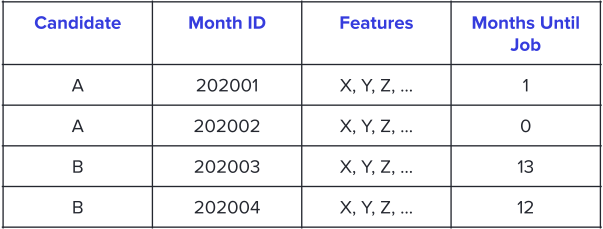
Let’s assume that we can gather data when the unemployed person registers on the website platform, and all the job-related interactions are stored until the candidate finds a job. For simplification purposes, we can build our dataset given a list of monthly snapshots of all platform users’ characteristics, which have a unique identifier.
What raw information would be interesting to have?
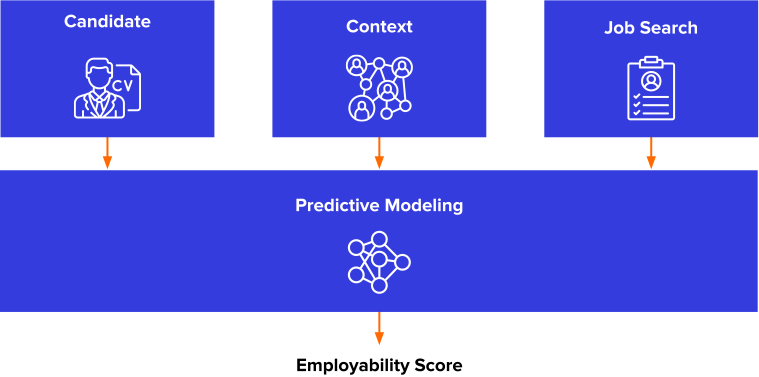
Candidate
Demographic (Age, Gender, Civil State, Address)
List of previous courses and education level
Curriculum Vitae
Years of Experience
Maximum job distance to home
Schedule in which he can work
Number of dependents
Disabilities
Languages
Skills
How can we encode in a similar way the information from a person with 10 previous courses vs. one with 2?
Encoding Options for List of Previous Courses
Label Encoding: We can represent each course as a number. But this means that the course number k is at a higher distance from course k – 5 than course k – 1, which might not be the best way of representing this.
One Hot Encoding: We can represent each course as a new column. With too high dimensionality, this becomes very sparse.
Content Based: This approach considers a domain-specific representation, where we can encode the courses by several areas of expertise (e.g. Maths, Chemistry, Programming, etc). As values, we can represent it either as binary (course covers that area or not) or represent it by the average grade of the candidate in those areas.
Embedding Based: From a list of courses, train a vector representation (embedding) from scratch or based on content found in external sources so that similar courses have lower distances between them. We can then use a model that’s able to deal with varying input shapes (e.g. RNN, CNN).
Encoding Options for Curriculum Vitae (CV)
The candidate’s CV is also rich with data – we could use several NLP techniques to extract data from here, such as a Bag of Words or the average word embedding value (which has the advantage of having a semantic representation of words).
Note on fairness: We could have added a feature related to the candidate’s monthly expenses, as a way to estimate how much money he would need per month. But this could create a negative feedback loop – if he has low expenses due to not having the ability to live a better life, the model could be allocating him to offers with low salaries.
Context
Unemployment History (e.g. total number of months since last job, statistics of unemployment time in the past – max, mean, etc)
Search Efforts (such as the total number of interviews, number of interviews above the minimum required threshold, percentage of recommended interviews attended)
Search Consistency (e.g. standard deviation of days between interviews and of days between applications). Note that these features might be influenced by job offer scarcity, so it can end up giving unwanted biases to our model!
Offers (Job/Formation)
Offer Name
Offer Areas (e.g. Maths, Science, Programming, …)
Offer Remuneration
Requirements
Offered shifts
Localization
Ideally, we would represent the offer list in a comparable domain to the candidate’s expertise, so our features could represent the similarity between the offer and the candidate skills. As such, offer areas would also be represented in a Content Based approach.
If we were to use a model that cannot learn this relationship directly (e.g. tree based models) we could calculate pairwise features, such as the difference between the offer remuneration and the candidate’s monthly expenses, or the intersection between the candidate and the offer’s areas.
Modeling
After having all these features, we can create a model that, given a candidate snapshot in a month and a job offer, returns an employability score. There are several ways this employability score can be modeled, all of which can be tested and should be picked depending on how the model intends to be applied in production:
Months until a job is found: allows us to determine how many months will the candidate still need to receive a monthly allowance from the government. Therefore, we can prioritize the cases according to this prediction.
Number of interviews until the candidate is accepted: Doesn’t tell us anything about the timeframe, since the candidate can do several interviews in a month or no interviews for several months.
Multiclass risk classification, from Low to High, depending on a threshold (this is what was done in DSSG Fellowship): is not as actionable as the previous ones. However, a model might learn these patterns more easily, as the problem is reduced to an ordinal classification.
Let’s assume, for now, the model gives us the months until the candidate finds a job.
Reliable estimation of the model performance
We can evaluate the model performance using regression metrics such as the Mean Absolute/Squared Error and the Spearman/Pearson correlation coefficients between the target and the predicted value.
Time is an important component in our learning system, and, as such, we must pay attention to the way we split our data for performance estimation. Random splits might “leak” information in training, giving overestimations of the model performance.
As we’re building a dataset with several rows for the same candidate in different months, if we had the same candidate in train and test, but in different months, we’d know whether he found a job or not.
An initial approach is grouping the train/test splits by candidate (A is in train, B is in test, in the above example).
However, this approach still has the issue of time-leakage. Imagine that you were training the model with data from October 2020. You know, since a big shift in employment happened started in March 2020, that the average value of “months until employment” has increased, so you could also have an overestimation of model performance in predictions from months before.
A possible solution is to do both temporal and grouped stratification: for instance, train with a list of applicants from the previous year, and test with a list of other applicants from the current year. In the above example, you could train with data from 2019, with a candidate list not considering A and B, and test it on 2020, in candidates A and B.
Decision-Making
We can optimize the employment institute’s resources by calculating the model performance for a list of available job/formation offers and having a cost function that tells us how good that offer is for that given candidate. We will not extensively discuss this in this blog post.
Imagine, for instance, we want to create an email marketing campaign where we send a list of K offers for each candidate. We can decide (at least) two types of actions:
– Improving candidate’s skills (e.g., courses).
– Improve candidate exposure to jobs (e.g., interviews).
This is an assignment problem with a huge number of possible combinations and budget/time constraints.
Two possible cost functions for this problem are.
argmax [f(Candidate) – f(Candidate + Offer)], which gives us the decay in months until the candidate finds a job, for a given offer. We then want to find the offer that maximizes this decay.
argmax [ (f(Candidate) – f(Candidate+Offer)) x UnemploymentAllowance + Costs(Offer) ], which considers processing costs related with a given offer and incorporates business metrics, such as the money that would be required to maintain that candidate
This can then be optimized efficiently, for instance, with the use of metaheuristics, if the list of possible options is very large.
There are some ethical concerns with such cost functions:
Are we minimizing the average time for employment at the expense of offering jobs with lower salaries?
Will optimizing this leave some people in “starvation” of job offers just because it’s harder to find good offers for them?
To account for this, we can include some extra factors on the loss function to account for this, such as a multi objective search: considering time constraints for finding jobs for everyone and at the same time, reducing the average time people spend without a job.
Conclusion
This blogpost was written after an internal discussion where we discussed this topic. Obviously, it covers only a small fraction of what could be done with this topic. If you’re interested in having such discussions for a specific business problem you have, make sure to contact us!
Like this story?
Subscribe to Our Newsletter
Special offers, latest news and quality content in your inbox.
Signup single post
Recommended Articles
Article
Descubra o significado do «Ai First»: Guia estratégico para 2026
22 de junho de 2026 in
Guia: Explicação
Descubra o verdadeiro significado da abordagem «AI First» para a sua empresa. Obtenha um roteiro estratégico para 2026, exemplos práticos e evite erros comuns.
IA para o Crescimento Empresarial: O Seu Guia Prático de Estratégia
17 de junho de 2026 in
Guia: Explicação
Descubra como a IA para o crescimento empresarial pode aumentar a eficiência, melhorar a tomada de decisões e criar laços mais fortes com os clientes. Obtenha agora estratégias práticas.
Automatização de faturas: otimize o seu departamento de contas a pagar em 2026
15 de junho de 2026 in
Guia: Explicação
Otimize o processo de contabilidade de fornecedores através da automatização das faturas. Conheça as tecnologias e as melhores práticas e avalie o valor real para a sua organização.
Utilizamos cookies no nosso website para lhe proporcionar a experiência mais relevante, lembrando as suas preferências e visitas repetidas. Ao clicar em “Aceitar Tudo”, concorda com a utilização de TODOS os cookies. No entanto, pode visitar as "Definições de Cookies" para fornecer um consentimento controlado.
Este website utiliza cookies para melhorar a sua experiência enquanto navega no website. Desses, os cookies categorizados como necessários são armazenados no seu navegador, pois são essenciais para o funcionamento das funcionalidades básicas do website. Também utilizamos cookies de terceiros que nos ajudam a analisar e compreender como utiliza este website. Estes cookies serão armazenados no seu navegador apenas com o seu consentimento. Tem também a opção de recusar estes cookies. No entanto, a recusa de alguns destes cookies pode afetar a sua experiência de navegação.
Os cookies necessários são absolutamente essenciais para que o website funcione corretamente. Estes cookies garantem funcionalidades básicas e recursos de segurança do website, de forma anónima.
Cookie
Duration
Description
cookielawinfo-checkbox-analiticas
11 meses
Este cookie é definido pelo plugin de Consentimento de Cookies do RGPD. O cookie é usado para armazenar o consentimento do utilizador para os cookies na categoria "Análise".
---
O seu texto é uma etiqueta ou nome de campo, provavelmente de um sistema de gestão de cookies ou de um formulário web, e não uma frase completa que necessite de tradução contextual.
No entanto, se o objectivo for manter a clareza e a funcionalidade para um utilizador de língua portuguesa, sugiro a seguinte tradução e explicação:
**"Checkbox Funcional"**
**Explicação:**
* **Checkbox:** Refere-se ao elemento gráfico de marcação (uma caixa que pode ser seleccionada ou desmarcada).
* **Funcional:** Indica que esta caixa de seleção está relacionada com funcionalidades essenciais do website, como o login, a gestão do carrinho de compras ou outras características que tornam o site utilizável.
Se esta etiqueta pertencer a um contexto onde se refere especificamente a cookies, a tradução poderia ser ajustada para ter mais clareza:
**"Aceitação de Cookies Funcionais"**
ou
**"Cookies Essenciais (Funcionais)"**
Esta última opção é comum em avisos de cookies para indicar que estes são estritamente necessários para o funcionamento do site.
---
11 meses
O cookie é definido pelo consentimento de cookies GDPR para registar o consentimento do utilizador para os cookies na categoria "Funcional".
cookielawinfo-checkbox-necessary
11 meses
Este cookie é definido pelo plugin GDPR Cookie Consent. O cookie é usado para armazenar o consentimento do utilizador para os cookies na categoria "Necessário".
cookielawinfo-checkbox-outros
11 meses
Este cookie é definido pelo plugin GDPR Cookie Consent. O cookie é usado para armazenar o consentimento do utilizador para os cookies na categoria "Outros".
checkbox-performance-cookielawinfo
11 meses
Este cookie é definido pelo plugin GDPR Cookie Consent. O cookie é usado para armazenar o consentimento do utilizador para os cookies na categoria "Desempenho".
política_de_cookies_visualizada
11 meses
O cookie é definido pelo plugin GDPR Cookie Consent e é utilizado para armazenar se o utilizador consentiu ou não com a utilização de cookies. Não armazena quaisquer dados pessoais.
Os cookies funcionais ajudam a realizar certas funcionalidades como partilhar o conteúdo do website em plataformas de redes sociais, recolher feedback e outras funcionalidades de terceiros.
Os cookies de desempenho são usados para compreender e analisar os principais índices de desempenho do website, o que ajuda a proporcionar uma melhor experiência ao utilizador para os visitantes.
Os cookies analíticos são usados para entender como os visitantes interagem com o website. Estes cookies ajudam a fornecer informações sobre métricas como o número de visitantes, taxa de rejeição, fonte de tráfego, etc.
Os cookies de publicidade são usados para fornecer aos visitantes anúncios relevantes e campanhas de marketing. Estes cookies rastreiam os visitantes em diferentes websites e recolhem informações para fornecer anúncios personalizados.

 With COVID-19, many were affected by the economic crisis and lost their jobs. In Portugal alone, between February and September,