Artificial Intelligence (AI) is one of the current hottest issues, intersecting many fields of interest. With the dissemination of this concept, the expectations about its potential grew a lot among the society. Some people look at AI as a set of mechanisms that can improve people’s intelligence, increasing the human activities performance, others look at it as smart machines capable of learning new concepts by themselves, but the higher expectations for AI settle on the creation of humanoids able to reproduce human reactions.
With this in mind, we idealize smart machines that can receive the same signals the human body receives, process that information and react in compliance with it. But in fact, here is where we can find one of the most interesting properties of AI: detecting and reading signals or information that can not be directly accessed by humans, as electromagnetic radiation out of the visible spectrum, infra- and ultrasounds, or signals from hostile environments.
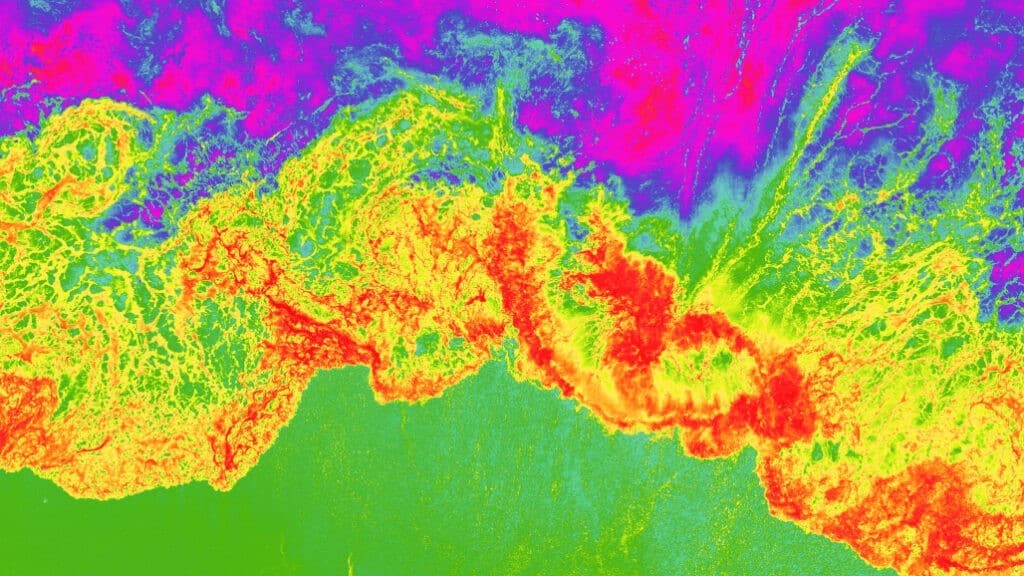
By now, we will focus on the potential of thermal imaging in Artificial Intelligence systems. Heat vision cameras are currently used in a wide range of sectors that include farming, construction, electrical, healthcare, and many others, however, only a few applications combine thermal cameras with smart systems.
In this post, we present a brief explanation of thermal radiation, followed by an introduction of thermal cameras and their properties, a few examples of current thermal imaging + AI solutions, and suggestions for use cases that can be explored in a near future, grouped by industry.
Similarly to RGB cameras, thermal imaging cameras are sensors that can capture electromagnetic radiation, in this case, thermal radiation. But what is thermal radiation?
The heat (or thermal radiation) results from the energy radiated by any matter with a temperature greater than 0 Kelvin (0K = -273.15º C). Above this temperature, the atoms and the molecules perform little movements that are associated with a certain kinetic energy. Once the atoms are composed of charged particles (protons and electrons), kinetic interactions result in the generation of electric and magnetic fields, and consequently photons emission.
Therefore, any object with a temperature above the absolute zero is able to radiate thermal energy. This radiation is visible to the naked eye on some occasions, for example, when a metal is heated until it turns red. In this case, the metal is emitting red radiation (which is included in the visible spectrum), however, before reaching this point, the metal was already emitting radiation but with less energy. The lower the temperature, the lower the energy, and the lower the wave frequency, therefore, the radiation emitted by everyday objects belongs to the Infrared (IR) spectrum.
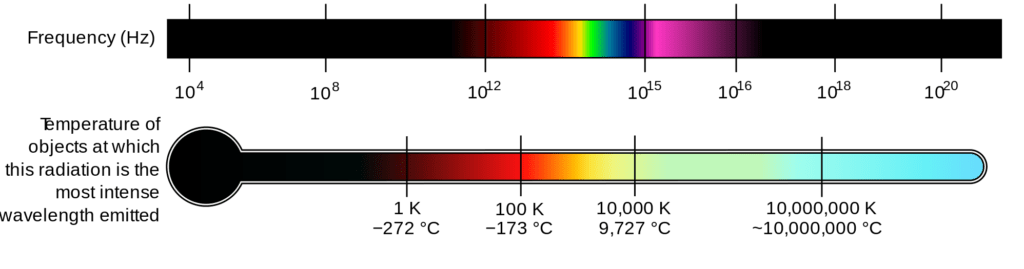
A diagram of the Milton spectrum, showing the type, frequency, and the black body emission temperature. Adapted from File:EM Spectrum Properties edit.svg.
A little bit of trivia: humans consider red, orange and yellow as warm colors while green, blue and violet are seen as cold colors but, in fact, objects that emit blue radiation are 10 times hotter (according to Kelvin scale) than objects that emit red radiation.
Thermal cameras
Regarding the information above, it is reasonable to conclude that thermal cameras are Infrared sensors. However, we shouldn’t confuse them with Infrared illuminated cameras, used for night vision. These last capture the reflection of the IR radiation projected by themselves, instead of capturing radiation emitted by the objects.
When working with thermal cameras, the user should be aware of two effects: emissivity and reflectivity. Emissivity is related to the efficiency of an object to emit IR radiation while reflectivity measures how the object surface reflects the radiation. Both depend on the object surface properties, such as roughness, morphology and oxidation, and are related by the equation: reflectivity = 1 – emissivity.
To achieve an emissivity of 1.0, the surface should behave as a perfect black body, which is impossible to obtain in normal conditions. However, for thermographic measurements, it is desirable that the surface has as much emissivity as possible.
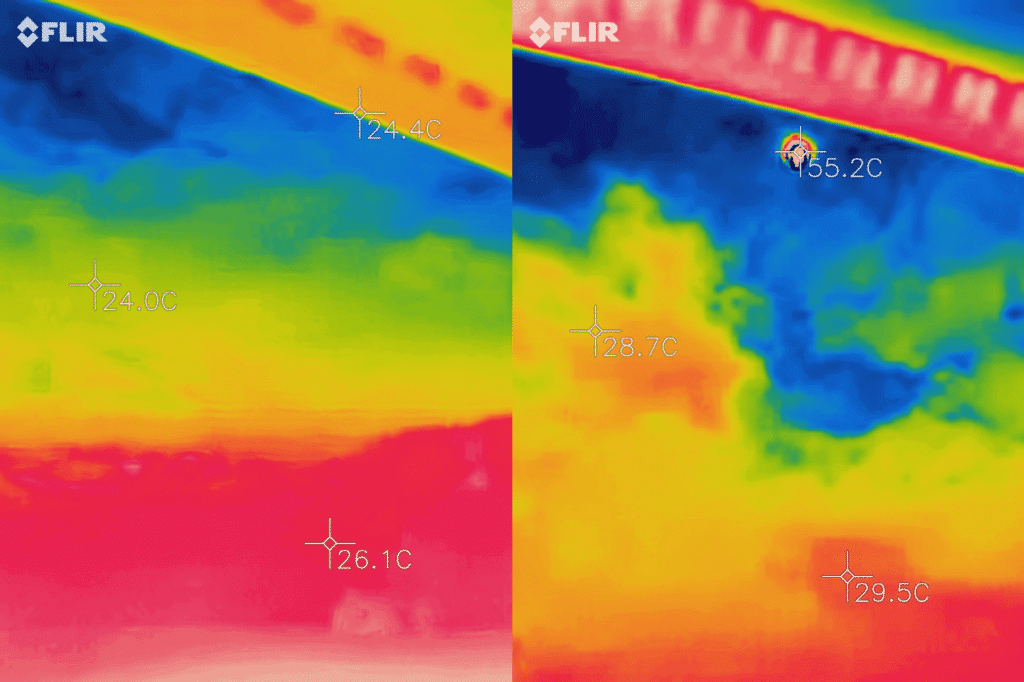
When the surface is very polished and shiny, like a mirror, the reflectivity is very high and the temperature measurements are biased by the background temperature. Therefore, the user should avoid capturing noisy signals through the reflection surface, like sun glints, and acquire images from different angles.
Thermal images of a glass window. On the left, the glass reflected the skyline, but no sun glints. On the right, the glass was reflecting the sun, compromising the measurement of the glass surface temperature.
When to use thermal imaging cameras?
Thermal cameras can be used to visualize signals that are invisible to the naked eye or to enhance the detection of visible objects in poor visibility conditions, when their temperature differs from the background.
There is a long list of what can be detected by a thermal camera that includes categories as buildings, land, rocks (especially at night, once they accumulate heat during the day), mechanical engines, vehicles, living beings (animals and vegetation), liquids, gas, electrical circuits, leaks in isolation systems, and so on.
One advantage of thermal cameras over RGB cameras is privacy maintenance, i.e. these cameras can be used to detect people and record their behaviour. Yet, for low-resolution systems, people can not be easily identified through thermal imaging.
Thermal sensors are also very useful to detect objects through dust or smoke, however, their performance decreases when trying to see through rain or fog, once the water droplets cause light scattering.
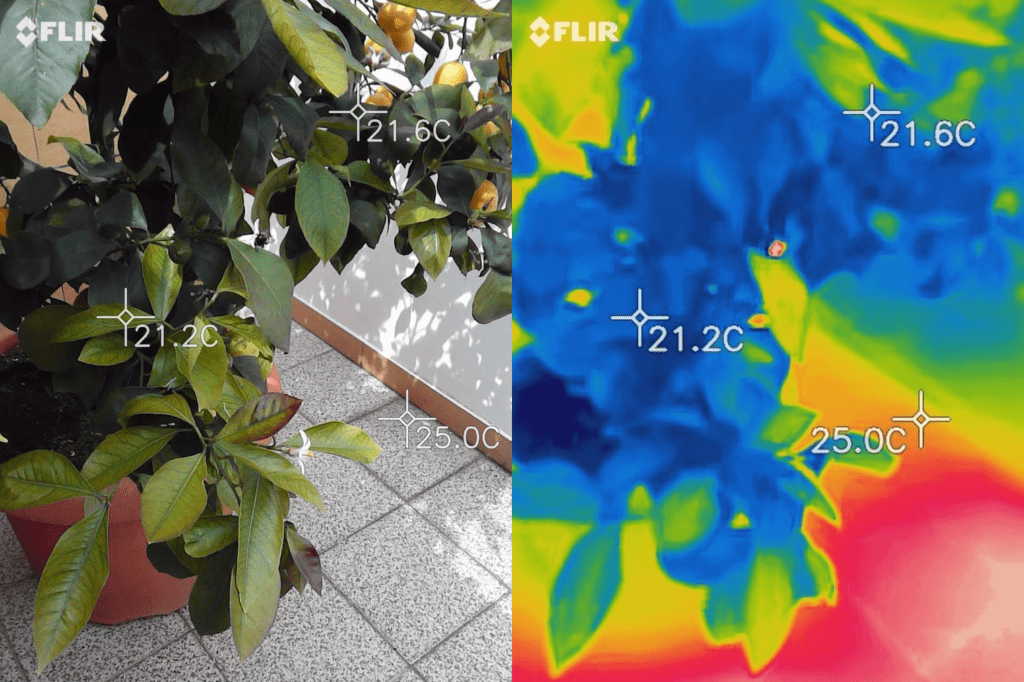
Looking at the RGB image on the left, can you identify the bee? Now, look for a hot point between the leaves, on the thermal image. Can you see the bee now?
AI applications for thermal imaging
Computer vision is the scientific field that focuses on the digital interpretation of visual data as images and videos. The classic methodologies for computer vision include image processing, feature extraction, and integration with machine learning algorithms. With the development of deep learning algorithms as convolution neural networks (CNN), the models have become able to automatically extract the most relevant features for each task.
These AI algorithms not only save work and time but also can find relevant information ignored by humans when extracting handcrafted features. If this property seems useful for RGB features, its utility is even more relevant for thermal imaging, whose interpretation is less intuitive and requires previous training.
With this in mind, some developers have been creating AI solutions that are fed by thermal images. In this section, you will find some of those applications.
Material recognition – Youngjun et al. developed a deep learning algorithm to recognize material types through temperature patterns. The model produced 98% accuracy for indoor materials and 89% for outdoor materials. This task could be performed using an RGB camera, however, thermal images do not depend on lighting conditions, being more consistent, no matter the daytime. [1]
Human detection – Human detection systems have a wide range of applications, as security surveillance, rescue missions, monitoring pedestrian traffic, monitoring crowds in public spaces, and so on. Currently, there are a few AI solutions for human detection that integrate thermal image. Nonetheless, they all are applied to security surveillance.
Automatic guidance for firefighters – Bhattarai and Martínez-Ramón developed a mechanism able to detect target objects like doors, windows, and ladders in conditions of heavy smoke and give support to firefighters, in real-time. This mechanism also detects people and estimates their posture, which is an indicator of their health status, assisting in rescue prioritization.
Fever detection – Athena incorporates thermal sensors in their security cameras to measure body temperature. Using AI, their system automatically detects people with fever, sending a warning, which is very useful nowadays to control COVID-19 contamination.
Carpal Tunnel Syndrome Diagnosis – Jesensek Papez et al. developed an automatic tool for Carpal Tunnel Syndrome diagnosis using thermography. This syndrome results in the compression of the median nerve inside the carpal tunnel which damages the nerve fibers around it. This damage causes a decrease in the vascular heat emission, which is visible in thermography.
Potential Use Cases
In the previous section, we presented some AI solutions that have been developed, so far. The list is not very long which means there is a lot to do with AI and thermal imaging. If you are interested in thermography or AI, check the suggested use cases below. They might inspire you to develop a new solution, by yourself or with the NILG.AI team!
Agro and Farming
Water content monitoring through spectral reflectance properties of vegetation and automatic irrigation scheduling.
Soil salinity detection.
Detection of plant-pathogen infections.
Crop yield forecasting.
Bruises and scratches detection for fruit and vegetable selection.
Fruit maturation evaluation.
Detection of foreign bodies in food.
Early detection of dermatitis in racing horses.
Early detection of subclinical mastitis in dairy cows.
Detection of joint damage in cattle.
Detection of tissue damage and inflammation in cattle.
Fashion and Textile
Fabric selection based on sweat retention monitoring in clothing.
Material research and analysis, measuring properties as drying and heat and moisture transport.
Environment
Automatic water contamination monitoring in drones.
Detection of illegal deforestation areas.
Automatic survey of populations of wildlife species.
Traffic and Transports
Effective traffic control and surveillance in low visibility conditions.
Detection of Unmanned Aerial Vehicles (UAVs).
Air traffic monitoring and control.
Vehicle maintenance, through electrical and mechanical components monitoring.
Construction
Automatic electrical inspection.
Detection of heat loss or air infiltration.
Detection of leaks on rooftops.
Detection of plumbing blockages.
Healthcare
Breast cancer screening.
Detection of infections and inflammations and injuries.
Blood perfusion detection.
Sexual assault lesions detection in colposcopy.
Detection of internal signs of strangulation.
There is a whole world of data beyond the reach of our human sensors, AI can help you to augment human capabilities by efficiently using that knowledge. Thermal imaging is one case, stay tuned for further information on other forms to sense the world where we live in.
Special offers, latest news and quality content in your inbox.
Signup single post
Recommended Articles
Article
Descubra o significado do «Ai First»: Guia estratégico para 2026
22 de junho de 2026 in
Guia: Explicação
Descubra o verdadeiro significado da abordagem «AI First» para a sua empresa. Obtenha um roteiro estratégico para 2026, exemplos práticos e evite erros comuns.
IA para o Crescimento Empresarial: O Seu Guia Prático de Estratégia
17 de junho de 2026 in
Guia: Explicação
Descubra como a IA para o crescimento empresarial pode aumentar a eficiência, melhorar a tomada de decisões e criar laços mais fortes com os clientes. Obtenha agora estratégias práticas.
Automatização de faturas: otimize o seu departamento de contas a pagar em 2026
15 de junho de 2026 in
Guia: Explicação
Otimize o processo de contabilidade de fornecedores através da automatização das faturas. Conheça as tecnologias e as melhores práticas e avalie o valor real para a sua organização.
Utilizamos cookies no nosso website para lhe proporcionar a experiência mais relevante, lembrando as suas preferências e visitas repetidas. Ao clicar em “Aceitar Tudo”, concorda com a utilização de TODOS os cookies. No entanto, pode visitar as "Definições de Cookies" para fornecer um consentimento controlado.
Este website utiliza cookies para melhorar a sua experiência enquanto navega no website. Desses, os cookies categorizados como necessários são armazenados no seu navegador, pois são essenciais para o funcionamento das funcionalidades básicas do website. Também utilizamos cookies de terceiros que nos ajudam a analisar e compreender como utiliza este website. Estes cookies serão armazenados no seu navegador apenas com o seu consentimento. Tem também a opção de recusar estes cookies. No entanto, a recusa de alguns destes cookies pode afetar a sua experiência de navegação.
Os cookies necessários são absolutamente essenciais para que o website funcione corretamente. Estes cookies garantem funcionalidades básicas e recursos de segurança do website, de forma anónima.
Cookie
Duration
Description
cookielawinfo-checkbox-analiticas
11 meses
Este cookie é definido pelo plugin de Consentimento de Cookies do RGPD. O cookie é usado para armazenar o consentimento do utilizador para os cookies na categoria "Análise".
---
O seu texto é uma etiqueta ou nome de campo, provavelmente de um sistema de gestão de cookies ou de um formulário web, e não uma frase completa que necessite de tradução contextual.
No entanto, se o objectivo for manter a clareza e a funcionalidade para um utilizador de língua portuguesa, sugiro a seguinte tradução e explicação:
**"Checkbox Funcional"**
**Explicação:**
* **Checkbox:** Refere-se ao elemento gráfico de marcação (uma caixa que pode ser seleccionada ou desmarcada).
* **Funcional:** Indica que esta caixa de seleção está relacionada com funcionalidades essenciais do website, como o login, a gestão do carrinho de compras ou outras características que tornam o site utilizável.
Se esta etiqueta pertencer a um contexto onde se refere especificamente a cookies, a tradução poderia ser ajustada para ter mais clareza:
**"Aceitação de Cookies Funcionais"**
ou
**"Cookies Essenciais (Funcionais)"**
Esta última opção é comum em avisos de cookies para indicar que estes são estritamente necessários para o funcionamento do site.
---
11 meses
O cookie é definido pelo consentimento de cookies GDPR para registar o consentimento do utilizador para os cookies na categoria "Funcional".
cookielawinfo-checkbox-necessary
11 meses
Este cookie é definido pelo plugin GDPR Cookie Consent. O cookie é usado para armazenar o consentimento do utilizador para os cookies na categoria "Necessário".
cookielawinfo-checkbox-outros
11 meses
Este cookie é definido pelo plugin GDPR Cookie Consent. O cookie é usado para armazenar o consentimento do utilizador para os cookies na categoria "Outros".
checkbox-performance-cookielawinfo
11 meses
Este cookie é definido pelo plugin GDPR Cookie Consent. O cookie é usado para armazenar o consentimento do utilizador para os cookies na categoria "Desempenho".
política_de_cookies_visualizada
11 meses
O cookie é definido pelo plugin GDPR Cookie Consent e é utilizado para armazenar se o utilizador consentiu ou não com a utilização de cookies. Não armazena quaisquer dados pessoais.
Os cookies funcionais ajudam a realizar certas funcionalidades como partilhar o conteúdo do website em plataformas de redes sociais, recolher feedback e outras funcionalidades de terceiros.
Os cookies de desempenho são usados para compreender e analisar os principais índices de desempenho do website, o que ajuda a proporcionar uma melhor experiência ao utilizador para os visitantes.
Os cookies analíticos são usados para entender como os visitantes interagem com o website. Estes cookies ajudam a fornecer informações sobre métricas como o número de visitantes, taxa de rejeição, fonte de tráfego, etc.
Os cookies de publicidade são usados para fornecer aos visitantes anúncios relevantes e campanhas de marketing. Estes cookies rastreiam os visitantes em diferentes websites e recolhem informações para fornecer anúncios personalizados.