AI Automations • AI4business • AI4tech • Artificial Intelligence •
10 Real-World Example of IT Strategy Models for 2026
NILG.AI on Nov 5, 2025
?>
Struggling to turn your tech vision into reality? You’re not alone. Many businesses see IT strategy as an abstract concept, disconnected from the very real challenges of daily operations. But what if you could see a clear, actionable example of IT strategy that provides a blueprint for success? That’s exactly what this article delivers. We’re moving past vague theories and generic advice to provide a deep dive into practical, replicable strategies.
This isn’t just another list of high-level ideas. We are breaking down 10 specific IT strategies that AI and data consulting businesses implement to drive measurable growth and efficiency for their clients. Each example is a mini-playbook, complete with key objectives, sample initiatives, performance metrics (KPIs), common risks, and implementation notes. You’ll see exactly how to connect technology investments to tangible business outcomes.
By the end of this list, you won’t just understand what an IT strategy is; you’ll have a toolkit of proven frameworks and tactical insights. You’ll be equipped to build a tech foundation that doesn’t just support your business operations but actively propels your organization forward, creating a sustainable competitive advantage. Let’s get started.
1. AI-Driven Process Automation Strategy
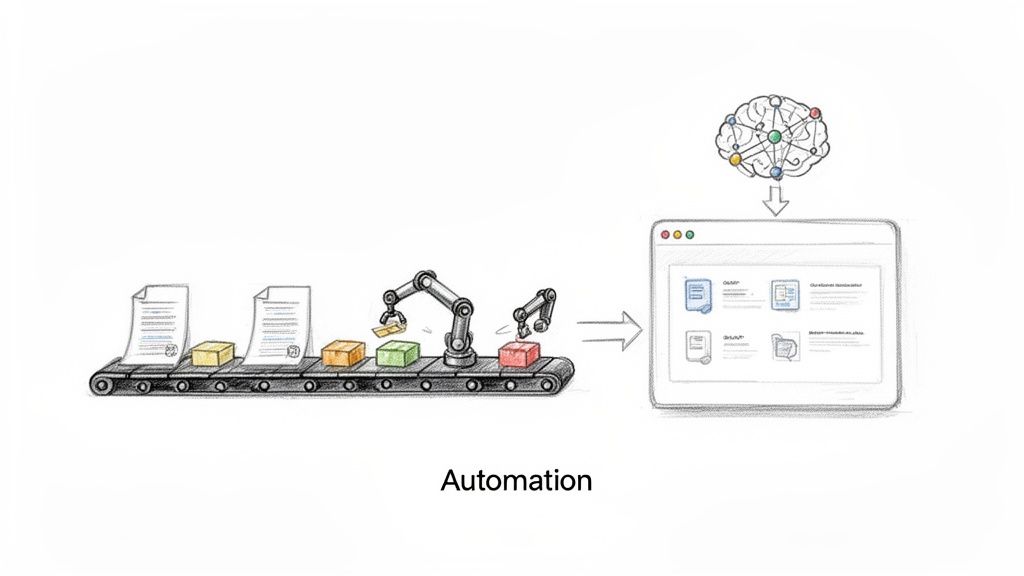
An AI-Driven Process Automation Strategy is a focused plan for using artificial intelligence and machine learning to automate repetitive, rules-based business tasks. This approach goes beyond simple scripting by implementing intelligent systems that learn and adapt, aiming to boost efficiency, slash human error, and let your team focus on more strategic work. It’s a top-tier example of it strategy for any business looking to scale its operations without a linear increase in headcount.
Why It’s a Game-Changer
This strategy delivers a competitive edge in environments with high-volume, predictable workflows. For AI and data consultancies, this could mean automating the data cleaning pipeline for client projects or using intelligent document processing to extract insights from reports. The core idea is to identify processes where human intervention adds little value and automation can deliver significant ROI for both internal operations and client engagements. A core component of modern IT strategy is leveraging advanced approaches like Intelligent Process Automation.
Actionable Takeaways
Ready to get started? Here’s a quick-start guide:
Start Small: Identify a high-volume, low-complexity task like data entry or invoice processing. Run a pilot project to prove the concept and demonstrate clear ROI.
Map Everything: Before writing a single line of code, meticulously map the existing workflow. You can’t automate what you don’t understand.
Prioritize Data Quality: AI is only as good as the data it’s trained on. Ensure your data is clean, structured, and accessible before launching.
Focus on People: Automation changes jobs, it doesn’t just eliminate them. Implement a strong change management program to upskill employees and transition them to higher-value roles.
For businesses seeking expert guidance on implementation, specialized AI and data consulting firms like NILG.AI offer targeted engagements that help organizations build and execute these complex strategies. You can explore how they structure these process automation engagements to learn more about a successful implementation path.
2. Strategic AI Roadmap Development
A Strategic AI Roadmap Development plan is a methodical approach to creating a comprehensive, tailored AI transformation journey that aligns directly with core business objectives. This process moves beyond ad-hoc AI experiments by establishing a clear, multi-year vision. It’s an essential example of it strategy for organizations that want to ensure their AI investments deliver tangible, long-term value instead of just isolated wins. This strategy bridges the gap between high-level vision and tactical execution, ensuring all stakeholders are on the same page.
Why It’s a Game-Changer
This strategy is crucial for any AI consultancy aiming to deliver transformative value. Instead of selling one-off projects, a roadmap allows a firm to become a long-term strategic partner. For a client in the retail sector, this means developing a multi-year plan that sequences projects from inventory forecasting to personalized marketing, ensuring each step builds upon the last. It prevents siloed efforts and ensures technology serves business goals, not the other way around. When developing your strategic AI roadmap, it’s crucial to understand fundamental challenges like the inherent AI speed-accuracy trade-off.
Actionable Takeaways
Ready to build your roadmap? Here’s a quick-start guide:
Assess and Align: Start with comprehensive stakeholder interviews to understand business pain points and goals. Map potential AI solutions directly to these objectives.
Prioritize Initiatives: Create a portfolio of AI projects that includes both quick wins (e.g., automating a specific report) and long-term, transformative initiatives (e.g., a predictive maintenance system).
Establish Governance Early: Define roles, responsibilities, and decision-making processes for AI projects. A clear governance structure prevents chaos as you scale.
Build in Flexibility: The AI landscape changes rapidly. Design your roadmap to be agile, with regular reviews and adjustments to accommodate new technologies and shifting market dynamics.
Crafting such a comprehensive plan often requires specialized expertise. AI consulting firms provide structured services to guide enterprises through this process, helping them build a realistic and impactful AI roadmap. You can learn more about how AI strategy consulting services help organizations navigate this complex journey.
3. Predictive Analytics and Data-Driven Decision Making
A Predictive Analytics and Data-Driven Decision Making strategy revolves around using historical data, statistical algorithms, and machine learning to identify the likelihood of future outcomes. This plan transforms your IT department from a reactive support function into a proactive strategic partner. By analyzing past trends and patterns, this powerful example of it strategy allows businesses to anticipate customer needs, forecast market shifts, and optimize operations before an issue ever arises.
Why It’s a Game-Changer
For data consultancies, this strategy is their core value proposition. It’s about moving clients from descriptive analytics (what happened) to predictive analytics (what will happen). For example, a consultancy can build a model for a SaaS client to predict which customers are likely to churn, enabling proactive retention campaigns. The goal is to harness a client’s existing data to make smarter, faster, and more profitable choices, turning insights into a tangible competitive advantage.
Actionable Takeaways
Ready to start making predictions? Here’s a quick-start guide:
Target High-Impact Problems: Begin with a business challenge where improved forecasting offers a clear ROI, such as predicting customer churn or optimizing inventory levels.
Establish Data Governance: Your predictions are only as reliable as your data. Implement strong governance policies to ensure data is clean, consistent, and accessible before you start modeling.
Combine Models with Expertise: The best results come from blending quantitative models with the domain knowledge of your subject matter experts. Their insights can help validate and refine algorithmic outputs.
Monitor and Iterate: Deploying a model is just the beginning. Continuously monitor its performance in a real-world environment and be prepared to retrain it as new data becomes available.
Organizations can significantly accelerate their progress by adopting a structured approach to data-driven decision making.
4. Generative AI Integration for Content and Knowledge Management
A Generative AI Integration strategy focuses on embedding large language models (LLMs) into core business functions to automate content creation and synthesize vast amounts of knowledge. This plan uses AI to generate marketing copy, summarize legal documents, or power intelligent chatbots. It’s a forward-thinking example of it strategy designed to unlock productivity and create new value by turning unstructured data into a strategic asset.
Why It’s a Game-Changer
This strategy is transformative for any knowledge-intensive business. An AI consultancy, for example, can use generative AI to rapidly summarize project findings, draft client proposals, or create an internal knowledge base that gives consultants instant access to past project insights. The goal is to augment human intelligence, allowing experts to focus on analysis and decision-making rather than the grunt work of drafting or data retrieval. Modern IT strategy now often includes developing and implementing a coherent Generative AI strategy to stay competitive.
Actionable Takeaways
Ready to harness generative AI? Here’s a quick-start guide:
Start Internally: Before launching a customer-facing chatbot, pilot an internal knowledge base assistant for your support team. This provides a safe environment to test, learn, and refine the technology.
Establish Guardrails: Set clear content policies and human-in-the-loop validation processes. AI outputs must be checked for accuracy, tone, and brand alignment before being published.
Train for Prompting: The quality of AI output depends on the quality of the input. Train your teams on effective prompt engineering to ensure they can get the specific, high-quality results they need.
Build Feedback Loops: Implement a system for users to rate and correct AI-generated content. This continuous feedback is crucial for fine-tuning the model and improving its performance over time.
For businesses looking to navigate the complexities of LLM integration, working with specialized AI and data consultancies is key. Firms like NILG.AI provide expertise in building custom AI solutions, ensuring that your generative AI initiatives are both powerful and aligned with your unique business goals.
5. Cloud-First and Hybrid Cloud Architecture Strategy
A Cloud-First and Hybrid Cloud Architecture Strategy is a plan to prioritize cloud-based services for new IT projects while maintaining a mix of on-premises and private cloud infrastructure where needed. This approach moves workloads to environments like AWS, Azure, or Google Cloud to gain scalability, cost-efficiency, and agility. It’s a foundational example of it strategy for any modern business, especially those leveraging AI and advanced analytics that demand immense computational power and data flexibility.
Why It’s a Game-Changer
This strategy is transformative because it shifts IT spending from a capital expenditure (CapEx) model of buying servers to an operational expenditure (OpEx) model of paying for what you use. For a data consulting firm, this means being able to spin up powerful GPU clusters for a specific client project without massive upfront hardware costs. A hybrid model allows them to process sensitive client data on a private cloud while leveraging the public cloud’s scale for model training. It provides the elasticity to handle unpredictable demand without over-provisioning expensive hardware.
Actionable Takeaways
Ready to make the move? Here’s a quick-start guide:
Assess Your Workloads: Not everything belongs in the public cloud. Analyze each application for its security, performance, and compliance requirements to determine the best fit.
Implement FinOps: Cloud costs can spiral without governance. Adopt FinOps (Financial Operations) practices early to monitor, analyze, and optimize your cloud spending.
Plan for Hybrid Reality: Most organizations will operate in a hybrid state for years. Design your architecture with seamless integration and data flow between on-premises and cloud environments in mind.
Build Cloud Expertise: The skills needed to manage cloud infrastructure are different. Invest in training and certification programs for your IT team to build in-house expertise.
6. Cybersecurity and Data Privacy By Design
A Cybersecurity and Data Privacy By Design strategy embeds security and privacy into the entire lifecycle of your technology projects, from initial concept to deployment and beyond. Instead of bolting on security as an afterthought, this approach makes it a core requirement from day one. This is a critical example of it strategy for any modern business, especially when implementing AI systems that handle sensitive personal or corporate data.
Why It’s a Game-Changer
For AI and data consultancies, this strategy is non-negotiable. Building client trust is paramount, and that means demonstrating a rigorous commitment to protecting their sensitive data. By embedding privacy-preserving techniques and zero-trust principles into their project methodologies, consultancies can differentiate themselves and mitigate significant reputational and financial risks. It shifts security from a reactive, emergency-response function to a proactive, value-adding part of the service delivery.
Actionable Takeaways
Ready to build a more secure foundation? Here’s a quick-start guide:
Adopt a Zero-Trust Mindset: Assume no user or device is inherently trustworthy. Verify every access request, enforce least-privilege access, and segment your network to contain potential threats.
Conduct Privacy Impact Assessments (PIAs): Before launching any new project that handles personal data, conduct a PIA to identify and mitigate privacy risks from the start.
Automate Compliance Checks: Use automated tools to continuously scan your systems for security vulnerabilities and ensure they align with compliance frameworks like NIST or ISO/IEC 27001.
Train Everyone: Security is a shared responsibility. Implement ongoing security awareness training for all employees, from the C-suite to the front lines, to create a culture of vigilance.
7. Computer Vision and Image Recognition Strategy
A Computer Vision and Image Recognition Strategy is a plan to use deep learning models to automate tasks involving visual data. This approach trains computers to “see” and interpret images and videos, enabling applications that range from quality control in manufacturing to cashierless retail experiences. This is a forward-thinking example of it strategy for businesses that rely on visual inspection, recognition, or analysis to operate.
Why It’s a Game-Changer
This strategy creates immense value in sectors where manual visual tasks are slow, costly, and prone to error. Data consultancies can deploy computer vision solutions for clients in manufacturing to spot microscopic defects on production lines or for agricultural clients to analyze drone footage for crop health. The goal is to automate visual interpretation at scale, driving consistency and freeing up human experts for complex decision-making. A robust computer vision plan is a cornerstone of modern industrial and service-oriented IT strategies.
Actionable Takeaways
Ready to give your business digital eyes? Here’s how to get started:
Curate Quality Data: The model’s performance depends entirely on its training data. Collect a large, diverse, and accurately labeled dataset that reflects real-world conditions.
Start in a Controlled Setting: Pilot your vision system in a predictable environment, like a lab or a specific section of a production line, before deploying it in more dynamic conditions.
Leverage Pre-Trained Models: Don’t reinvent the wheel. Use transfer learning with models like YOLO or ResNet that are already trained on massive datasets, and fine-tune them for your specific task.
Address Privacy Head-On: If your application involves people, be transparent about how data is collected, used, and protected. Build privacy into the design from day one.
8. Natural Language Processing and Text Analytics Strategy
A Natural Language Processing (NLP) and Text Analytics Strategy is a plan to unlock value from the massive amount of unstructured text data your business generates and encounters. This approach uses AI to understand, interpret, and process human language from sources like emails, documents, and customer feedback. It’s a key example of it strategy for organizations aiming to derive actionable intelligence from conversations and text, turning qualitative data into quantitative insights.
Why It’s a Game-Changer
This strategy is transformative for any business that relies on understanding customer or employee sentiment, managing large volumes of documents, or improving service interactions. An AI consulting firm, for instance, could deploy an NLP solution for a financial services client to analyze thousands of customer support chats to identify emerging issues. The goal is to automate language-based tasks and extract meaningful patterns that would be impossible for humans to find at scale.
Actionable Takeaways
Ready to turn text into strategic assets? Here’s a quick-start guide:
Define a Clear Use Case: Start with a specific business problem, such as automatically routing customer support tickets or analyzing survey responses. A focused goal prevents scope creep.
Prioritize Data Preparation: Clean and normalize your text data before analysis. Inconsistent formatting, typos, and jargon can derail even the most advanced NLP models.
Use Domain-Specific Models: Whenever possible, use NLP models trained on data from your industry (e.g., finance, healthcare). This significantly improves accuracy and relevance.
Implement Feedback Loops: Create a system for human experts to review and correct model predictions. This continuous improvement cycle is vital for maintaining high performance and adapting to new language patterns.
9. DataOps and MLOps Infrastructure Strategy
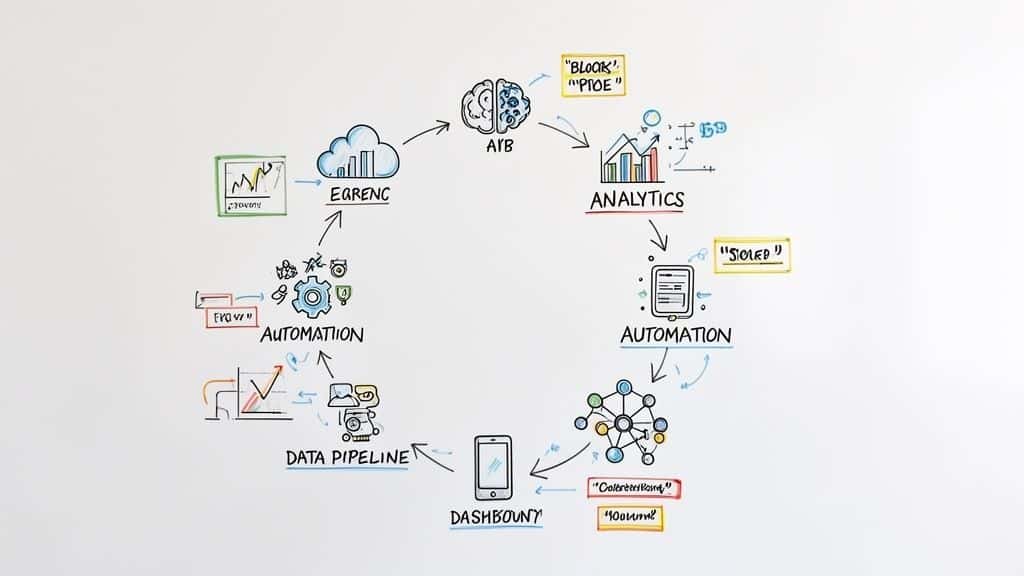
A DataOps and MLOps Infrastructure Strategy is a plan to build a reliable factory for your data pipelines and machine learning models. This approach treats data and AI models not as one-off projects, but as core business products that need continuous testing, versioning, and monitoring. It’s a crucial example of it strategy for any organization looking to scale its AI initiatives reliably and ensure models perform as expected long after they are deployed.
Why It’s a Game-Changer
This strategy is vital for AI consultancies that need to deliver robust, production-grade solutions to clients. Without a solid MLOps framework, a high-performing model built during a project can quickly degrade in the client’s live environment as data changes. By implementing MLOps, consultancies can ensure their solutions are reproducible, maintainable, and deliver long-term value, moving beyond proof-of-concept projects to scalable enterprise systems.
Actionable Takeaways
Ready to productionalize your data and AI assets? Here’s a quick-start guide:
Standardize Your Environment: Use containerization tools like Docker to ensure your models run consistently everywhere, from a data scientist’s laptop to production servers.
Implement a Feature Store: Create a central repository for reusable, well-documented features. This speeds up model development and reduces redundant data engineering work.
Monitor Everything: Don’t just deploy a model and forget it. Implement continuous monitoring for both model performance (like accuracy) and data drift to catch issues before they impact the business.
Establish Feedback Loops: Build automated pipelines that can trigger model retraining when performance drops or new data becomes available, ensuring your models stay relevant.
10. Change Management and Organizational Learning Strategy
A Change Management and Organizational Learning Strategy is a people-centric plan for navigating the human side of technological transformation. Instead of just deploying new tools, this approach focuses on ensuring employees understand, embrace, and effectively use new systems and processes. It combines structured training, transparent communication, and cultural initiatives to make technology adoption stick. This is a crucial example of it strategy because even the best technology will fail if your team resists or misunderstands it.
Why It’s a Game-Changer
This strategy is indispensable when AI consultancies implement solutions that fundamentally change how a client’s employees work. Introducing an AI-powered forecasting tool, for example, requires more than just technical integration; it requires training analysts to trust the model’s outputs and use them effectively in their decision-making. The goal is to minimize disruption, reduce resistance, and accelerate the time-to-value for new tech investments. It acknowledges that true ROI comes from user adoption, not just from the technology itself.
Actionable Takeaways
Ready to ensure your next tech rollout is a success? Here’s a quick-start guide:
Start Early: Begin change management activities well before the technology is deployed. Build awareness and desire for the change from the very beginning.
Empower Champions: Identify influential employees across different departments to act as “change champions.” Their advocacy will build grassroots support.
Offer Diverse Learning: Provide training in multiple formats to suit different learning styles, such as hands-on workshops, video tutorials, and detailed documentation.
Create Feedback Loops: Establish clear channels for employees to ask questions, voice concerns, and provide feedback. Use this input to refine your approach and show you’re listening.
For organizations needing to build these capabilities, specialized firms offer targeted training to prepare teams for technological change. For instance, NILG.AI provides corporate training services that help upskill teams in AI and data, ensuring they have the knowledge to succeed with new systems.
Comparison of 10 IT Strategy Examples
Strategy
🔄 Implementation complexity
⚡ Resource requirements
📊 Expected outcomes
💡 Ideal use cases
⭐ Key advantages
AI-Driven Process Automation Strategy
High — integration, ML tuning and change mgmt
High — RPA/ML engineers, integration tools, moderate compute
From Example to Execution: Building Your Own IT Strategy
We’ve journeyed through a wide array of real-world IT strategies, from deploying AI for process automation to embedding cybersecurity by design. Seeing a detailed example of IT strategy in action demystifies what can often feel like an overwhelming topic. The examples of AI roadmap development, cloud-first architecture, and advanced data analytics all share a common thread: they succeed not because of the technology alone, but because they are laser-focused on solving specific, high-value business problems.
The most critical takeaway is that a powerful IT strategy is never a one-size-fits-all template. It’s a custom-built engine designed to drive your unique business objectives forward. Whether your goal is to enhance customer experiences with NLP, optimize operations with computer vision, or simply make smarter decisions with predictive analytics, the strategy must directly connect technology investment to tangible business outcomes.
Your Blueprint for Action
So, how do you move from inspiration to implementation? The key is to avoid trying to boil the ocean. Instead, think like a startup, even if you’re an established enterprise. Start small, prove value, and then scale.
Here are your actionable next steps:
Identify One High-Impact Problem: Don’t start with a technology. Start with a pain point. Which operational bottleneck, if solved, would deliver the most significant ROI? Which customer friction point is costing you revenue?
Launch a Pilot Project: Frame your first initiative as a pilot. This lowers the stakes and creates a safe space to experiment, learn, and adapt. A successful pilot is the best internal marketing tool you have for gaining wider buy-in.
Define Clear KPIs from Day One: How will you measure success? Whether it’s reduced processing time, increased lead conversion, or lower error rates, establish your key performance indicators before you write a single line of code.
Build Your Strategic Roadmap: If you’re unsure which problem to tackle first, or how various initiatives fit together, developing a strategic AI roadmap is your essential first move. It provides the clarity and direction needed to align stakeholders and prioritize investments effectively.
The Real Value of a Modern IT Strategy
Mastering this process is about more than just staying competitive; it’s about building a resilient, adaptable organization. The examples we explored, from robust MLOps infrastructure to proactive change management, show that a forward-thinking IT strategy creates a culture of continuous improvement and data-driven innovation. It transforms technology from a cost center into your most powerful strategic asset.
Ultimately, every example of IT strategy we’ve covered is a story of a business that chose to be proactive rather than reactive. They identified an opportunity, aligned their technology with their goals, and executed with precision. Now, it’s your turn to write your own success story.
Ready to turn these examples into your reality? At NILG.AI, we specialize in crafting and implementing bespoke AI and data strategies that deliver measurable business impact. Let our team of experts help you build the strategic roadmap that will guide your next phase of growth. Request a proposal
Like this story?
Subscribe to Our Newsletter
Special offers, latest news and quality content in your inbox.
Signup single post
Recommended Articles
Article
Digital business transformation examples: 10 Real-World Case Studies
Feb 10, 2026 in
Listicle: Examples
Discover digital business transformation examples and how AI, data, and strategy fuel growth with practical, actionable insights.
Master customer retention rate calculation with this practical guide. Learn the formulas, see real-world examples, and get actionable tips for business growth.
We use cookies on our website to give you the most relevant experience by remembering your preferences and repeat visits. By clicking “Accept All”, you consent to the use of ALL the cookies. However, you may visit "Cookie Settings" to provide a controlled consent.
This website uses cookies to improve your experience while you navigate through the website. Out of these, the cookies that are categorized as necessary are stored on your browser as they are essential for the working of basic functionalities of the website. We also use third-party cookies that help us analyze and understand how you use this website. These cookies will be stored in your browser only with your consent. You also have the option to opt-out of these cookies. But opting out of some of these cookies may affect your browsing experience.
Necessary cookies are absolutely essential for the website to function properly. These cookies ensure basic functionalities and security features of the website, anonymously.
Cookie
Duration
Description
cookielawinfo-checkbox-analytics
11 months
This cookie is set by GDPR Cookie Consent plugin. The cookie is used to store the user consent for the cookies in the category "Analytics".
cookielawinfo-checkbox-functional
11 months
The cookie is set by GDPR cookie consent to record the user consent for the cookies in the category "Functional".
cookielawinfo-checkbox-necessary
11 months
This cookie is set by GDPR Cookie Consent plugin. The cookies is used to store the user consent for the cookies in the category "Necessary".
cookielawinfo-checkbox-others
11 months
This cookie is set by GDPR Cookie Consent plugin. The cookie is used to store the user consent for the cookies in the category "Other.
cookielawinfo-checkbox-performance
11 months
This cookie is set by GDPR Cookie Consent plugin. The cookie is used to store the user consent for the cookies in the category "Performance".
viewed_cookie_policy
11 months
The cookie is set by the GDPR Cookie Consent plugin and is used to store whether or not user has consented to the use of cookies. It does not store any personal data.
Functional cookies help to perform certain functionalities like sharing the content of the website on social media platforms, collect feedbacks, and other third-party features.
Performance cookies are used to understand and analyze the key performance indexes of the website which helps in delivering a better user experience for the visitors.
Analytical cookies are used to understand how visitors interact with the website. These cookies help provide information on metrics the number of visitors, bounce rate, traffic source, etc.
Advertisement cookies are used to provide visitors with relevant ads and marketing campaigns. These cookies track visitors across websites and collect information to provide customized ads.