AI Automations • AI Strategy • AI4business • Artificial Intelligence •
10 Strategic Process Innovations Examples to Boost Efficiency in 2026
NILG.AI on Nov 28, 2025
?>
Outdated processes are more than just inefficient; they’re silent profit killers. Many organizations cling to familiar workflows, unaware that these legacy systems are bleeding cash, frustrating talented teams, and actively stifling growth. You might be paying for sluggish manual data entry, redundant approval cycles, or disconnected software tools without even realizing the full extent of the cost. The “if it ain’t broke, don’t fix it” mindset is a surefire way to get left behind.
This article is your playbook for turning those operational drags into strategic assets. We’re moving past high-level theories to deliver a tactical breakdown of 10 powerful process innovations examples. You won’t find generic success stories here. Instead, we’ll dissect each example, focusing on how AI, automation, and data-driven strategies can be applied in real-world business scenarios, particularly for consulting and service-oriented firms.
Get ready to explore replicable strategies and actionable takeaways. We’ll break down the what, the why, and the how for methodologies like Lean, Six Sigma, Agile, and Robotic Process Automation (RPA). You’ll learn to identify hidden inefficiencies in your own operations and gain a clear roadmap for implementing changes that deliver measurable results. Let’s dive in and transform your processes from a liability into a competitive advantage.
1. Robotic Process Automation (RPA)
Robotic Process Automation (RPA) is a game-changer for businesses bogged down by repetitive, manual tasks. It uses software “bots” to mimic human actions on a computer, like logging into applications, moving files, filling out forms, and extracting data from documents. Think of it as a digital workforce that handles the boring stuff, freeing your human team for more strategic work.
This is one of the most accessible process innovations examples because it doesn’t require overhauling your entire IT infrastructure. RPA bots interact with systems just like people do, through the user interface, making implementation faster and less disruptive than traditional API-based automation.
Case in Point: Automating Consulting Firm Invoicing
An AI consulting firm struggled with a manual, error-prone invoicing process. Each month, project managers would manually compile timesheets, cross-reference them with client contracts, and generate invoices. The process took dozens of hours and often contained errors, leading to payment delays. By implementing an RPA bot, the firm automated the entire workflow. The bot now extracts data from timesheet software, validates it against contract terms in their CRM, and generates accurate invoices in minutes. This not only saved significant administrative time but also improved cash flow by reducing invoice disputes.
Actionable Takeaways & Strategy
RPA is ideal for processes that are high-volume, rule-based, and use structured data. It’s a quick win for efficiency gains in areas like finance, HR, and customer service.
Start Small, Win Big: Identify a low-risk, high-impact process for a pilot project. Think invoice processing or employee onboarding data entry. A quick win builds momentum and proves ROI.
Standardize First: Before you automate a messy process, clean it up. Standardizing the workflow ensures the bot operates efficiently and reduces exceptions.
Plan for People: Automation changes roles. Proactively plan for reskilling and upskilling employees. Frame it as an opportunity for them to take on more valuable, engaging work, not as a replacement. For organizations looking to implement process automation and build custom workflows, exploring low-code tools like the Microsoft Power Platform can be a strategic move.
RPA serves as a powerful entry point into automation, but it truly shines when combined with AI and machine learning. To see how this technology evolves, you can dive deeper into intelligent process automation.
2. Six Sigma
Six Sigma is a disciplined, data-driven methodology designed to eliminate defects and reduce variability in any business process. Its core goal is to achieve near-perfect quality, aiming for no more than 3.4 defects per million opportunities (DPMO). It’s less about a specific technology and more about a rigorous, statistical approach to problem-solving and process refinement.
While originating in manufacturing, Six Sigma stands as one of the most powerful process innovations examples for service-based industries too. It provides a structured framework (often DMAIC: Define, Measure, Analyze, Improve, Control) to identify the root cause of problems, rather than just treating the symptoms, leading to sustainable, high-impact improvements.
Case in Point: Improving Data Quality for a Consulting Practice
A data analytics consultancy discovered that a significant portion of its project time was spent cleaning and correcting client data before analysis could even begin. This “defect” in their intake process was eroding profit margins. Using the Six Sigma DMAIC framework, they defined the problem (poor data quality), measured the frequency and type of errors, and analyzed the root causes—unclear client submission guidelines and inconsistent data formats. They improved the process by creating a standardized data submission template and an automated validation tool. The control phase involved monitoring data quality scores for all new projects. This initiative reduced data prep time by over 40%, allowing consultants to focus on high-value analysis rather than data janitorial work.
Actionable Takeaways & Strategy
Six Sigma is most effective for complex problems where the root cause isn’t obvious and requires deep statistical analysis to uncover. It’s a commitment to a culture of continuous improvement, not a one-off project.
Secure Executive Sponsorship: Six Sigma requires a cultural shift. Without strong, visible support from the top, initiatives often lose momentum and fail to get the necessary resources.
Focus on High-Impact Projects: Don’t try to boil the ocean. Start with projects that have a clear and significant impact on customer satisfaction or the bottom line. This builds buy-in for future efforts.
Invest in Training: The methodology is only as good as the people using it. Proper training and certification (like Green and Black Belts) are crucial. This ensures your team can correctly apply statistical tools and lead projects effectively. For a deeper dive into the methodology, the American Society for Quality (ASQ) is an excellent resource for training and certification standards.
3. Business Process Management (BPM)
Business Process Management (BPM) is a holistic approach to optimizing business workflows. Instead of looking at tasks in isolation, BPM treats processes as strategic assets that can be continuously analyzed, improved, and automated to align with organizational goals. It’s about stepping back, seeing the entire journey a task takes through your company, and making that journey smarter, faster, and more efficient.
This discipline is one of the foundational process innovations examples because it provides a framework for systematic improvement. BPM isn’t just a one-time fix; it’s a continuous cycle of modeling, implementing, monitoring, and optimizing processes to adapt to changing market demands and customer needs.
Case in Point: Streamlining a B2B Sales Cycle
A B2B technology consulting firm used BPM to map its entire sales process, from lead generation to client onboarding. The “as-is” map revealed major bottlenecks: proposal generation was slow, contract reviews involved multiple handoffs via email, and client onboarding was inconsistent. Using a BPM platform, they redesigned the process. Now, when a lead is qualified, the system automatically generates a proposal using standard templates. The contract is routed for digital signatures via a defined workflow, and once signed, it triggers an automated onboarding sequence for the project management team. This BPM initiative cut their sales cycle time by 30% and ensured a consistent, professional experience for every new client.
Actionable Takeaways & Strategy
BPM is perfect for core, cross-departmental processes that directly impact customer value or operational costs, like order-to-cash or new product development. Its principles are often integrated with agile methodologies to increase responsiveness.
Map It to Master It: You can’t improve what you don’t understand. Start by creating a detailed visual map of your current “as-is” process to identify pain points and redundancies. To get started, you can explore guides on how to create a process map.
Engage the Experts: Involve the employees who actually perform the process every day. Their ground-level insights are invaluable for identifying practical improvements and ensuring the new process is adopted successfully.
Think Agile, Not Rigid: Modern BPM is flexible. To effectively implement Agile Process Management, it’s crucial to understand the various roles in agile software development that drive project success. This approach allows for iterative improvements rather than a massive, one-time overhaul.
4. Agile Process Management
Agile Process Management throws the traditional, rigid “plan everything upfront” model out the window. It’s an iterative and flexible approach that prioritizes rapid delivery, continuous feedback, and adapting to change on the fly. Born from software development, its principles of breaking big projects into small, manageable cycles (sprints) are now transforming marketing, HR, and product development across all industries.
This method stands out as one of the most human-centric process innovations examples because it champions collaboration and customer feedback over rigid processes. Instead of a single, long development phase, Agile teams work in short bursts, continuously delivering value and adjusting their direction based on real-world results and stakeholder input.
Case in Point: An AI Consulting Firm’s Project Delivery
An AI consulting firm adopted Agile to manage its complex client projects. Previously, they used a “waterfall” approach, spending months on a detailed project plan that often became obsolete as client needs evolved. By switching to an Agile (Scrum) framework, they broke projects into two-week “sprints.” At the end of each sprint, they deliver a functional piece of the solution, like a working data model or a dashboard prototype. This allows the client to provide immediate feedback, ensuring the final product is perfectly aligned with their needs. The result was higher client satisfaction, less rework, and a more predictable delivery schedule.
Actionable Takeaways & Strategy
Agile is perfect for complex projects where requirements are likely to change. It thrives in dynamic environments where speed and customer satisfaction are top priorities.
Launch a Pilot Squad: Don’t try to transform the entire organization overnight. Select a single, cross-functional team to run a pilot project using an Agile framework like Scrum or Kanban. Use their success as a blueprint.
Visualize Everything: Use tools like Jira or Trello to create visual boards that track tasks through every stage (“To Do,” “In Progress,” “Done”). This transparency keeps everyone aligned and makes bottlenecks obvious.
Embrace the Feedback Loop: The core of Agile is learning and adapting. Schedule regular, non-negotiable ceremonies like daily stand-ups, sprint reviews, and retrospectives to ensure continuous communication and improvement. This is about progress, not perfection.
True agility is a cultural shift, not just a process change. To get started, it’s vital to invest in training and understand the foundational principles laid out in the original Agile Manifesto.
5. Total Quality Management (TQM)
Total Quality Management (TQM) is a deep-seated philosophy that ingrains quality into every fiber of an organization’s operations. It shifts the responsibility for quality from a single inspection department to every single employee, from the CEO to the front line. The core idea is that continuous, incremental improvements across all functions lead to superior products, services, and customer satisfaction.
This methodology is one of the most foundational process innovations examples because it transforms a company’s culture, not just a single workflow. TQM focuses on long-term success through customer satisfaction, achieved by integrating all organizational functions like marketing, finance, design, and engineering to focus on a common goal: quality. It’s about building a system that prevents errors from happening in the first place.
Case in Point: A Call Center’s Customer Service Overhaul
A service provider’s call center was plagued by low customer satisfaction scores and high agent turnover. They initiated a TQM program focused on improving service quality. Instead of just monitoring call times, they empowered agents to solve customer problems on the first call, providing them with better training and more authority. They created cross-functional “Quality Circles” with agents, team leads, and IT staff to identify the root causes of common customer complaints, such as billing system errors. By addressing these systemic issues and focusing on employee empowerment, they saw a 30% increase in first-call resolution rates and a significant boost in both customer and employee satisfaction.
Actionable Takeaways & Strategy
TQM is best suited for organizations committed to a long-term cultural shift toward excellence, rather than just seeking a quick fix. It’s powerful in manufacturing, healthcare, and service industries where consistency and customer trust are paramount.
Lead from the Top: TQM cannot be a bottom-up initiative. Executive leadership must champion the quality vision relentlessly and provide the necessary resources and training.
Empower Everyone: Give employees the authority and tools to identify and solve quality problems within their own areas. Create cross-functional teams to tackle systemic issues.
Measure What Matters: Establish clear, measurable quality standards (Key Performance Indicators) for every process. You can’t improve what you don’t measure. Focus on metrics like defect rates, customer satisfaction scores, and process cycle times.
6. Robotic Process Automation (RPA)
Robotic Process Automation (RPA) is a game-changer for businesses bogged down by repetitive, manual tasks. It uses software “bots” to mimic human actions on a computer, like logging into applications, moving files, filling out forms, and extracting data from documents. Think of it as a digital workforce that handles the boring stuff, freeing your human team for more strategic work.
This is one of the most accessible process innovations examples because it doesn’t require overhauling your entire IT infrastructure. RPA bots interact with systems just like people do, through the user interface, making implementation faster and less disruptive than traditional API-based automation.
Case in Point: Automating Consulting Firm Invoicing
An AI consulting firm struggled with a manual, error-prone invoicing process. Each month, project managers would manually compile timesheets, cross-reference them with client contracts, and generate invoices. The process took dozens of hours and often contained errors, leading to payment delays. By implementing an RPA bot, the firm automated the entire workflow. The bot now extracts data from timesheet software, validates it against contract terms in their CRM, and generates accurate invoices in minutes. This not only saved significant administrative time but also improved cash flow by reducing invoice disputes.
Actionable Takeaways & Strategy
RPA is ideal for processes that are high-volume, rule-based, and use structured data. It’s a quick win for efficiency gains in areas like finance, HR, and customer service.
Start Small, Win Big: Identify a low-risk, high-impact process for a pilot project. Think invoice processing or employee onboarding data entry. A quick win builds momentum and proves ROI.
Standardize First: Before you automate a messy process, clean it up. Standardizing the workflow ensures the bot operates efficiently and reduces exceptions.
Plan for People: Automation changes roles. Proactively plan for reskilling and upskilling employees. Frame it as an opportunity for them to take on more valuable, engaging work, not as a replacement.
RPA serves as a powerful entry point into automation, but it truly shines when combined with AI and machine learning. To see how this technology evolves, you can dive deeper into intelligent process automation.
7. Design Thinking
Design Thinking is a process innovation framework that flips traditional problem-solving on its head. Instead of starting with a solution or a piece of technology, it begins with deep empathy for the end-user. It’s a human-centered methodology that uses cycles of prototyping, testing, and iterating to create processes, products, and services that people actually want and need.
This approach is one of the most powerful process innovations examples because it forces you to challenge assumptions and redefine problems from a user’s perspective. It’s less about a linear, rigid plan and more about a flexible, iterative journey to uncover the best possible solution.
Case in Point: Redesigning a Client Onboarding Process
A boutique management consultancy used Design Thinking to tackle its inconsistent and confusing client onboarding experience. Instead of just tweaking their existing process, they started by interviewing recent clients to understand their anxieties and expectations. This “empathy” phase revealed that clients felt overwhelmed by initial data requests and unsure of the project timeline. Armed with these insights, the firm prototyped a new process that included a visual project roadmap, a single point of contact, and a “Week 1 Kickstart Kit” with clear instructions. They tested this new process with a pilot client, gathered feedback, and iterated. The result was a streamlined, client-centric onboarding process that set a positive tone for the entire engagement.
Actionable Takeaways & Strategy
Design Thinking is perfect for tackling ambiguous or complex problems where the user experience is paramount. Use it to innovate customer service workflows, internal HR processes, or new product development cycles.
Empathize, Don’t Assume: Start with deep user research. Conduct interviews, create user journey maps, and use observational techniques. Your goal is to understand the why behind user actions, not just the what.
Prototype Low and Fast: Don’t invest heavily in a polished solution upfront. Use paper sketches, wireframes, or simple role-playing to test ideas quickly and cheaply. The goal is to learn, not to launch a perfect product on the first try.
Build Diverse Teams: A successful Design Thinking process requires multiple perspectives. Create cross-functional teams with members from engineering, marketing, sales, and customer support to generate more holistic and innovative solutions. This approach avoids departmental silos and fosters a culture of shared ownership.
8. Kanban System
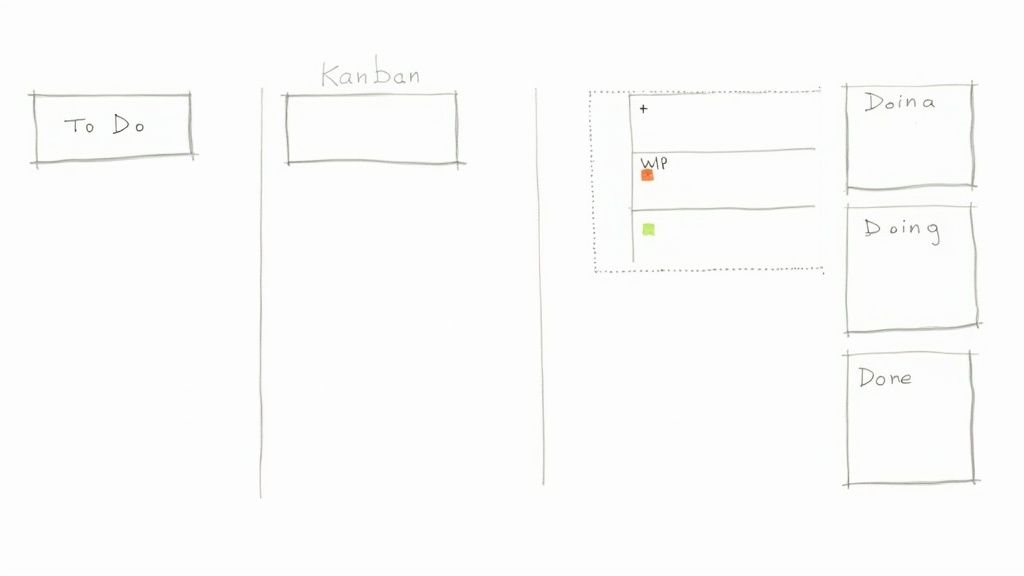
The Kanban system is a visual management method for controlling and improving work across human systems. Originating from Toyota’s manufacturing process, this approach uses visual cues, typically cards on a board, to represent work items and their flow through various stages. It’s designed to limit work-in-progress (WIP), identify bottlenecks, and maximize efficiency.
This method is one of the most powerful process innovations examples because of its simplicity and flexibility. Unlike rigid methodologies, Kanban doesn’t prescribe specific roles or processes; instead, it provides a framework to visualize your existing workflow and incrementally improve it. This makes it adaptable for everything from software development to marketing and warehouse management.
Case in Point: A Marketing Agency’s Content Workflow
A digital marketing agency’s content creation process was chaotic. Writers were overloaded, editors were bottlenecks, and stakeholders had no visibility into when content would be ready. They implemented a simple digital Kanban board with columns for “Backlog,” “Writing,” “Editing,” “Client Review,” and “Published.” Each blog post or case study became a card. By setting a WIP limit on the “Editing” column, they forced the team to clear the editing backlog before new content was submitted. This simple change immediately highlighted the editing bottleneck, leading them to reallocate resources. The visual board gave everyone, including clients, real-time visibility, reducing status-update emails and improving the flow of content delivery.
Actionable Takeaways & Strategy
Kanban is perfect for teams that need to balance continuous delivery with changing priorities. It provides clarity and focus, making it a go-to for DevOps, content creation, and operations teams.
Visualize What You Do Now: Don’t invent a new process. Map your current workflow onto a simple board with columns like “To Do,” “In Progress,” and “Done.” This initial step immediately exposes hidden inefficiencies.
Limit Your WIP: This is the core principle. Set explicit limits on how many tasks can be in any “In Progress” column. This forces the team to finish work before starting new tasks, which is the key to improving flow.
Manage the Flow: Use the board to monitor work as it moves from left to right. When a card gets stuck, it signals a bottleneck. This is your cue to swarm on the problem and resolve it, learning how to prevent it in the future. Digital tools like Jira and Trello make this easy for remote teams.
9. Business Process Reengineering (BPR)
Business Process Reengineering (BPR) isn’t about small tweaks; it’s a radical redesign of core business processes to achieve dramatic improvements in productivity, cycle times, and quality. Instead of incrementally improving an existing process, BPR starts with a blank slate and asks, “If we were starting this company today, how would we do this?” It’s a complete overhaul, often driven by new technological capabilities.
This approach is one of the most transformative process innovations examples because it forces an organization to question its long-held assumptions and redesign workflows around outcomes, not tasks. BPR challenges the “this is how we’ve always done it” mentality, aiming for quantum leaps in performance rather than minor gains.
Case in Point: Reimagining a Recruitment Process
A rapidly growing tech consultancy found its hiring process couldn’t keep up with demand. The process was a linear, multi-stage pipeline involving recruiters, hiring managers, and technical interviewers, often taking over 60 days to make an offer. They decided to reengineer it completely. Instead of a sequential process, they created a “Hiring Hub” model. For a specific role, all key decision-makers would block out a single day. Candidates would go through all interview stages—from screening to technical assessment to final culture-fit—in one session. The team would then deliberate and make a hiring decision by the end of the day. This radical redesign cut the time-to-hire from 60 days to less than a week, dramatically improving their ability to land top talent in a competitive market.
Actionable Takeaways & Strategy
BPR is a high-risk, high-reward strategy best suited for processes that are fundamentally broken or hopelessly inefficient, not those that just need a minor tune-up.
Start with the Customer: Design processes from the outside-in. Focus on what delivers maximum value to the customer, not what is most convenient for internal departments. Eliminate any step that doesn’t add direct value.
Secure Top-Down Sponsorship: BPR is disruptive and will face internal resistance. It cannot succeed without unwavering, visible support from senior leadership who can champion the vision and clear political roadblocks.
Leverage Technology as an Enabler: Don’t just automate a bad process. Use technology (like AI, workflow automation, and shared databases) to enable entirely new ways of working that were previously impossible. Technology should empower the redesigned process, not just patch the old one. For a modern take on redesigning workflows, see how organizations are leveraging platforms for business process management.
10. Continuous Improvement (Kaizen)
Kaizen is less of a single project and more of a cultural shift. This Japanese philosophy centers on making small, incremental improvements to processes continuously over time. Instead of waiting for a massive, disruptive overhaul, Kaizen empowers every employee, from the CEO to the front-line worker, to identify and eliminate waste in their daily tasks.
This approach is one of the most powerful process innovations examples because it builds a self-sustaining engine for efficiency. It’s not a one-and-done software implementation; it’s a mindset that embeds optimization into the very fabric of your company’s operations, promoting collaboration and collective ownership of process quality.
Case in Point: A Data Science Team’s Workflow Refinements
A data science team at a consulting firm adopted a Kaizen approach to their project workflow. They started a weekly “Process Improvement” meeting that lasted just 30 minutes. In one meeting, a junior analyst suggested that the team was wasting time setting up project environments from scratch for every new client. The team agreed and decided to create a standardized project template in their data science platform. This small change saved each data scientist several hours per project. Over the months, other small improvements—like creating a shared library of reusable code snippets and standardizing reporting formats—compounded. These incremental changes significantly reduced project setup time and improved the consistency and quality of their deliverables.
Actionable Takeaways & Strategy
Kaizen thrives in environments where employee feedback is valued and acted upon. It’s perfect for mature processes where revolutionary change is risky, but incremental gains can compound into significant long-term advantages.
Empower from the Ground Up: Create a formal system for employees to submit improvement ideas, no matter how small. Implement a “suggestion box” program and ensure every idea receives a response.
Standardize, Improve, Repeat: Use the Plan-Do-Check-Act (PDCA) cycle. When a team identifies a better way to do something, document it as the new standard operating procedure. This prevents backsliding and creates a new baseline for future improvements.
Make it Visual: Use visual management tools like Kanban boards or process flow charts on the factory floor or office wall. This makes waste, bottlenecks, and the progress of improvements visible to everyone, fostering a shared sense of responsibility. For those looking to implement this methodology, studying the works of its pioneers, such as Masaaki Imai, provides deep foundational knowledge.
10 Process Innovation Methods Compared
Method
🔄 Implementation complexity
⚡ Resource & speed
📊 Expected outcomes / impact
💡 Ideal use cases
⭐ Key advantages
Lean Manufacturing
Moderate–high: cultural change and phased rollout
Moderate: training + process changes; improves lead time
Low: quick to implement; improves flow and cycle time rapidly
Improved visibility, reduced WIP, faster throughput at team level
Team-level workflow management, maintenance, small projects
Simplicity, flexibility, rapid identification of bottlenecks
Business Process Reengineering (BPR)
Very high: radical redesign, restructuring and high risk
Very high: large resource investment; potential for rapid large gains
Dramatic performance improvements or disruption; large cost reduction
When incremental change insufficient; major transformations
Potential for step-change performance and competitive differentiation
Continuous Improvement (Kaizen)
Low–moderate: ongoing cultural discipline and daily practices
Low: low-cost, incremental changes; slow but compounding speed gains
Sustained small gains, improved morale, cumulative efficiency
Organizations seeking steady improvement and employee engagement
Low-risk, sustainable improvements and strong employee ownership
Putting Innovation into Action: Your Next Steps
We’ve journeyed through a landscape rich with process innovations examples, from the disciplined frameworks of Lean Manufacturing and Six Sigma to the dynamic, human-centric approaches of Design Thinking and Agile. We’ve seen how Robotic Process Automation (RPA) can obliterate mundane tasks and how a philosophy of Continuous Improvement (Kaizen) can create a culture of excellence.
The single most important thread connecting all these successful examples is this: innovation isn’t a one-size-fits-all solution. It’s a strategic choice. The goal isn’t to adopt every new technology or methodology. The real goal is to diagnose your specific operational pains and prescribe the right remedy.
Recapping the Core Lessons
Before charting your course, let’s distill the key takeaways from the examples we’ve explored. True process transformation hinges on a few fundamental truths:
Problem-First, Technology-Second: The most successful AI and data consulting firms don’t lead with a flashy tool. They start with a deep understanding of the business problem. They ask: Where are the bottlenecks? What’s draining our resources? Where is the friction in our customer experience?
Data is the Compass: Gut feelings are great for brainstorming, but data is what should guide your decisions. Whether you’re implementing TQM or fine-tuning an RPA bot, measurable outcomes are non-negotiable. Metrics are your proof of progress.
People Drive the Process: You can have the best technology in the world, but if your team isn’t on board, your initiative will stall. Change management, clear communication, and empowering your people to contribute are just as critical as the process itself.
Your Actionable Roadmap to Innovation
Feeling inspired is one thing; taking action is another. It’s easy to get overwhelmed by the possibilities. Here’s a simple, three-step framework to move from idea to implementation, helping you apply these process innovations examples to your own organization.
Identify Your ‘High-Friction’ Zones: Grab a whiteboard (virtual or physical) with your team. Map out a core business process, from start to finish. Pinpoint the areas where things slow down, require manual rework, or cause frustration. These are your prime targets for innovation.
Ask: “If we could wave a magic wand and fix one part of this process, what would it be?”
Look for: Repetitive data entry, information silos, and tasks that depend on a single person.
Match the Method to the Mess: Now, look at your high-friction zones and align them with the strategies we’ve discussed.
Is it a repetitive, rule-based digital task? RPA could be a quick and high-impact win.
Is it a systemic quality control issue? Six Sigma or TQM might provide the right framework.
Is it an undefined, complex user problem? Design Thinking is your best starting point.
Start Small, Scale Smart: Don’t try to overhaul your entire company overnight. Select one high-friction zone and launch a pilot project. This “small-batch” approach, borrowed from Lean principles, allows you to learn, adapt, and demonstrate value quickly. A successful pilot builds momentum and makes a powerful case for broader investment.
Strategic Insight: The true power of process innovation lies not in a single grand gesture, but in the cumulative effect of many intelligent, targeted improvements. Your first project doesn’t need to be perfect; it just needs to deliver measurable value and create a blueprint for what’s next.
Mastering these concepts is more than just an operational upgrade; it’s a competitive advantage. In a world where speed, efficiency, and customer value are paramount, your processes are your engine for growth. By continuously refining how you work, you build a resilient, agile organization that can not only weather change but thrive on it. The journey starts with a single step, a single process, and a commitment to making it better.
Ready to move from exploring process innovations examples to implementing a tailored solution? NILG.AI specializes in diagnosing core business challenges and deploying custom AI and data strategies that drive real efficiency and growth. Let’s build your innovation roadmap together. Request a proposal
Like this story?
Subscribe to Our Newsletter
Special offers, latest news and quality content in your inbox.
Signup single post
Recommended Articles
Article
Transform Your Growth with custom ai software development in 2026
Apr 1, 2026 in
Guide: Explainer
Explore how custom ai software development can boost efficiency, cut costs, and deliver measurable value - find trusted partners and practical steps for 2026.
Discover how AI for customer service can transform your support operations. Learn practical strategies to reduce costs, improve satisfaction, and drive growth.
How Might We Statements: Turn Challenges into Opportunities
Mar 15, 2026 in
Guide: Explainer
Discover how might we statements transform complex challenges into real opportunities. Learn practical crafting tips, workshops, and real-world examples.
We use cookies on our website to give you the most relevant experience by remembering your preferences and repeat visits. By clicking “Accept All”, you consent to the use of ALL the cookies. However, you may visit "Cookie Settings" to provide a controlled consent.
This website uses cookies to improve your experience while you navigate through the website. Out of these, the cookies that are categorized as necessary are stored on your browser as they are essential for the working of basic functionalities of the website. We also use third-party cookies that help us analyze and understand how you use this website. These cookies will be stored in your browser only with your consent. You also have the option to opt-out of these cookies. But opting out of some of these cookies may affect your browsing experience.
Necessary cookies are absolutely essential for the website to function properly. These cookies ensure basic functionalities and security features of the website, anonymously.
Cookie
Duration
Description
cookielawinfo-checkbox-analytics
11 months
This cookie is set by GDPR Cookie Consent plugin. The cookie is used to store the user consent for the cookies in the category "Analytics".
cookielawinfo-checkbox-functional
11 months
The cookie is set by GDPR cookie consent to record the user consent for the cookies in the category "Functional".
cookielawinfo-checkbox-necessary
11 months
This cookie is set by GDPR Cookie Consent plugin. The cookies is used to store the user consent for the cookies in the category "Necessary".
cookielawinfo-checkbox-others
11 months
This cookie is set by GDPR Cookie Consent plugin. The cookie is used to store the user consent for the cookies in the category "Other.
cookielawinfo-checkbox-performance
11 months
This cookie is set by GDPR Cookie Consent plugin. The cookie is used to store the user consent for the cookies in the category "Performance".
viewed_cookie_policy
11 months
The cookie is set by the GDPR Cookie Consent plugin and is used to store whether or not user has consented to the use of cookies. It does not store any personal data.
Functional cookies help to perform certain functionalities like sharing the content of the website on social media platforms, collect feedbacks, and other third-party features.
Performance cookies are used to understand and analyze the key performance indexes of the website which helps in delivering a better user experience for the visitors.
Analytical cookies are used to understand how visitors interact with the website. These cookies help provide information on metrics the number of visitors, bounce rate, traffic source, etc.
Advertisement cookies are used to provide visitors with relevant ads and marketing campaigns. These cookies track visitors across websites and collect information to provide customized ads.