AI Automations • AI Strategy • AI4business • AI4tech • Artificial Intelligence •
Your Guide to the Three Horizon Framework for AI Strategy
NILG.AI on Nov 12, 2025
?>
Ever feel like you’re stuck in a tug-of-war between keeping the lights on today and trying to invent the future? It’s a classic business headache. You need to hit this quarter’s numbers, but you also know that what works now won’t work forever.
This is where the Three Horizons Framework comes in. It’s a simple but powerful way to think about growth and innovation across different timelines. Instead of seeing today’s business and tomorrow’s big ideas as separate, it helps you manage them all at once.
So, What Is the Three Horizons Framework Anyway?
Think of it like this: you’re a farmer. This season, you’ve got a field of corn that needs harvesting right now. That’s your cash cow, your core business. But you’ve also planted an apple orchard that will start producing fruit in a few years. And in a small greenhouse, you’re experimenting with exotic new seeds that could become a huge deal way down the road.
That’s the Three Horizons Framework in a nutshell. It’s a mental model for juggling your present, your near future, and your distant future. You’re harvesting the corn (Horizon 1), tending the orchard (Horizon 2), and tinkering in the greenhouse (Horizon 3) all at the same time.
For an AI and data consulting business, it means delivering on current client projects while also building new AI-powered products and even exploring speculative tech that might not pay off for a decade.
Where Did This Idea Come From?
This isn’t some brand-new buzzword. The Three Horizons Framework was actually developed by consultants at McKinsey way back in their 1999 book, The Alchemy of Growth. It caught on fast because it gave leaders a practical way to talk about and plan for long-term survival without getting bogged down in theory.
By 2000, hundreds of big-name companies were already using it to guide their strategy. It’s one of those timeless business innovation models because it addresses a fundamental challenge: how to grow without breaking what’s already working.
The secret sauce is in the balance. If you only focus on today, you become a dinosaur. If you only focus on the distant future, you run out of cash. The framework forces you to give the right amount of attention to all three.
A Quick Visual
The model is often shown as a graph with three overlapping curves. It’s a great way to see how the different horizons flow into one another.
Horizon 1 is your current, dominant business. It’s profitable now, but you know it will eventually fade. Horizon 3 is that fuzzy, emerging future you’re betting on. And Horizon 2? That’s the crucial bridge—the new ventures and innovations that will transition you from today’s business to tomorrow’s.
Breaking Down Each Horizon for Your AI Initiatives
To really get the hang of the Three Horizons framework, you have to appreciate the unique personality of each stage. Think of it this way: each horizon requires a completely different mindset, focuses on different goals, and is measured by a totally different yardstick.
Let’s dig into what this actually means when you’re planning your AI strategy.
Horizon 1: Defending and Optimizing Your Core Business
Horizon 1 (H1) is all about the “here and now.” Its main job is to protect and fine-tune your current business operations. It’s like keeping the engine of your company running smoothly—and maybe even making it a bit more fuel-efficient.
For an AI consultancy, this means using AI to make existing services better, faster, and more profitable. The mindset here is purely operational. You’re not swinging for the fences with disruptive ideas; you’re looking for efficiency gains and small, smart improvements. These projects are low-risk and should deliver a clear, almost immediate return on investment.
Key activities in Horizon 1 often look like this:
Automating Repetitive Tasks: Using machine learning to automate things like data cleaning, report generation, or basic customer support tickets. This frees up your people to do more valuable work.
Optimizing Existing Processes: Implementing AI tools to sharpen up project management workflows, improve how you allocate resources, or even streamline internal communication.
Enhancing Core Services: Adding a layer of predictive analytics to an existing client service to provide deeper insights and more immediate value.
Here’s the most important thing to remember about Horizon 1: it funds everything else. A strong H1 provides the financial stability and resources you need to explore the more ambitious, uncertain projects in Horizons 2 and 3.
Horizon 2: Building Your Next Growth Engine
Horizon 2 (H2) is the crucial bridge between your present and your future. This is where you start to nurture those emerging opportunities that have the potential to become your next core business. These aren’t just wild guesses; they’re calculated bets based on clear market trends and what your customers are starting to ask for.
The mindset here has to shift from operational to entrepreneurial. H2 initiatives require a bit more risk tolerance and a longer view than H1 projects. You’re building new capabilities and testing new business models that could generate serious revenue in the next two to five years.
For an AI and data consulting business, Horizon 2 might involve:
Developing New AI-Powered Services: Creating a brand-new offering around natural language processing to help clients automate complex document analysis.
Entering Adjacent Markets: Using your existing data science expertise to build something new, like a predictive maintenance product for a completely different industry.
Scaling Proven Pilots: Taking a successful H1 automation project and turning it into a scalable, standalone software-as-a-service (SaaS) product.
This middle phase can often feel a bit turbulent, but it’s absolutely essential for any kind of sustained growth.
Horizon 3: Inventing the Future
Horizon 3 (H3) is your R&D lab for visionary ideas. These are the high-risk, high-reward bets on emerging technologies and disruptive business models that could completely redefine your market. Let’s be honest: most H3 projects will probably fail. But the one that succeeds could secure your company’s future for the next decade.
The mindset here is all about being a visionary and embracing experimentation. Success isn’t measured by immediate revenue but by what you learn and discover along the way. You’re exploring what’s possible, not just what’s profitable today.
Examples of H3 initiatives for a consultancy could include:
Proprietary Model Development: Investing in R&D to build a unique generative AI model specialized for your niche industry.
Exploring Uncharted Territory: Researching how computer vision could be applied to a problem that no one in your market is even thinking about solving yet.
New Venture Creation: Launching a small, independent team to explore how something like quantum computing might impact data analysis in the very long term.
To help you keep these distinct horizons straight, here’s a quick comparison table. It lays out the key characteristics side-by-side, making it easy to see the fundamental differences in goals, risk, and focus.
Comparing the Three Horizons of AI Innovation
Characteristic
Horizon 1 (Core Business)
Horizon 2 (Emerging Opportunities)
Horizon 3 (Future Innovations)
Timeframe
0-12 months
1-3 years
3-5+ years
Main Goal
Improve, optimize, and defend
Build new revenue streams and capabilities
Discover and create disruptive opportunities
Mindset
Operational & Managerial
Entrepreneurial & Growth-focused
Visionary & Experimental
Risk Level
Low
Medium
High
Focus
Existing business models and customers
Adjacent markets and emerging needs
New markets and entirely new models
Typical KPIs
Efficiency, cost savings, profit margins
Market share, adoption rates, revenue growth
Learning velocity, technical milestones
AI Examples
Process automation, predictive analytics
NLP-based services, new SaaS products
Proprietary models, quantum AI research
This table serves as a great cheat sheet. As you map out your own AI initiatives, you can use it to quickly classify where each project belongs and ensure you have a healthy, balanced portfolio across all three horizons.
While the original framework came from McKinsey, it has continued to evolve. One popular interpretation visualizes this change as a series of overlapping waves. For a business, this might translate to using machine learning in H1 for 15-20% efficiency gains, leveraging natural language processing in H2 for automations that create 40% faster workflows, and pioneering computer vision in H3 for visionary predictive systems. You can find out more about this perspective on the three horizons and how it visualizes change.
By carefully balancing your initiatives across these three distinct horizons, your company can manage the demands of today while actively building the success of tomorrow.
Mapping Your AI Portfolio to the Three Horizons
Alright, so you get the theory behind the three horizon framework. That’s the easy part. The real magic happens when you roll up your sleeves and actually put it to work. This is where you go from abstract ideas to a concrete game plan, turning your AI wish list into a portfolio you can actually manage.
It all kicks off with a brutally honest look at every AI initiative you’ve got cooking—from the projects running right now to the half-baked ideas on a whiteboard somewhere. This isn’t just about making a list. It’s about getting real about the strategic goal of each one.
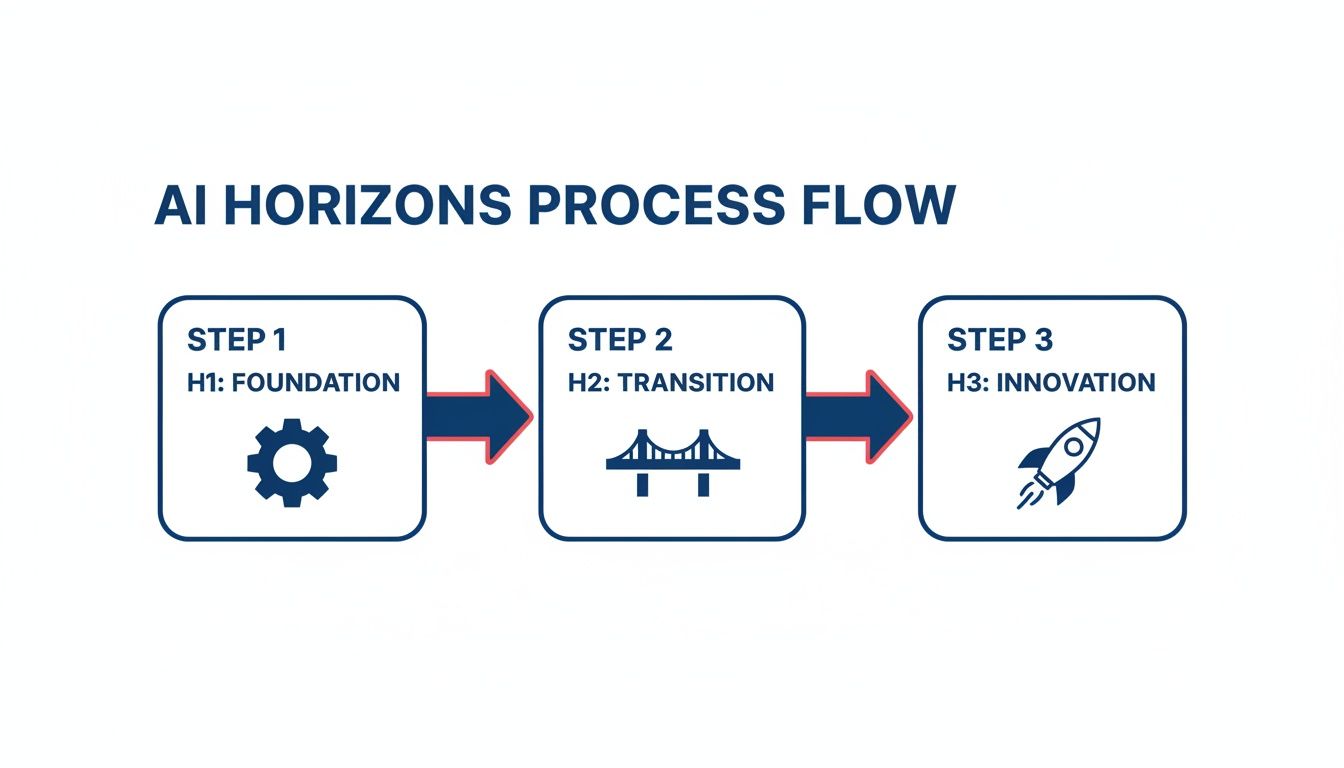
This flow chart gives you a nice visual of how projects should ideally move through the pipeline: starting with foundational work in H1, bridging the gap with H2, and ultimately aiming for those game-changing H3 innovations.
Each horizon demands a different mindset, different resources, and a different team structure. Get that right, and you’re well on your way to building a balanced innovation engine.
Conducting Your AI Portfolio Audit
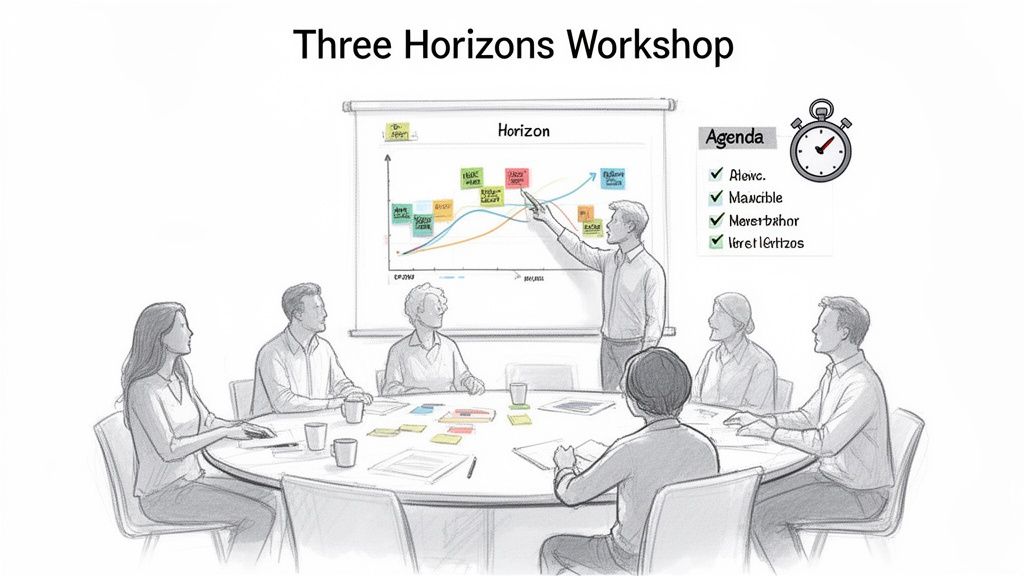
To get started, grab your team, draw three big columns on a whiteboard—Horizon 1, Horizon 2, and Horizon 3—and start slotting in every single AI-related activity you can think of.
Here’s a simple way to guide that conversation:
Spot Your H1 Core Work: First, hunt for the quick wins that make your current business run better. Ask your team, “What core processes are a total time-suck, super repetitive, or just begging to be automated?” These are your H1 slam dunks. Think about using AI to automate client reports or streamline internal workflows.
Brainstorm H2 Adjacent Growth: Now, look just beyond what you do today. Ask, “How can we use the AI tech we already have to solve a new problem for our existing customers? Or maybe crack into a market that’s right next door?” This might look like building a predictive model that becomes a whole new consulting service.
Dream Up H3 Disruptive Futures: This is where you get to think big and a little bit wild. The question is, “What emerging AI could completely flip our industry on its head in the next five years?” This kind of thinking could lead you to explore a proprietary generative AI that redefines your entire business model.
When you step back and look at the board, you get a crystal-clear snapshot of where your energy is going. Don’t be surprised if you find almost everything crammed into Horizon 1. That’s totally normal. Seeing that imbalance is the first critical step toward fixing it.
Allocating Resources with the 70-20-10 Rule
Once your projects are mapped out, you need to decide where to put your money, time, and people. A fantastic rule of thumb for this is the 70-20-10 rule. It’s a simple but incredibly effective way to balance your investments.
70% to Horizon 1: The lion’s share of your resources goes to defending and improving your core business. This keeps the lights on and the revenue flowing, which, by the way, funds everything else.
20% to Horizon 2: A healthy chunk is set aside for those emerging opportunities. These are your calculated bets on what will drive growth tomorrow.
10% to Horizon 3: A small, protected slice of your resources is reserved for the high-risk, high-reward experiments. These are your moonshots.
Now, this isn’t a hard-and-fast law; it’s a flexible guide. A young AI startup trying to grow like a weed might lean closer to a 50-30-20 split. A more established consultancy might stick to the classic 70-20-10. The point is to be deliberate about where your resources are going.
The 70-20-10 rule is about more than just your budget; it’s about your focus. It’s a system that stops the urgent (H1) from constantly killing the important (H2 and H3). You’re building for tomorrow while delivering today.
For any Product Manager tasked with building out these long-term AI initiatives, truly mastering AI product management is a must. To get a handle on what that entails, check out a complete AI PM roadmap for some great insights.
Structuring Teams for Success Across Horizons
Finally, you can’t treat all these projects the same. The team you need for an H1 efficiency project is completely different from the crew you’d assemble for a risky H3 venture. A one-size-fits-all team structure is a recipe for failure.
For H1, you need executors. These teams are all about reliability, process, and making small, steady improvements. They work within established systems and are measured on things like ROI and efficiency gains.
H2 calls for more of an entrepreneurial spirit. These teams need the freedom to build, test, and learn. Their leaders have to be comfortable with a bit of chaos, and their success is measured by learning, market validation, and early adoption rates.
H3 teams are your explorers, your pioneers. They should be small, nimble, and completely shielded from the short-term pressures of the main business. Their goal isn’t to turn a profit; it’s to discover what’s possible. For a closer look at how to run these kinds of projects, our guide on data science project management offers some really practical advice.
By sorting your portfolio, investing with intention, and building the right teams for the job, you can take the Three Horizons framework from a cool concept on a slide to a powerful engine for real, sustainable growth.
Real-World Examples of AI Strategy in Action
Okay, theory is one thing, but seeing the Three Horizons Framework play out in the real world is what really makes it all click.
To bring this home, let’s walk through how a few different businesses could use this model for their AI plans. We’ll skip the usual stories about giant tech corporations and look at more down-to-earth examples that AI and data consulting firms might actually encounter with their clients.
These scenarios show how spreading your AI bets across different timelines can deliver quick wins while building a real, lasting edge over the competition.
Logistics and Supply Chain Consulting
Picture an AI consultant working with a mid-sized logistics company. The client is getting squeezed by razor-thin margins and brutal competition. This is a classic case where the Three Horizons can build a strategy that tackles today’s fires and seeds tomorrow’s growth.
Horizon 1: The first job is to protect the core business. The consultant deploys an AI-powered route optimization tool. Almost immediately, it cuts fuel consumption by 15% and gets deliveries done faster. It’s a perfect H1 play: low risk, fast return, and it makes the current business stronger.
Horizon 2: Next, they look a little further out. The team helps the company build a predictive maintenance system for its truck fleet. Using sensor data, the AI can flag a truck for repairs before it breaks down on the highway. This slashes unexpected downtime and expensive emergency fixes, giving them a serious operational advantage. It’s a new capability that starts shifting their business from reactive to proactive.
Horizon 3: The big, long-term bet? Autonomous delivery. The consultant advises them to start a small R&D project, maybe just testing a few drones for last-mile drops in a controlled area. It’s years away from being a real service, but this H3 initiative ensures they’re not caught flat-footed when the technology and regulations finally catch up. They’re positioning themselves to be a leader, not a follower.
Retail and E-commerce Advisory
Now, let’s switch gears to a data consulting firm advising a retail brand. In retail, trends move at lightning speed. Having a balanced AI portfolio isn’t just a nice-to-have; it’s about survival.
The firm helps its client map out its AI investments like this:
Horizon 1: Make the online store better, right now. They roll out a smart recommendation engine that personalizes what shoppers see, bumping up the average order value.
Horizon 2: Create a new way to compete. They build a dynamic pricing model that automatically adjusts prices based on what’s in stock, what competitors are doing, and what customers are buying. This makes them far more agile in the market.
Horizon 3: Imagine the store of the future. They start tinkering with a proof-of-concept for an AI-powered virtual stylist, where customers get personalized fashion advice in a totally immersive digital space.
A Masterclass in Horizon Management
Even the giants follow these same principles. Just look at Amazon. They are masters of this framework, reportedly putting about 70% of their resources into Horizon 1 (keeping the core e-commerce engine humming), 20% into Horizon 2 (growing giants like AWS), and 10% into Horizon 3 (moonshots like their advanced AI ventures).
This 70/20/10 split lets them dominate today while building the businesses that will dominate tomorrow. It’s a powerful blueprint that smaller AI and data consultancies can adapt for their clients’ own projects, whether it’s for generative AI, recommender systems, or forecasting. You can find a great breakdown of how Amazon uses this framework to drive innovation on Tech Tales and Tactics.
By using the Three Horizons, these consulting firms are doing more than just putting out fires. They’re giving their clients a clear roadmap to compete today, grow tomorrow, and own the future.
How to Run a Three Horizons AI Workshop
Putting the Three Horizons framework into action isn’t something that just happens. It takes a focused, collaborative push to get everyone on the same page and thinking beyond their immediate to-do lists. I’ve found that running a dedicated workshop is the single best way to take this model from a slide deck concept to a real, actionable roadmap for your AI goals.
This isn’t just another meeting. It’s a structured session designed to get people thinking critically about the business today while also brainstorming creatively about what’s next. A well-run workshop can turn an abstract strategy into a shared mission, sparking the ideas and getting the buy-in you need to actually make things happen.
Preparing for a Successful Session
Before you even think about booking a room, a little prep work goes a long way. The idea is to walk in with a solid plan so you’re not wasting anyone’s valuable time.
First, get the right people in the room. You need a mix of voices, not just the usual leadership team. Pull in people from tech, sales, operations, and marketing. Their different viewpoints are absolutely essential for painting a complete picture of where the real challenges and opportunities are.
Next, you need to set clear expectations. Send out a simple agenda and maybe some quick pre-reading that explains the Three Horizons model. This gets everyone up to speed so they can jump right in and contribute from the start.
The best workshops I’ve been a part of are the ones where people feel safe enough to share both practical, down-to-earth ideas for Horizon 1 and some really wild, “out-there” thoughts for Horizon 3. As the facilitator, it’s your job to create that space for both kinds of thinking.
A Practical Workshop Template
To help you get started, here is a straightforward template you can adapt. I’ve designed it to guide the conversation logically from the present to the future, making sure each horizon gets the attention it needs.
Here’s a practical template to help structure your workshop and keep the conversation focused and productive.
Your Three Horizons AI Workshop Template
Agenda Item
Objective
Key Questions to Ask
Intro & Framework
Get everyone on the same page about the goals and the Three Horizons model.
What is our core business today? Why is it important to plan for multiple futures at once?
Horizon 1
Identify immediate AI opportunities to strengthen the current business.
What are our biggest inefficiencies? Which manual tasks are slowing us down the most?
Horizon 3
Brainstorm visionary, long-term AI bets without constraints.
What emerging AI tech could make our current business model obsolete? What’s a crazy idea?
Horizon 2
Bridge the gap by defining stepping-stone initiatives.
How can we get from H1 to H3? What new products or services can we build to test H3 ideas?
Prioritization & Next Steps
Turn ideas into an actionable plan by mapping and prioritizing.
Which H2 ideas have the most potential? What are the first concrete steps we need to take?
This structure ensures you cover all the bases, from shoring up today’s business to dreaming up tomorrow’s big bets.
From Ideas to an Actionable Roadmap
The workshop doesn’t end with a wall full of sticky notes. That’s just the beginning. The output is the raw material for your official AI roadmap. After the session, the real work starts: your team needs to gather all those ideas, see how they stack up against your business goals, and assign owners to start moving them forward.
This process of turning brainstorms into a documented strategy is a crucial part of AI change management. It builds the alignment and accountability you need to see real progress. By leading this conversation, you’re not just planning; you’re empowering your team to take ownership of the company’s future.
Watch Out for These Common Traps
Getting the Three Horizons Framework into your strategic planning is a huge win. But like any powerful tool, it’s easy to use it the wrong way. I’ve seen plenty of companies get excited, dive in, and then fall into a few predictable traps that turn a brilliant framework into a source of total frustration.
Knowing what these pitfalls look like ahead of time is half the battle. If you can spot the warning signs, you can keep your AI strategy on track and make sure your big plans actually turn into real-world results, not just forgotten doodles on a whiteboard.
The “Horizon 1 Treadmill”
By far the most common trap is getting stuck running in place on the Horizon 1 treadmill. This is what happens when a company gets so obsessed with optimizing what they’re doing right now that they completely forget to plant seeds for the future. The constant pressure for quarterly profits and immediate ROI just screams louder than the quiet need to explore what’s next.
It’s a nasty feedback loop. The better your Horizon 1 performs, the more resources it demands, which starves the very H2 and H3 projects meant to secure your future. For an AI or data consulting firm, this might mean only green-lighting automation projects with a guaranteed 3-month payback, while passing on a golden opportunity to develop a new predictive service that could define your business in three years.
The “Horizon 2 Identity Crisis”
Horizon 2 is tricky, and projects here often struggle with an identity crisis. They tend to swing to one of two extremes. Either they’re way too timid—basically just a slightly beefier H1 project with a fancy name—or they’re way too “out there,” feeling more like a disconnected H3 daydream than a logical next step.
A great H2 initiative needs to be a real bridge. It should feel a little uncomfortable. It’s supposed to stretch the boundaries of your current business model, but not snap them entirely.
To steer clear of this mess, keep asking two simple questions:
Is this a big enough bet? Does this project have a real shot at becoming a major part of our business in a few years?
Is this grounded in reality? Does it actually build on something we’re good at and solve a problem customers will have?
“Horizon 3 Daydreaming”
The last pitfall is treating Horizon 3 like a magical fantasy land where cool ideas live without any connection to reality. Yes, H3 projects are speculative, but that doesn’t mean they get a free pass on discipline. “H3 Daydreaming” is when those big, visionary ideas have no plan for validation, no link to a potential market, and no path forward.
Think of your H3 initiatives less like brainstorms and more like scientific experiments. The goal isn’t to make money right away; it’s to learn something valuable. Figure out what you need to discover, and set clear milestones for that learning.
The best way to do this is to protect H3 projects from the rest of the business. Give them their own small budget and a dedicated team that has the breathing room to explore without someone from finance knocking on their door every week demanding an ROI report. This is how you protect your future from being killed by the present.
Answering Your Questions About the Three Horizons
Whenever I introduce teams to the Three Horizons framework, the same handful of questions pop up. It’s totally normal. Getting your head around these concepts is one thing, but making them work in the real world is another.
Let’s cut through the theory and get to the practical stuff. Here are some quick answers to the questions that are probably on your mind.
How Often Should We Review Our Horizons Map?
This isn’t a “one-and-done” exercise you can stick in a drawer. Your horizons map is a living document, a compass for your strategy. Things change fast—markets zig-zag, new tech appears out of nowhere, and your own priorities shift.
I usually recommend a simple rhythm: a quick check-in every quarter and a full-on workshop once a year.
Quarterly Check-in: Think of this as a quick pulse check. Are our Horizon 1 projects delivering? Are we seeing any promising signs from our Horizon 2 experiments? A quick 30-minute huddle is often enough.
Annual Deep-Dive: This is where you roll up your sleeves. Get the team together, challenge every assumption on the map, and kill the projects that aren’t going anywhere. It’s also the time to brainstorm fresh ideas for all three horizons.
This keeps your strategy nimble and prevents it from becoming a dusty artifact.
Is This Framework Useful for a Small Consulting Firm?
Absolutely. In fact, you could argue it’s more important for smaller companies. You might not have the massive R&D budgets of a huge corporation, but the challenge of balancing today’s business with tomorrow’s growth is exactly the same.
For a smaller AI consultancy, this framework brings much-needed focus. It stops you from getting completely sucked into the whirlwind of current client work (that’s all Horizon 1). It forces you to carve out even a little bit of time and energy—maybe just 10-15% of your team’s non-billable hours—to plant the seeds for your next big service offering (H2) or to explore a wild new idea that could redefine your business (H3).
What’s the Biggest Mistake to Avoid with Horizon 3?
Impatience. Hands down, the biggest mistake is expecting Horizon 3 ideas to behave like Horizon 1 projects. These are your long shots, your experiments into the unknown. They aren’t supposed to show a profit next quarter.
If you try to measure an H3 initiative with a Horizon 1 yardstick, like immediate ROI, you’ll strangle it in the crib.
The real goal of Horizon 3 isn’t profit—it’s learning. You’re making small investments to understand what the future might look like and where you fit into it. You have to protect these projects from the intense pressure for short-term results.
At NILG.AI, we help businesses build robust, future-focused strategies using frameworks like this. We specialize in creating tailored AI solutions, from process automation to strategic roadmaps, that deliver results today while preparing you for tomorrow. Request a proposal
Like this story?
Subscribe to Our Newsletter
Special offers, latest news and quality content in your inbox.
Signup single post
Recommended Articles
Article
Transform Your Growth with custom ai software development in 2026
Apr 1, 2026 in
Guide: Explainer
Explore how custom ai software development can boost efficiency, cut costs, and deliver measurable value - find trusted partners and practical steps for 2026.
Discover how AI for customer service can transform your support operations. Learn practical strategies to reduce costs, improve satisfaction, and drive growth.
How Might We Statements: Turn Challenges into Opportunities
Mar 15, 2026 in
Guide: Explainer
Discover how might we statements transform complex challenges into real opportunities. Learn practical crafting tips, workshops, and real-world examples.
We use cookies on our website to give you the most relevant experience by remembering your preferences and repeat visits. By clicking “Accept All”, you consent to the use of ALL the cookies. However, you may visit "Cookie Settings" to provide a controlled consent.
This website uses cookies to improve your experience while you navigate through the website. Out of these, the cookies that are categorized as necessary are stored on your browser as they are essential for the working of basic functionalities of the website. We also use third-party cookies that help us analyze and understand how you use this website. These cookies will be stored in your browser only with your consent. You also have the option to opt-out of these cookies. But opting out of some of these cookies may affect your browsing experience.
Necessary cookies are absolutely essential for the website to function properly. These cookies ensure basic functionalities and security features of the website, anonymously.
Cookie
Duration
Description
cookielawinfo-checkbox-analytics
11 months
This cookie is set by GDPR Cookie Consent plugin. The cookie is used to store the user consent for the cookies in the category "Analytics".
cookielawinfo-checkbox-functional
11 months
The cookie is set by GDPR cookie consent to record the user consent for the cookies in the category "Functional".
cookielawinfo-checkbox-necessary
11 months
This cookie is set by GDPR Cookie Consent plugin. The cookies is used to store the user consent for the cookies in the category "Necessary".
cookielawinfo-checkbox-others
11 months
This cookie is set by GDPR Cookie Consent plugin. The cookie is used to store the user consent for the cookies in the category "Other.
cookielawinfo-checkbox-performance
11 months
This cookie is set by GDPR Cookie Consent plugin. The cookie is used to store the user consent for the cookies in the category "Performance".
viewed_cookie_policy
11 months
The cookie is set by the GDPR Cookie Consent plugin and is used to store whether or not user has consented to the use of cookies. It does not store any personal data.
Functional cookies help to perform certain functionalities like sharing the content of the website on social media platforms, collect feedbacks, and other third-party features.
Performance cookies are used to understand and analyze the key performance indexes of the website which helps in delivering a better user experience for the visitors.
Analytical cookies are used to understand how visitors interact with the website. These cookies help provide information on metrics the number of visitors, bounce rate, traffic source, etc.
Advertisement cookies are used to provide visitors with relevant ads and marketing campaigns. These cookies track visitors across websites and collect information to provide customized ads.