AI Automations • AI Strategy • AI4business • AI4tech • Artificial Intelligence •
What Is Generative AI and How Does It Work?
NILG.AI on Nov 21, 2025
?>
Generative AI isn’t just another tech buzzword; it’s a category of artificial intelligence that creates entirely new content. We’re talking about fresh text, images, music, and even computer code that didn’t exist before.
Think of it less like an analyst and more like a creative partner. It can invent, write, and design on command.
So, What’s the Big Deal?
Let’s break it down without the jargon. Most of the AI we’ve used for years—let’s call it traditional AI—is like a super-smart detective. It can sift through mountains of data to spot patterns, predict future sales, or flag a weird transaction. It’s brilliant at understanding what is.
Generative AI is different. It’s more like a creative director. Give it the same sales data, and it can dream up a whole new marketing campaign, sketch a product mockup, or write the code for a new feature. It’s built to imagine what could be.
That’s the fundamental split: one analyzes, the other creates.
From Insight to Action
This leap from analyzing to creating is what makes generative AI such a game-changer for businesses. You’re no longer just getting charts and predictions from your data; you’re getting tangible outputs you can actually use, right now.
This shift from passive insight to active creation is unlocking some seriously cool opportunities for getting things done faster and smarter.
And it’s not just a niche trend. The global generative AI market hit USD 16,877.1 million in 2024 and is expected to rocket to USD 109,370.1 million by 2030. That kind of growth tells you businesses are jumping on board, and fast.
Generative AI vs. Traditional AI
Getting a handle on the difference between these two types of AI is key to figuring out where they fit in your business. While both are incredibly useful, they solve completely different problems. If you want to go deeper into the basics, this is a great explainer on what AI-generated content truly entails.
To make it even clearer, here’s a quick side-by-side comparison.
Generative AI vs. Traditional AI at a Glance
This table breaks down the core distinctions between the two, from what they do to how they’re typically used in a business setting.
Aspect
Generative AI
Traditional AI
Primary Function
Creates new, original content (text, images, code).
Analyzes existing data to find patterns and make predictions.
Output
Unique and novel outputs that did not exist before.
Insights, classifications, or forecasts based on input data.
Ultimately, knowing which tool to use for the job is the first step. One helps you understand the past and predict the future, while the other helps you build it.
How Generative AI Actually Works
It’s easy to think of generative AI as some kind of magic box, but what’s happening under the hood is surprisingly logical. At its core, this technology isn’t “thinking”—it’s a master of pattern recognition.
Think of it like an apprentice who has read every single book in the world’s largest library. They wouldn’t have memorized every sentence, but they’d have an incredible, intuitive grasp of grammar, style, and how ideas connect. Generative AI models learn the same way. They sift through massive datasets to internalize the underlying rules and structures.
That learning process is what allows them to generate something entirely new—text, images, or code—that just feels right because it follows the patterns it has learned.
The Engines Behind the Magic
Two main types of models are doing the heavy lifting for most of the generative AI tools we use today: Large Language Models (LLMs) for text and Diffusion Models for images. They work differently, but the basic idea is the same: learn from data, then create.
Large Language Models (LLMs): These are the powerhouses behind popular chatbots and writing assistants. Trained on a mind-boggling amount of text and code, LLMs get incredibly good at one thing: predicting the next word in a sentence. That simple predictive skill is what allows them to write emails, summarize long reports, and even crank out functional code.
Diffusion Models: These models are the artists. They learn to create an image by starting with a canvas of pure random noise—like old-school TV static. Then, guided by a text prompt, they slowly refine that noise, step-by-step, until a clear picture emerges. It’s a bit like a sculptor who sees a statue in a block of marble and chips away everything that isn’t part of it.
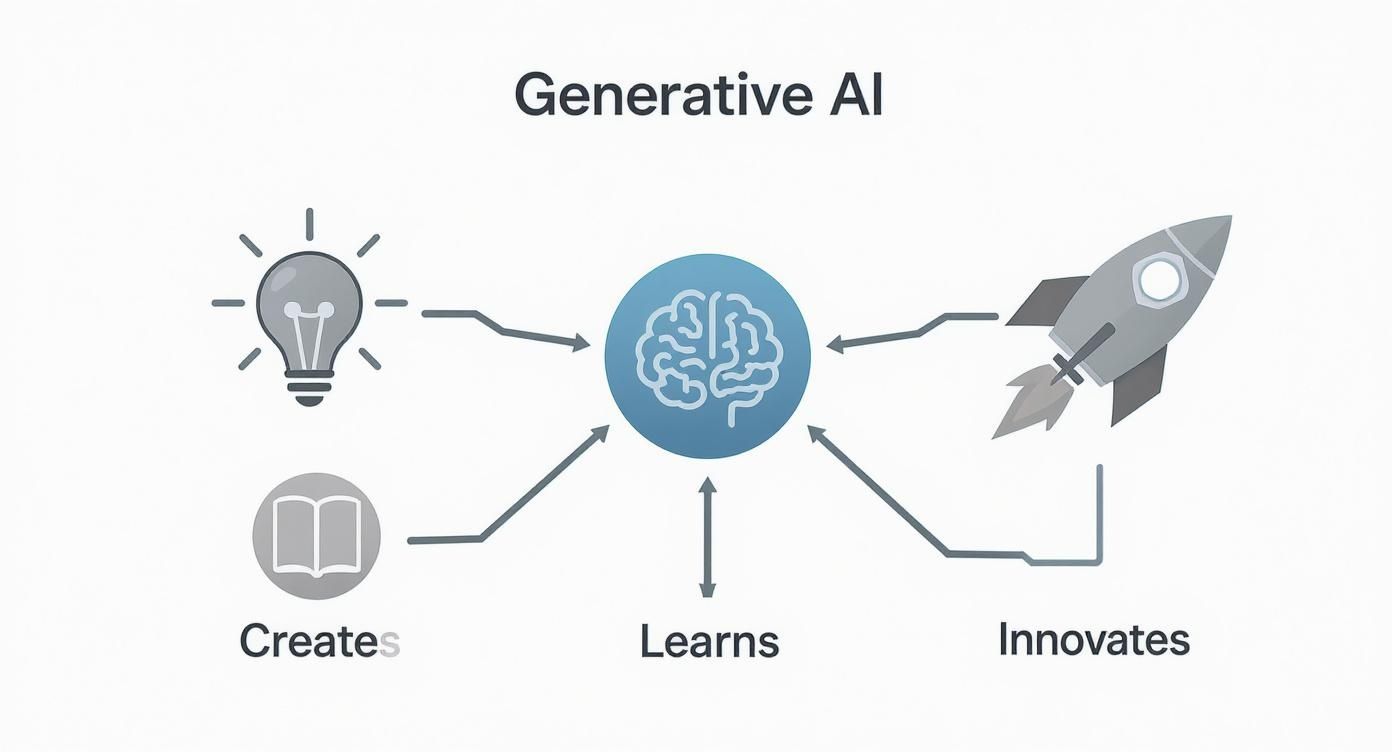
This whole process is about turning raw information into creative output, which in turn fuels new ideas and innovation.
As the diagram shows, it’s a cycle: learning leads to creation, and creation sparks innovation. For a business, this becomes a powerful feedback loop for growth.
Giving the AI Clear Instructions
Just having a powerful model isn’t enough. You have to know how to talk to it. That’s where two key concepts come into play: prompts and tokens.
A prompt is simply your instruction to the AI. It can be a question, a command, or a detailed request. The quality of your output is almost entirely dependent on the quality of your prompt. A vague prompt gets you a generic, unhelpful answer. But a specific, well-crafted prompt? That’s how you get targeted, useful results. This skill, often called prompt engineering, is becoming essential.
What about tokens? You can think of them as the building blocks of language for the AI.
A token is the smallest piece of data the model processes. For English, a token is usually a word or even just part of a word. The phrase “generative AI,” for instance, is three tokens: “generative,” “A,” and “I.”
Why should you care? Because models have limits on how many tokens they can handle in a single conversation. Tokens also directly impact the cost and speed of getting a response, so it’s a practical thing to keep in mind for any real-world application.
Getting good at talking to these models is what turns them from a cool tech demo into a genuine business asset. If you want to take your skills to the next level, understanding the trade-offs between fine-tuning vs. prompt engineering is a great next step for getting even more customized results.
Putting Generative AI to Work in Your Business
It’s one thing to understand the theory behind generative AI, but seeing it in action—solving real problems—is where it all clicks. This isn’t just about abstract concepts anymore; it’s about practical, day-to-day business operations that create new opportunities and drive actual growth. We’re talking about turning AI’s potential into tangible results.
So, where do you even begin? That’s the first question on everyone’s mind. The best starting point is to look for specific, high-impact areas where generative AI can take over repetitive tasks, kickstart creativity, or deliver personalized customer experiences at a scale you never thought possible.
This is precisely where a specialized AI and data partner comes in. Instead of just grabbing generic, off-the-shelf tools and hoping for the best, a good partner helps you pinpoint the unique bottlenecks in your workflow and build custom solutions that deliver a measurable return on your investment.
Driving Growth with Smarter Marketing
Marketing teams were some of the earliest adopters of generative AI, and for good reason. The ability to create high-quality content on the fly lets them test more ideas, reach new audiences, and personalize their messaging in incredibly powerful ways.
Here are just a few concrete examples of how marketers are using it:
Hyper-Personalized Ad Copy: Imagine creating thousands of ad variations, each one tweaked for a specific customer segment with messaging that speaks directly to their needs. Generative AI can comb through customer data to generate compelling copy that seriously boosts engagement and conversion rates.
Rapid Campaign Brainstorming: Instead of spending weeks whiteboarding ideas, teams can use AI to dream up entire campaign concepts in minutes. Give it a simple prompt about the product and target audience, and it can spit out slogans, visual themes, and social media post ideas—acting as a powerful creative assistant.
Content Creation at Scale: Whether it’s blog posts, email newsletters, video scripts, or product descriptions, generative AI can knock out a solid first draft. This frees up marketers to focus on high-level strategy and polishing the final product instead of staring at a blank page.
The financial impact is already huge. By 2030, generative AI is on track to add a staggering USD 19.9 trillion to the global economy. It’s telling that in 2023, marketing, advertising, and creative fields made up 46% of this value creation, which shows just how fast these industries are jumping on board. You can find more details in this report on generative AI’s economic impact on Amplifai.com.
Empowering Sales and Operations Teams
The perks of generative AI definitely don’t stop at marketing. In sales and operations, the focus shifts to boosting efficiency, improving communication, and making sense of data—all of which help teams close more deals and run a tighter ship.
Think of generative AI as a productivity multiplier. It automates the routine stuff, freeing up your team to focus on high-value work like building client relationships and strategic planning.
An experienced AI consulting firm can help you build custom solutions that attack specific operational pain points. For instance:
Automated Call Summaries: Sales reps spend way too much time writing up call notes. A custom AI tool can transcribe and summarize client conversations instantly, pulling out key action items, pain points, and follow-up opportunities.
Tailored Outreach Emails: Drafting personalized emails for hundreds of leads is a grind. Generative AI can scan a prospect’s LinkedIn profile and company website to craft a highly relevant outreach message that feels personal and gets a much better response rate.
Streamlined Reporting: Operations managers can put an end to manual report creation. An AI system can pull data from different sources, analyze trends, and generate a clean, concise summary with key insights, saving hours of tedious work every week.
Custom Internal Training: Creating training materials from scratch is slow. Generative AI can whip up custom training modules, quizzes, and even role-playing scenarios based on your company’s internal documents, getting new hires up to speed much faster.
The end goal here is to move your organization from just dabbling with generic tools to implementing targeted systems built for your specific business needs. That’s how you drive real efficiency and lasting growth.
Managing the Risks of Generative AI
Let’s be honest: jumping into any powerful new technology without looking at the potential pitfalls is a bad idea. While generative AI is opening up some incredible doors, it’s not a silver bullet. If you ignore the downsides, you’re setting yourself up for trouble. But with a smart strategy, you can innovate with confidence, keeping your business, data, and customers safe.
This isn’t about fear-mongering. It’s about giving your team a realistic view of what generative AI is and the responsibilities that come with it. When you understand the risks from the get-go, you can build a solid framework for using it responsibly and effectively.
The goal is to stop being reactive and start being proactive. A good AI and data consulting partner can help you build systems that are both secure and reliable, turning those potential risks into just another manageable part of your strategy.
Navigating Key Challenges
There are a few core challenges with generative AI that every business leader needs to keep on their radar. These aren’t reasons to stop, but they definitely require some careful planning and active management.
Data Privacy and Security: What happens when an employee pastes sensitive company info into a public AI tool? That data could easily become part of the model’s training set or get exposed in a breach. Your first line of defense is a crystal-clear policy on what can and can’t be shared.
Inaccurate Information (‘Hallucinations’): AI models can sometimes make things up. They’ll state complete falsehoods with all the confidence of an expert, which is a huge problem. Relying on that output for critical decisions without fact-checking can lead to some seriously expensive mistakes.
Copyright and Intellectual Property: The legal world is still catching up to AI-generated content. Using AI to create stuff can lead to tricky questions about who owns it and whether you’re accidentally stepping on someone else’s copyright.
For any business with a foothold in the EU, a big piece of managing these risks is staying on the right side of regulations. To get a better handle on this, check out A Practical AI GDPR Compliance Guide — it’s packed with useful advice for staying compliant.
Building a Framework for Responsible AI
Successfully handling these risks really comes down to one thing: a strong governance framework. This is about creating clear rules of the road that guide how your team uses AI, making sure everyone is on the same page from day one.
A strong AI governance policy is your playbook for innovation. It doesn’t restrict creativity; it provides the guardrails that allow your team to experiment safely and effectively.
Working with an AI consultant can help you put together a solid framework with all the right pieces. This isn’t just about plugging in new tech; it’s about building a culture where people use AI responsibly.
Actionable Steps for Safe Implementation
So, how can you start building that protective framework right now?
Establish Clear Governance Policies: Write down and share a formal AI usage policy. It needs to spell out exactly what kind of data can be used with AI tools and which platforms are approved, ensuring everything lines up with your company’s security standards.
Maintain Human Oversight: Always, always keep a human in the loop for important workflows. Think of AI as an incredibly powerful assistant, not the final decision-maker. This is non-negotiable for things like customer communications or financial reports.
Invest in Team Training: Give your people the knowledge they need to use AI the right way. Training should cover your specific policies, how to spot potential AI weirdness (like hallucinations), and best practices for writing prompts that are both effective and safe.
By taking these steps, you create an environment where you can actually get the most out of generative AI while keeping the potential headaches to a minimum. If you’re wondering where your company stands, you can learn more about how to prepare for the challenges and opportunities of generative AI in our detailed guide.
So, you understand what generative AI is and you’ve thought about the risks. Great. Now for the real question every leader is asking: “How do we actually start using it?”
Moving from theory to practice can feel like staring up at a mountain. But it doesn’t have to be an impossible climb. The trick is to follow a clear path—a structured, phased approach that turns a massive ambition into a series of small, manageable steps.
This isn’t about flipping a switch and hoping for the best. A smart generative AI journey is all about identifying the right problems to solve, testing your ideas on a small scale, and then doubling down on what works. It’s a deliberate process designed to minimize risk while making sure you see a real return.
We’ve broken this journey down into a simple, three-stage roadmap to guide you from initial curiosity to full-scale deployment with confidence.
Stage 1: Assessment and Strategy
Before you write a single line of code or subscribe to a new tool, you need a plan. This first stage is all about discovery. You have to pinpoint exactly where generative AI can deliver the biggest punch for your specific business. It’s time to look past the hype and focus on what actually matters.
Start by asking the tough questions. Where are our biggest operational headaches? What repetitive tasks are eating up our team’s time? How can we make our customer experience feel truly personal? The goal here is to find high-impact use cases that tie directly to your bottom line.
This is where an AI and data consulting partner is worth their weight in gold. They bring a fresh pair of eyes, helping you spot opportunities you might have missed while stress-testing your ideas to make sure they’re technically possible and financially viable. Getting this strategic alignment right is the foundation for everything else.
Stage 2: Pilot and Prototype
Once you’ve got a clear strategy and a short list of potential projects, it’s time to get your hands dirty. The second stage is all about starting small to prove value quickly. Don’t try to boil the ocean. Just pick one focused project—a pilot—to test your assumptions and score an early win.
A great pilot project has a few things in common:
Clear Success Metrics: You have to know what winning looks like. Is it cutting a task’s time in half? Boosting customer engagement by 15%? Define your KPIs before you start.
Contained Scope: The project needs to be small enough to finish in a few weeks or months. This keeps the team focused and builds momentum.
Visible Impact: Pick a project that, if it works, will get noticed. A visible win helps build the business case for more investment down the line.
A successful pilot is more than just a technical proof of concept; it’s a powerful storytelling tool. It shows tangible value to the rest of the company and gets everyone excited about what’s next.
An AI consulting team can make all the difference here by building the actual prototype for you. They can quickly develop a working model, plug it into a specific workflow, and measure its performance against your goals, turning your big idea into a reality. If you want to dive deeper into how this works, check out our guide on how to implement AI in business.
Stage 3: Scale and Optimize
With a successful pilot in the bag, you’ve proven your idea works. Now what? The final stage is all about taking that proven solution and expanding its impact across the entire organization.
Scaling isn’t just about giving more people access to a cool new tool. It’s about thoughtfully weaving it into your core business processes and constantly making it better. This is where you go from a one-off project to building a genuine, in-house capability. It’s a continuous cycle of deploying, measuring, and refining based on real-world feedback.
The confidence to invest in this stage is backed by a massive surge of capital into the AI space. In 2023, total private investment in generative AI exploded by an incredible 407% from the previous year, hitting USD 21.8 billion. This flood of money is fueling the development of more powerful and scalable solutions for businesses ready to go all-in. You can explore more insights on this trend and what it means for the future of AI on mend.io.
A long-term partner helps make this transition smooth. They can handle the full-scale integration, monitor performance to fix issues before they become problems, and help you find the next big opportunity—turning your first AI success into a lasting competitive edge.
Finding the Right AI Partner for the Job
Let’s be honest, diving into generative AI isn’t something you should do alone. The tech is packed with potential, but turning that promise into real, measurable business results takes a specific kind of expertise, a solid strategy, and some serious technical chops. This is exactly where a specialized partner comes in.
Think of it like this: you wouldn’t build a new factory without an architect and an engineering crew. In the same way, building effective AI requires a guide who gets both the technology and the nuances of your business. A good partner helps you bridge the gap between just trying stuff out and actually getting results.
Moving Beyond Off-the-Shelf Tools
An AI and data consulting firm like NILG.AI isn’t just a vendor; we’re your guide. The focus is on partnership and outcomes you can actually measure. Instead of selling you a one-size-fits-all piece of software, our goal is to build a custom AI strategy that solves your specific problems and unlocks your unique opportunities. That means developing bespoke models and making sure they plug right into the systems you already have.
This hands-on approach saves you from the expensive and frustrating trial-and-error that sinks so many AI projects. We kick things off with deep-dive workshops to really get to the heart of your goals and see it through to full implementation, setting up your team for the long haul.
The right partner doesn’t just hand you a tool and walk away. They build a new capability inside your organization, turning complex technology into a competitive edge that’s all yours.
It’s a totally different mindset from just buying a product off the shelf. It’s about creating a solution that molds to your business, not forcing your business to fit into a pre-built box.
What a True Partnership Looks Like
A real strategic partnership is all about working together through a clear process that delivers value every step of the way. It’s about building momentum and proving the investment was worth it, right from the start.
Here’s what you should expect from a hands-on AI consulting firm:
Custom Strategy Development: The first step is always about understanding your business goals. A partner will help you pinpoint the high-impact areas where generative AI can deliver the biggest wins, whether that’s cutting costs, automating tedious processes, or finding new ways to make money.
Bespoke Model Building: Your business runs on its own unique data and faces its own distinct challenges. A good partner builds custom models trained on your information, making sure the results are relevant, accurate, and truly useful for your day-to-day operations.
Seamless System Integration: AI is most powerful when it plays nice with the tools your team already relies on. A partner does the heavy lifting to weave new AI features into your current tech stack without causing a massive disruption to everyone’s workflow.
Ongoing Support and Optimization: The job isn’t done once the system goes live. A true partner sticks around to monitor performance, fine-tune the models, and help you spot new opportunities for innovation as your business grows.
Your Generative AI Questions, Answered
As you start to think about what generative AI could do for your business, a lot of practical questions will pop up. It’s only natural. Here are some straightforward answers to the questions we hear most often from business leaders.
Is This Going to Be Expensive?
It doesn’t have to be. The cost really depends on how you decide to jump in. Playing around with public, off-the-shelf tools can be incredibly cheap, while a custom solution built by an AI and data consulting team will obviously need a bigger upfront investment.
But here’s the thing: a smart pilot project is designed to deliver a clear ROI from the get-go. It proves its own value before you ever have to commit to a company-wide rollout. The trick is to start with a specific business problem where the gains in efficiency or new revenue will quickly pay for the project.
How Tech-Savvy Do We Need to Be?
You definitely don’t need to hire a whole team of data scientists just to get started. A lot of the newer generative AI tools are built with surprisingly simple interfaces, which means your non-technical teams can use them right away for things like drafting content or kicking around new ideas.
When you want to build something more advanced—say, an application that plugs directly into your core business systems—that’s when you’ll need specialized expertise. This is exactly where partnering with an AI consulting firm makes sense. They handle all the heavy technical lifting for you.
What’s the Difference Between Generative AI and Machine Learning?
Great question, and it’s one that trips people up all the time. Think of it like this:
Machine learning is the big, overarching field where systems learn from data to make predictions. A classic example is a model that predicts which customers are likely to cancel their subscriptions based on past behavior. It’s all about analyzing what’s already there.
Generative AI is a specific branch of machine learning. Instead of just predicting things based on existing data, it creates brand-new, original stuff that looks just like the data it was trained on. So, while all generative AI is a form of machine learning, not all machine learning is generative.
Can We Use Our Own Company Data?
Absolutely—in fact, that’s where the real magic happens. Using your own private data is what unlocks the most powerful results. A custom model trained on your company’s sales reports, customer service chats, and internal documents will give you vastly more relevant and accurate outputs than any generic tool ever could.
A good AI partner can help you build secure systems that tap into your proprietary data without ever exposing it publicly. This turns your internal knowledge into a serious competitive advantage.
Ready to move from asking questions to taking action? NILG.AI specializes in creating custom AI strategies and solutions that drive real business growth. Find out how we can build a clear roadmap for your success. Request a proposal
Like this story?
Subscribe to Our Newsletter
Special offers, latest news and quality content in your inbox.
Signup single post
Recommended Articles
Article
Transform Your Growth with custom ai software development in 2026
Apr 1, 2026 in
Guide: Explainer
Explore how custom ai software development can boost efficiency, cut costs, and deliver measurable value - find trusted partners and practical steps for 2026.
Discover how AI for customer service can transform your support operations. Learn practical strategies to reduce costs, improve satisfaction, and drive growth.
How Might We Statements: Turn Challenges into Opportunities
Mar 15, 2026 in
Guide: Explainer
Discover how might we statements transform complex challenges into real opportunities. Learn practical crafting tips, workshops, and real-world examples.
We use cookies on our website to give you the most relevant experience by remembering your preferences and repeat visits. By clicking “Accept All”, you consent to the use of ALL the cookies. However, you may visit "Cookie Settings" to provide a controlled consent.
This website uses cookies to improve your experience while you navigate through the website. Out of these, the cookies that are categorized as necessary are stored on your browser as they are essential for the working of basic functionalities of the website. We also use third-party cookies that help us analyze and understand how you use this website. These cookies will be stored in your browser only with your consent. You also have the option to opt-out of these cookies. But opting out of some of these cookies may affect your browsing experience.
Necessary cookies are absolutely essential for the website to function properly. These cookies ensure basic functionalities and security features of the website, anonymously.
Cookie
Duration
Description
cookielawinfo-checkbox-analytics
11 months
This cookie is set by GDPR Cookie Consent plugin. The cookie is used to store the user consent for the cookies in the category "Analytics".
cookielawinfo-checkbox-functional
11 months
The cookie is set by GDPR cookie consent to record the user consent for the cookies in the category "Functional".
cookielawinfo-checkbox-necessary
11 months
This cookie is set by GDPR Cookie Consent plugin. The cookies is used to store the user consent for the cookies in the category "Necessary".
cookielawinfo-checkbox-others
11 months
This cookie is set by GDPR Cookie Consent plugin. The cookie is used to store the user consent for the cookies in the category "Other.
cookielawinfo-checkbox-performance
11 months
This cookie is set by GDPR Cookie Consent plugin. The cookie is used to store the user consent for the cookies in the category "Performance".
viewed_cookie_policy
11 months
The cookie is set by the GDPR Cookie Consent plugin and is used to store whether or not user has consented to the use of cookies. It does not store any personal data.
Functional cookies help to perform certain functionalities like sharing the content of the website on social media platforms, collect feedbacks, and other third-party features.
Performance cookies are used to understand and analyze the key performance indexes of the website which helps in delivering a better user experience for the visitors.
Analytical cookies are used to understand how visitors interact with the website. These cookies help provide information on metrics the number of visitors, bounce rate, traffic source, etc.
Advertisement cookies are used to provide visitors with relevant ads and marketing campaigns. These cookies track visitors across websites and collect information to provide customized ads.