AI Automations • AI Strategy • AI4business • Artificial Intelligence •
What Is Prescriptive Analytics Guide
NILG.AI on Nov 21, 2025
?>
Think of prescriptive analytics as the ultimate strategic GPS for your business. While other analytics might tell you where you’ve been or forecast traffic ahead, prescriptive analytics is the one that says, “Take this specific route right now to achieve your business goals.”
It cuts through the noise to answer the one question that really matters: “What should we do?”
Decoding Prescriptive Analytics
Prescriptive analytics represents the final, most advanced frontier in business analytics. It doesn’t just hand you a report or a forecast; it actually recommends specific actions you can take to get the results you want. To pull this off, it uses a powerful mix of artificial intelligence, machine learning, and complex optimization algorithms to sort through endless options and find the single best path forward.
This isn’t just a niche technology anymore—it’s becoming a business necessity. The global market for prescriptive analytics was pegged at around $6.9 billion in 2024 and is projected to explode to $32.4 billion by 2033. That kind of growth tells you just how many companies are moving past basic data analysis and toward automated, intelligent decision-making.
Where It Fits in the Analytics Family
To really get what makes prescriptive analytics so special, it helps to see it as the final step in a journey. Each type of analytics answers a progressively harder question, moving you from simple insight all the way to decisive action.
Predictive analytics, for example, gives you a solid glimpse into the future but stops short of telling you what to do about it. If you want to dive deeper into that, understanding the benefits of predictive analytics can show you how it sets the stage for what comes next.
The real goal here is to stop reacting to what the data says happened and start proactively making things happen.
By looking at historical data (descriptive), figuring out why things happened (diagnostic), and forecasting what’s next (predictive), prescriptive analytics delivers concrete, actionable advice. It’s the final piece of the puzzle that connects insight to execution.
The Four Types of Business Analytics Compared
Let’s lay out the entire analytics family in a simple table. Each one builds on the last, adding more value and bringing you closer to the kind of automated guidance that prescriptive analytics delivers.
Analytics Type
Core Question
Business Example
Descriptive
What happened?
A weekly sales report shows a 15% drop in revenue for a specific product last quarter.
Diagnostic
Why did it happen?
Digging deeper, you find the sales drop happened right when a competitor launched a big marketing blitz.
Predictive
What will happen?
The forecast suggests that if you do nothing, sales will likely keep falling by another 10% next quarter.
Prescriptive
What should we do?
The system recommends launching a targeted 20% discount and a social media ad campaign to win back customers and recover sales.
As you can see, each step gets you closer to a smart, data-backed decision, with prescriptive analytics providing the final, clear-cut recommendation.
How Does Prescriptive Analytics Actually Work?
So, what’s really going on under the hood? Let’s use an analogy. Think of prescriptive analytics as a seasoned financial advisor. They don’t just look at market forecasts and tell you what might happen. They take those predictions, weigh them against your personal financial goals and how much risk you’re comfortable with—your “business rules”—and then give you a specific, tailored investment plan.
That’s the essence of it: prescriptive analytics combines predictions with your real-world constraints to recommend the best possible move.
It isn’t a single magical step. Instead, it’s a powerful fusion of technologies. It starts with the output from predictive models (the “what will likely happen”) and funnels that information into a much more sophisticated engine built on artificial intelligence and machine learning.
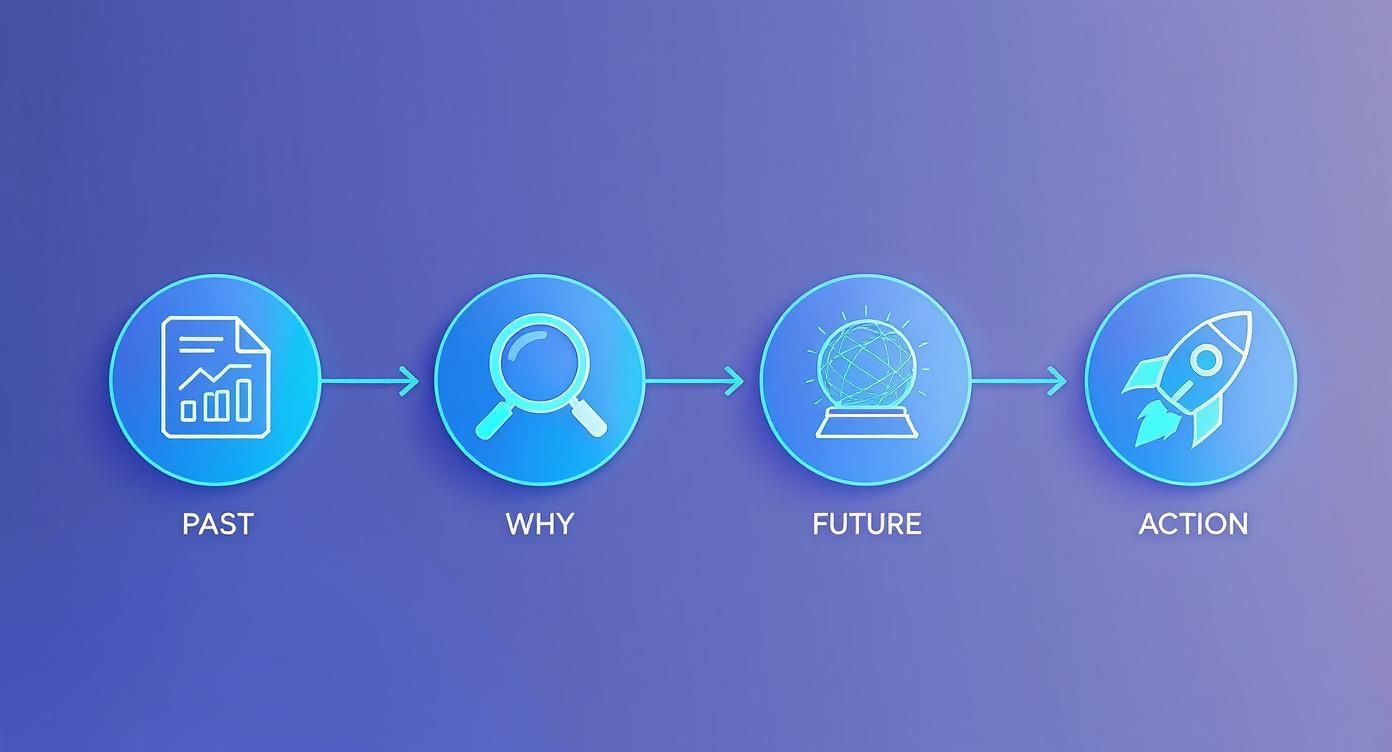
This handy infographic breaks down the journey, showing how data analysis matures from looking backward to actively guiding future decisions.
As you can see, it’s a clear progression from understanding the past to actively creating a better future, with prescriptive analytics serving as that final, decisive step.
The Core Components
At the heart of this process, you’ll find algorithms designed for two key tasks: simulation and optimization. These are the workhorses that truly separate prescriptive analytics from the other types, giving it the ability to game out endless possibilities to find the winning play.
Simulation Algorithms: Think of these as creating a digital playground—a “digital twin”—of your business. They run thousands of “what-if” scenarios to see how different decisions would pan out based on the forecasts. A retailer, for instance, could simulate ten different pricing strategies to see their potential impact on sales and profit before committing to one in the real world.
Optimization Engines: Once the simulations have laid out all the possibilities, the optimization engines take over. Their job is to methodically search through every potential outcome to find the one that best aligns with your goals, whether that’s maximizing revenue, slashing costs, or minimizing risk.
Getting a handle on the core machine learning algorithms is key to understanding how these engines learn and improve over time. They don’t just find a solution; they are designed to find the best one available given the circumstances.
The true genius of prescriptive analytics is its ability to evaluate complex trade-offs. It might calculate that a 5% price cut could spike sales by 20% but ultimately hurt your profit margin. So instead, it might recommend a smaller 2% discount paired with a new marketing push to achieve a better overall financial result.
From Possibilities to Prescriptions
This is where the idea of optimization truly comes to life. The system isn’t just making an educated guess; it’s using math to find the most efficient path forward. A big part of this is deciding on the right problem-solving approach. Digging into concepts like the difference between local vs global optimization offers a fascinating look at how these systems zero in on the most effective strategy.
Ultimately, prescriptive analytics is the bridge connecting raw data, future predictions, and your on-the-ground business constraints. It blends all these elements to go far beyond simple forecasting, delivering solid, data-driven advice built to hit your most important targets.
Real-World Business Applications
This is where the rubber meets the road. Theory is one thing, but prescriptive analytics really shines when you see what it can do for a business. We’re talking about moving past static reports and simple forecasts to actually making things happen. Companies are using this stuff right now to tackle their toughest problems and get a real leg up on the competition.
As businesses in every sector—from retail and logistics to healthcare—get buried in more and more data, they need better tools. It’s no longer enough to just know what happened or guess what might happen next. They need clear, automated guidance on the absolute best next move. If you want to dig into the numbers, you can read the full research on the prescriptive analytics market.
Optimizing Retail and Dynamic Pricing
The retail world moves at lightning speed, and pricing is a constant battle. This is where prescriptive analytics becomes a secret weapon, especially with dynamic pricing.
The Problem: Imagine a retailer trying to squeeze every last drop of profit from a hot new product. Price it too high, and customers walk. Price it too low, and you leave money on the table.
The Solution: A prescriptive model chews through real-time sales figures, what competitors are charging, how much stock is left, and even what people are saying on social media. It then spits out the perfect price adjustments to make, sometimes minute by minute.
The Outcome: The system might suggest nudging the price up during the evening rush and then offering a small discount overnight. Suddenly, pricing isn’t a quarterly meeting—it’s a live, tactical advantage that maximizes revenue while keeping you competitive.
Streamlining Supply Chain and Logistics
For any company moving physical goods, efficiency is the name of the game. Prescriptive analytics is completely changing how supply chains are managed, from the warehouse floor to the customer’s front door.
By simulating thousands of different routes and inventory placements, a prescriptive system can pinpoint the single best operational plan to save money and speed things up. It’s not just about finding the shortest route; it’s about optimizing the entire network.
A logistics company, for example, can get specific advice on exactly how much inventory to keep at each distribution center or the most efficient delivery routes for its truck fleet. The result? Lower fuel bills, faster delivery times, and happier customers. If this is your world, we’ve got more to say about modern inventory optimization techniques.
Enhancing Healthcare and Manufacturing
The power of prescriptive analytics isn’t limited to retail shelves and shipping containers. It’s making a huge impact in highly specialized fields, improving both patient health and factory output.
Personalized Healthcare: In the medical field, a prescriptive model can analyze a patient’s genetics, lifestyle, and medical history to recommend a truly personalized care plan. It suggests the ideal combination of treatments and medications, pushing healthcare from a one-size-fits-all approach to something tailored for each individual.
Manufacturing Resource Allocation: A factory manager can lean on prescriptive analytics to create the perfect production schedule. The system juggles machine uptime, employee shifts, and the flow of raw materials to recommend the smartest way to run the floor, cutting down on wasted time and boosting production.
See the pattern? In every scenario, prescriptive analytics takes a messy, complex problem with a million different variables and provides a clear, data-backed path forward. It turns decision-making from a gut feeling into a science.
So, What’s the Real Payoff? The Strategic Benefits of a Prescriptive Approach
Alright, let’s move past the theory. What does bringing prescriptive analytics into your business actually do for you? The value isn’t just some vague promise of “better decisions.” It’s about fundamentally rewiring how your company operates. You stop reacting to yesterday’s problems and start proactively shaping tomorrow’s outcomes.
Think of it as embedding an expert advisor directly into your daily workflow. Instead of teams running on gut feelings or staring at rearview-mirror reports, they get clear, data-backed directions on the single best action to take. This pulls the guesswork out of the equation and makes hitting the optimal choice the new normal, for everyone.
Sharpen Your Competitive Edge
One of the biggest wins here is the ability to see and sidestep risks long before they ever hit your bottom line. Prescriptive models can sniff out a potential supply chain disruption, predict which customers are about to leave with scary accuracy, or flag an operational bottleneck weeks before it grinds things to a halt.
This is a massive competitive advantage. While your rivals are scrambling to put out fires, your business is already implementing the best possible solution, saving a ton of time and money in the process.
By simulating what could happen and telling you what to do about it, prescriptive analytics flips risk management on its head. It’s no longer a defensive chore; it becomes an offensive strategy for sidestepping threats and turning potential headaches into real opportunities.
Drive Killer Efficiency and Find New Money
When you remove ambiguity, operational efficiency goes through the roof. Prescriptive analytics can fine-tune everything from how much inventory you keep on hand and how you schedule your staff to where you spend your marketing dollars. It’s all about finding that perfect balance to cut waste and maximize what you get out of your resources.
Nail Your Resource Allocation: Get the right people and the right equipment in the right place at the right time. No more costly downtime or paying for staff you don’t need.
Plug the Leaks: Pinpoint those hidden, inefficient processes that have been quietly draining your budget and slowing you down for years.
Discover Untapped Opportunities: Uncover entirely new ways to make money, whether it’s through smarter pricing or identifying customer needs you never knew existed.
This is where AI really shines. These systems are constantly learning from the firehose of real-time data, allowing them to adapt on the fly. That ability to process new information and immediately tweak recommendations is the secret sauce. If you want to dig deeper into this, you can learn more about how AI is shaping the market’s capabilities and growth.
Your Roadmap to Implementation
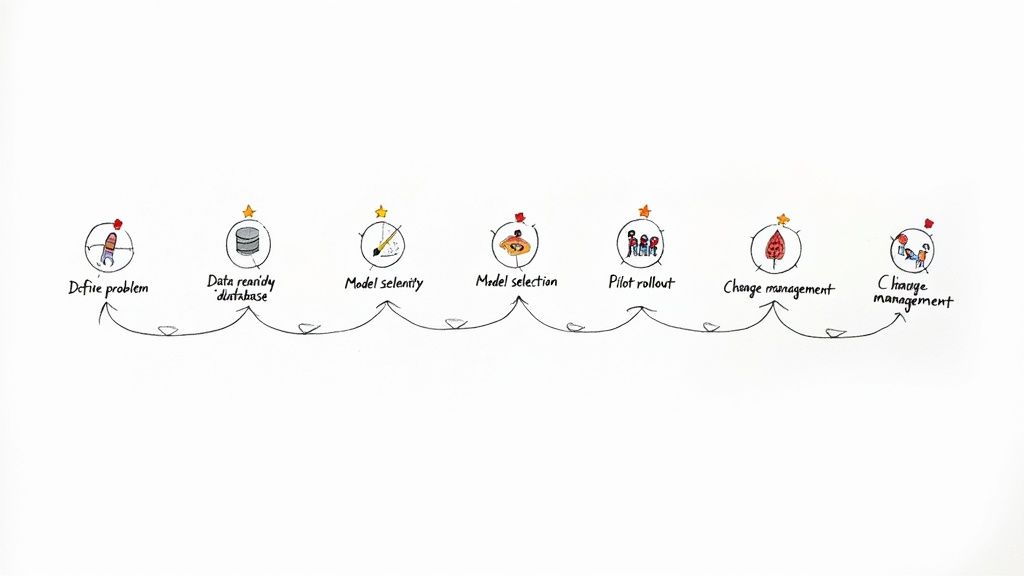
So, you’re sold on the idea and ready to get started? Great. But implementing prescriptive analytics isn’t like flipping a switch. It’s a process that needs a clear plan, and it’s best to think of it as a flexible roadmap, not a rigid instruction manual. A good data consulting partner can be invaluable in helping you navigate the twists and turns.
Here’s the most important part: the whole thing starts with a real, high-value business problem you need to solve. Without a clear target, even the most powerful analytics tools are just expensive toys.
Phase 1: Laying the Groundwork
Before you can build anything meaningful, you need a solid foundation. This first phase is all about figuring out your mission and making sure you have the right raw materials—your data—to get the job done. Too many projects stumble because they rush this step.
Start by framing a very specific question. “Improving efficiency” is way too broad. Something like, “How can we cut shipping costs by 15% by optimizing our delivery routes?” is a concrete goal that a prescriptive model can actually sink its teeth into.
Once you’ve got your target, it’s time for a data audit.
Data Readiness Assessment: Do you even have the right data? Is it clean, accessible, and trustworthy? This means hunting down gaps, inconsistencies, and biases that could send your models in the wrong direction.
Problem-to-Model Alignment: You need to match the business problem to the right kind of analytical approach. A pricing optimization problem uses completely different algorithms than a supply chain logistics challenge.
Phase 2: Building and Testing the Engine
With a clear goal and good data, you can finally start building and testing. This is where your data scientists and business experts need to work hand-in-hand. You’re trying to build a solution that not only works on paper but also makes sense in the real world. Expect this phase to be iterative—you’ll build, test, and refine things over and over.
A non-negotiable step here is running a small-scale pilot project. A pilot is your proof-of-concept. It lets you test the model’s recommendations in a controlled setting, which helps you iron out the kinks, measure the initial impact, and build confidence before you go all-in.
The goal of a pilot isn’t just to see if the model is accurate; it’s to see if the recommendations are practical and if your team will actually use them. User adoption is just as important as algorithmic precision.
Phase 3: Rolling It Out and Driving Adoption
The final phase is all about scaling the solution and weaving it into your day-to-day operations. This is just as much about people as it is about technology. A successful rollout depends on smart change management to get your team to trust and actually use the new tools.
For a more structured guide on this part of the process, there are some great resources that break down how to implement AI in business from a leadership perspective. A little planning here goes a long way.
Here are the key steps in this phase:
Phased Rollout: Whatever you do, don’t attempt a “big bang” launch. Introduce the system to one department or region at a time. This lets you gather feedback and show real value along the way.
Training and Support: Give your team the training they need to understand the model’s recommendations and feel confident acting on them.
Monitor and Iterate: Prescriptive models are not “set it and forget it.” You have to continuously monitor their performance against your business goals and be ready to tweak them as market conditions inevitably change.
This roadmap helps turn the complex idea of what is prescriptive analytics into a structured, achievable plan.
Partnering For Success With NILG.AI
Taking the plunge into prescriptive analytics is a big step. It’s about more than just buying the latest software—it’s about finding a strategic partner who really gets it. While plenty of big-box solutions offer tools, a specialized AI and data consulting firm like NILG.AI brings the focused expertise you need to turn those tools into real-world wins.
We believe in rolling up our sleeves and working right alongside you. Our team is there for the whole journey, from figuring out which business problems are most worth solving to deploying custom models that actually make sense for how you operate. We’re not just here to install software; we’re here to help you architect better business outcomes.
From Strategy To Measurable ROI
Let’s be honest: the whole point of investing in prescriptive analytics is to see a clear and significant return. A lot of companies get stuck trying to connect a complex data model to actual financial gains. That’s exactly where having a dedicated consulting partner makes all the difference.
We bridge the gap between what’s technically possible and what’s valuable for your business. By zeroing in on your specific challenges, we help you unlock your data’s full potential and make sure every move you make is tied to a result you can measure.
Ultimately, understanding what is prescriptive analytics is just the first step. The real key is finding a partner who can help you apply it in a way that truly works. Our experience is your shortcut past the common pitfalls, moving you straight toward building a smarter, more data-driven organization.
Still have some questions floating around? Let’s tackle a few of the most common ones we hear when people start digging into prescriptive analytics.
How Is This Different From Predictive Analytics?
This is easily the most common question we get, and there’s a really simple way to look at it.
Think of predictive analytics as your weather app telling you there’s a 90% chance of rain tomorrow. That’s great information, right? It helps you plan.
Prescriptive analytics is what comes next. It’s the alert that says, “Hey, you should probably bring an umbrella, take the covered walkway to the train, and leave five minutes early to miss the worst of it.” It doesn’t just tell you what’s coming; it gives you the best possible game plan. One tells you what will happen, the other tells you what to do about it.
What Skills Does My Team Need?
To really nail prescriptive analytics, you need a mix of talent. You definitely need people with data science chops who can build and fine-tune the complex models behind the scenes. But just as important, you need people who know your business inside and out—the ones who can spot the right problems to solve and translate the model’s output into real-world action.
Don’t let a skills gap stop you, though. This is exactly where a good AI and data partner comes in. They can handle the heavy technical lifting, letting your team focus on using the insights to make a real impact on the business.
Can Small Businesses Use This Too?
Yes, one hundred percent. It used to be that this kind of powerful analytics was only for the big players with bottomless budgets. Thankfully, that’s not the world we live in anymore.
With the rise of cloud platforms and specialized firms, prescriptive analytics is far more accessible and affordable. This has really leveled the playing field, giving businesses of all sizes the tools to make smarter decisions, streamline how they work, and compete with anyone.
Ready to stop asking “what is prescriptive analytics” and start using it to solve your biggest challenges? The team at NILG.AI builds custom AI solutions that drive real, measurable results.
Special offers, latest news and quality content in your inbox.
Signup single post
Recommended Articles
Article
Transform Your Growth with custom ai software development in 2026
Apr 1, 2026 in
Guide: Explainer
Explore how custom ai software development can boost efficiency, cut costs, and deliver measurable value - find trusted partners and practical steps for 2026.
Discover how AI for customer service can transform your support operations. Learn practical strategies to reduce costs, improve satisfaction, and drive growth.
How Might We Statements: Turn Challenges into Opportunities
Mar 15, 2026 in
Guide: Explainer
Discover how might we statements transform complex challenges into real opportunities. Learn practical crafting tips, workshops, and real-world examples.
We use cookies on our website to give you the most relevant experience by remembering your preferences and repeat visits. By clicking “Accept All”, you consent to the use of ALL the cookies. However, you may visit "Cookie Settings" to provide a controlled consent.
This website uses cookies to improve your experience while you navigate through the website. Out of these, the cookies that are categorized as necessary are stored on your browser as they are essential for the working of basic functionalities of the website. We also use third-party cookies that help us analyze and understand how you use this website. These cookies will be stored in your browser only with your consent. You also have the option to opt-out of these cookies. But opting out of some of these cookies may affect your browsing experience.
Necessary cookies are absolutely essential for the website to function properly. These cookies ensure basic functionalities and security features of the website, anonymously.
Cookie
Duration
Description
cookielawinfo-checkbox-analytics
11 months
This cookie is set by GDPR Cookie Consent plugin. The cookie is used to store the user consent for the cookies in the category "Analytics".
cookielawinfo-checkbox-functional
11 months
The cookie is set by GDPR cookie consent to record the user consent for the cookies in the category "Functional".
cookielawinfo-checkbox-necessary
11 months
This cookie is set by GDPR Cookie Consent plugin. The cookies is used to store the user consent for the cookies in the category "Necessary".
cookielawinfo-checkbox-others
11 months
This cookie is set by GDPR Cookie Consent plugin. The cookie is used to store the user consent for the cookies in the category "Other.
cookielawinfo-checkbox-performance
11 months
This cookie is set by GDPR Cookie Consent plugin. The cookie is used to store the user consent for the cookies in the category "Performance".
viewed_cookie_policy
11 months
The cookie is set by the GDPR Cookie Consent plugin and is used to store whether or not user has consented to the use of cookies. It does not store any personal data.
Functional cookies help to perform certain functionalities like sharing the content of the website on social media platforms, collect feedbacks, and other third-party features.
Performance cookies are used to understand and analyze the key performance indexes of the website which helps in delivering a better user experience for the visitors.
Analytical cookies are used to understand how visitors interact with the website. These cookies help provide information on metrics the number of visitors, bounce rate, traffic source, etc.
Advertisement cookies are used to provide visitors with relevant ads and marketing campaigns. These cookies track visitors across websites and collect information to provide customized ads.