AI Automations • AI Strategy • AI4business • AI4tech • Artificial Intelligence •
Ai Implementation Challenges: A Strategic Guide to Successful Deployment
NILG.AI on Dec 15, 2025
?>
The biggest AI implementation challenges arise when cutting-edge technology collides with business reality. This clash is why so many ambitious projects get stuck in the pilot phase, never delivering tangible value. We’re talking about hurdles like messy data, a lack of skilled people, and the sheer headache of plugging AI into the systems you already use.
Overcoming these roadblocks isn’t just a tech problem—it’s a business strategy challenge that requires a smart, people-focused approach.
Why So Many AI Projects Fail to Launch
AI holds incredible promise, but far too many companies find their first projects trapped in “pilot purgatory”—that frustrating zone where an idea seems great but never actually delivers real value. Think of it like test-driving a Formula 1 car. It’s a blast on the track, but you can’t just start using it for your daily commute without upgrading the roads, training the driver, and making sure it even fits in your garage.
Ultimately, a successful AI rollout has less to do with the model itself and everything to do with laying the right groundwork, integrating it into how you work, and putting your people first.
The Reality of Pilot Purgatory
The numbers tell a pretty stark story about these AI implementation challenges. An MIT report recently found that a jaw-dropping 95% of generative AI pilots fail to make a real impact on a company’s bottom line. On top of that, McKinsey found that only a tiny 1% of executives feel their GenAI initiatives are ‘mature’. It’s clear there’s a massive gap between experimentation and successful deployment.
This isn’t just about the tech being difficult; it’s about organizations not being ready for it. The biggest hurdles are almost always tied to your data strategy, company culture, and how you manage change.
The number one reason AI projects fail isn’t a flaw in the technology. It’s a mismatch between the AI tool and a real-world business problem. If you start with a clear, specific goal, you’re already miles ahead of projects chasing a vague notion of “innovation.”
Key Hurdles on the Path to AI Success
Before diving headfirst into an AI project, it’s worth taking a hard look at whether you’re truly set up for success by assessing organizational readiness for AI. Understanding the common roadblocks is the first step to avoiding them.
Here’s a quick summary of the most common challenges we’ll break down in this guide:
Data Quality & Availability: Dealing with information that’s messy, incomplete, or locked away in different departments.
Integration & Technical Debt: The nightmare of making shiny new AI tools talk to your clunky old legacy systems.
Talent & Change Management: Finding people with the right skills and getting your current team excited—not scared—about AI.
Governance & Compliance: Navigating the tricky rules around data privacy, security, and ethical AI use.
Measuring ROI: The struggle to prove that your AI investment is actually paying off in a meaningful way.
To give you a high-level view, this table lays out the common traps and the strategic shift needed to overcome them.
Quick Guide to Overcoming Top AI Implementation Hurdles
Challenge Area
The Common Pitfall
The Strategic Solution
Data
Diving in with messy, siloed, or incomplete data.
Treat data as a core business asset; establish clear ownership and quality standards before you begin.
Integration
Trying to bolt AI onto outdated systems without a plan.
Prioritize modernizing your tech stack and build with interoperability in mind from day one.
People
Focusing only on hiring experts while ignoring the current team.
Invest in upskilling your workforce and foster a culture of curiosity and experimentation.
Governance
Treating compliance as an afterthought, leading to risks.
Build a proactive governance framework that balances innovation with responsibility.
ROI
Chasing vanity metrics or failing to define success.
Define clear, business-centric KPIs and start with small projects that deliver tangible value quickly.
By approaching these issues as solvable puzzles instead of giant roadblocks, you can build a clear path forward. This guide will give you the mindset and practical steps you need to tackle each one and turn your AI vision into a reality.
Solving the Data Dilemma Before You Start
AI runs on data. But what happens when that data is a mess—biased, incomplete, or locked away in different departmental silos? This isn’t a small technical hurdle; it’s the most common and critical of all ai implementation challenges. Before you even whisper the words “algorithm” or “model,” you have to get your information house in order.
Think of it like building a skyscraper. You wouldn’t start framing the penthouse on a shaky, uneven patch of dirt. You’d first pour a massive, steel-reinforced foundation. In the world of AI, your data is that foundation.
Skipping this step almost guarantees failure. A predictive tool trained on biased historical data will just spit out biased predictions, alienating entire customer segments. A recommendation engine fed incomplete info will serve up bizarre suggestions, quickly eroding trust and wasting everyone’s time.
Conducting Your Initial Data Audit
First things first: you need to figure out what you actually have. A data audit isn’t just a job for the IT department; it’s a strategic gut-check that maps out your assets and exposes the weak spots before they become expensive disasters.
Your audit should answer a few fundamental questions:
Where does our data live? Is it all in one central warehouse, or is it scattered across a graveyard of disconnected spreadsheets and old software?
How clean is it? Are you dealing with duplicates, missing fields, or entries from five years ago? Your AI’s accuracy is a direct reflection of its input quality.
Who can actually get to it? Can the teams who need the data access it easily and securely, or is it guarded by departmental dragons?
Answering these honestly gives you a clear roadmap for the foundational work ahead. Bad data isn’t a minor annoyance; it’s the number one reason AI projects don’t deliver. To get ahead of this, check out our guide on how to solve common data quality issues before they sink your project.
Establishing a Strong Data Governance Framework
Once you know what data you have, you need a rulebook for managing it. A data governance framework does just that—it defines who can do what, with what data, and how they can do it. It becomes your single source of truth for keeping data clean, reliable, and secure.
Building a solid data foundation isn’t a one-off technical chore. It’s an ongoing business strategy that prevents costly rework, builds stakeholder confidence, and ensures your AI systems are trustworthy from day one.
This framework is your best weapon against the biggest hurdles in AI adoption. Data-related roadblocks dominate the list of ai implementation challenges, with 45% of organizations pointing to data accuracy or bias as their top barrier. Right behind, 42% struggle with a simple lack of their own unique data, and privacy concerns trip up another 40% of businesses. When you consider that 75% of customers are already worried about the security of generative AI, a transparent governance plan isn’t just nice to have—it’s essential. You can discover more insights about these AI adoption statistics on walkme.com.
Unifying Silos and Ensuring Security
With a plan in place, it’s time to execute. This means knocking down the walls between departments to create one unified view of your business data. It also means putting security front and center.
Practical steps like data anonymization (stripping out personally identifiable information) and implementing strict access controls are non-negotiable. They not only keep you compliant with regulations but also build the internal and external trust you need for your AI initiatives to have any chance of succeeding in the long run.
The People Problem: Bridging the AI Skills Gap
Let’s be blunt: the most sophisticated AI on the planet is just expensive shelfware without sharp people to build, manage, and actually use it. This is where so many AI initiatives hit a wall. One of the biggest AI implementation challenges is the massive talent shortage and the glaring skills gap it has created. There simply aren’t enough experts to go around, and most teams aren’t ready for the new reality of AI tools.
Think of it like building a championship-winning sports team. You can’t just sign a star quarterback and expect to win the Super Bowl. You need a full roster—offense, defense, special teams—where every player knows their role and how to execute together. Success with AI is no different. It demands a true team effort, blending deep technical chops with a broad understanding of the business itself.
This isn’t just about hiring a few data scientists and calling it a day. The real work is twofold: you have to find and hold onto top-tier technical talent while also upskilling your current workforce so they feel confident, not terrified, when a new AI-powered system lands on their desk.
The Scale of the Talent Shortage
The numbers don’t lie. A staggering 45% of businesses admit they just don’t have the right expertise to implement AI effectively. It gets worse. A global survey from Deloitte found that only 20% of executives feel their companies are even remotely prepared for the skills crunch ahead.
Drilling down further, 42% of leaders point their finger directly at a lack of generative AI expertise as a top reason they can’t move forward. If you’re serious about AI, tackling this talent deficit isn’t optional. You can see more of these key AI market trends on missioncloud.com.
This skills gap acts like a giant bottleneck, grinding projects to a halt and preventing companies from getting real value out of their tech investments.
Beyond the Hiring Scramble
The gut reaction to a talent gap is to jump into the hiring Hunger Games, fighting over the same small pool of expensive data scientists and machine learning engineers. And while you’ll certainly need to make a few key hires, a much smarter and more sustainable solution is to look inward. Your current employees already have something priceless: institutional knowledge.
Instead of a frantic hiring spree, take a more balanced, proactive approach. The real goal is to build a culture of continuous learning where everyone sees AI as a tool that empowers them, not a threat that will replace them.
Here are three practical ways to start bridging that gap:
Targeted In-House Training: Ditch the generic, one-size-fits-all online courses. Your sales team doesn’t need to know the math behind a neural network, but they absolutely need to know how to use an AI-powered CRM to find the hottest leads. Run hands-on workshops tailored to specific roles.
Create “Translator” Roles: These are the people who can speak both “business” and “data science” fluently. An “AI translator” can sit between your technical team and your business units, making sure projects are actually solving the right problems and are aligned with your company’s strategic goals.
Bring in Specialized Partners: You don’t have to build everything from scratch. Partnering with an external AI and data consulting firm gives you instant access to elite expertise. They can kickstart your first few projects, help you establish best practices, and train your team along the way—all without the long, painful hiring cycle.
Solving the “people problem” isn’t an HR task; it’s a strategic investment in education and change management. When you empower your own team, you’re building a resilient, AI-fluent culture that can roll with the punches as technology continues to evolve.
For any leader looking to build out their internal team, it’s critical to understand what kind of talent you actually need. Our guide on hiring data teams breaks down how to structure your team for real-world success.
Ultimately, the winning formula is a blend of smart hiring, dedicated upskilling, and strategic partnerships. It’s the most effective way to tackle one of the biggest AI implementation challenges and build a team that’s truly ready for what’s next.
Getting AI to Play Nice with Your Business
Here’s a hard truth: a brilliant AI model is totally useless if it sits in a corner by itself. It has to be woven into your existing systems and, just as importantly, into the daily rhythm of how your people work. This brings us to two of the most consistently underestimated hurdles in any AI project: the technical mess of integration and the human puzzle of change management.
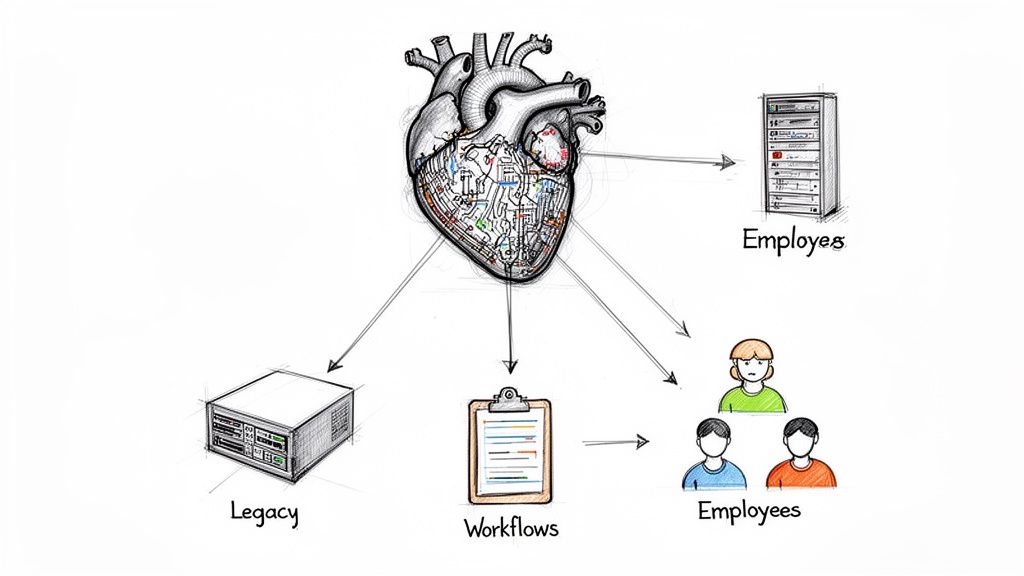
Think of it like a heart transplant. You can’t just drop a new heart into a patient and walk away. It has to be painstakingly connected to every vein and artery, and the body has to be prepped to accept it. Your new AI tool is that new heart; it needs clean connections to your tech stack, and your team needs to welcome it, not reject it.
Getting this right is a delicate dance between good code and good psychology. Mess up one, and the whole operation fails.
The Technical Tangle of Integration
For most established businesses, the biggest headache is getting shiny new AI tools to talk to their crusty old legacy systems. It’s a huge problem. In fact, 65% of professionals point to poor system integration as a major source of frustration, leading to endless double-entry and clunky workarounds. Your powerful AI model can’t do its job if it’s cut off from the data locked away in your ancient CRM or ERP.
This is exactly where AI and data consultants earn their keep—they act as the bridge between the old and the new. Their job is to map out an integration plan that doesn’t force you to rip everything out and start from scratch.
The secret is a phased approach that focuses on making things work together. This usually involves a few key moves:
Building APIs (Application Programming Interfaces): Think of these as universal translators that let your old and new systems have a conversation.
Picking Your Modernization Battles: Figure out which legacy systems are causing the most pain and create a realistic plan to update or replace them over time.
Designing for the Future: Make sure your integration plan can handle growth. The last thing you want is to be rebuilding the whole thing in a year.
The Human Side of the Equation
Now, getting the tech to work is only half the battle. Honestly, the human side is often tougher. People are naturally resistant to change, especially when they worry a new AI tool will make their job harder or, worse, obsolete. A recent study found that a staggering 58% of employees aren’t confident they can use new AI tools effectively, mostly because they’ve been thrown in the deep end with no real training.
Successful AI adoption is as much about psychology and clear communication as it is about code. If your team doesn’t understand the ‘why’ behind the change and see what’s in it for them, they will find ways to work around the new tool, rendering your investment useless.
You can get some great ideas on this from guides on implementing AI tutoring software, which really drive home the need to focus on user adoption. The whole point is to make this feel like a genuine upgrade for your team, not a top-down mandate.
A Mini-Roadmap for a Smooth Transition
Managing this change requires a real plan, not just a memo. It’s about leading a cultural shift with empathy. The best strategies are built on non-stop communication, getting people involved, and showing them the payoff.
Here’s a simple checklist to get you started:
Talk Early, Talk Often: Don’t let the rumor mill run wild. Start discussing the AI project long before it launches. Explain the problems it solves and the doors it will open.
Get People Involved: Find your champions. Ask for volunteers from different teams to test the new tools and give you honest feedback. When people feel they have a stake in the outcome, they become advocates instead of roadblocks.
Show “What’s in It for Me?”: Frame the AI as a new teammate that handles the boring, repetitive stuff. Show them how it frees them up to do more interesting, strategic work that actually uses their brain.
Train for the Real World: Generic, one-size-fits-all training is a waste of time. Run hands-on sessions that are tailored to how each specific team will use the AI in their day-to-day workflow.
Celebrate the Small Wins: When a team uses the new AI to hit a goal or fix a nagging problem, shout it from the rooftops! Success stories are contagious and build the momentum you need for everyone else to get on board.
How to Measure Real AI ROI
So, how do you actually prove your shiny new AI tool is worth the investment? This is a massive hurdle. If you can’t show the C-suite a real return, you can bet that your budget will be the first on the chopping block next quarter.
Let’s be honest, without clear metrics, you’re just throwing expensive tech at a wall and hoping something sticks.
Think of it like planting a forest. You don’t get a shady canopy overnight. Sure, some benefits pop up right away—like saving money by automating a few mind-numbing tasks. But the big, game-changing wins, like gaining a strategic edge from predictive customer insights, take time to mature. The trick is knowing what to measure and when.
Too many AI projects get shot down before they even start because the business case is full of fluffy promises about “transformation” instead of cold, hard numbers. Your CFO doesn’t care about buzzwords; they care about the bottom line.
Defining Your KPIs Before You Start
The single biggest mistake I see teams make is waiting until after they’ve launched to figure out how they’ll measure success. You absolutely have to define your Key Performance Indicators (KPIs) before anyone writes a single line of code. If you don’t have a target, how will you ever know if you hit it?
And these can’t be generic metrics. They need to be tied directly to tangible business outcomes.
For instance, take an AI project meant to fix a call center’s performance. One company, Auto Approve, was bleeding business, with an 80% churn rate on loan applications simply because of missed calls. They got smart and defined success upfront: improve response time and boost lead conversion. After rolling out their AI solution, they tracked a 25% drop in missed calls and a 20% rise in loan completions. Now that’s a story you can take to the board.
Vague goals lead to vague results. If you can’t put a number on it—like “cut customer churn by 15%” or “improve lead qualification accuracy by 30%”—then your AI project doesn’t have a real purpose.
Balancing Direct and Indirect Metrics
A solid ROI calculation looks at more than just the immediate cash flow. You need to build a balanced scorecard that captures both the hard numbers and the softer, more strategic benefits that create long-term competitive advantage.
Direct Financial Metrics (The “Quick Wins”):
Cost Reduction: How much money are you saving? Think automating repetitive work, cutting down on manual errors, or making better use of your resources.
Revenue Growth: Is the AI directly making you more money? This could be through smarter lead scoring, personalized product recommendations, or even finding new markets you hadn’t seen before.
Productivity Gains: Is your team getting more done in less time? Measure things like output per employee or how long it takes to complete a key process from start to finish.
Indirect Strategic Metrics (The “Long Game”):
Improved Customer Satisfaction (CSAT): Are your CSAT or Net Promoter Scores (NPS) going up? This often happens when service gets faster and more accurate thanks to AI.
Faster Decision-Making: Is your leadership team making smarter, quicker calls because they have AI-driven insights at their fingertips?
Employee Experience: Has automating the boring stuff freed up your people to do more creative, high-impact work? Happier employees tend to stick around longer, which is a huge win in itself.
By tracking both types of metrics, you tell the whole story. The direct wins justify the initial cost, while the strategic gains show how AI is building a stronger, more competitive business for the future. This is how you manage expectations and prove that while some returns are immediate, the real payoff is still on the horizon.
Your Strategic Roadmap to AI Success
Feeling a bit overwhelmed by all the potential AI implementation challenges? Let’s cut through the noise and get practical. This section pulls everything together into a straightforward, actionable roadmap to guide you and your teams through the entire AI journey.
Think of this as a flexible framework, not a rigid, one-size-fits-all plan. You can—and should—tweak it to fit your company’s specific needs, resources, and ambitions. By breaking the process into manageable phases, you can turn what feels like a mountain of challenges into a series of achievable steps.
Phase 1: Discovery and Strategy
This is where it all begins—your foundation. The goal here is to connect the dots between what AI can do and what your business needs it to do. Forget chasing the latest shiny tech; focus on identifying high-impact use cases that will deliver real, measurable value.
Trust me, rushing this step is a recipe for a project that looks impressive on a slide deck but accomplishes nothing in the real world.
Your checklist for this phase should look something like this:
Find the Business Pain: Where are the biggest bottlenecks, inefficiencies, or missed opportunities in your day-to-day operations?
Brainstorm AI Solutions: How could things like automation or predictive analytics directly solve those specific pain points?
Run a Feasibility Check: For your top 2-3 ideas, honestly assess your data availability, technical needs, and the potential ROI.
Get Executive Buy-In: Build a clear, compelling business case for a single, focused pilot project.
Phase 2: Pilot and Proof-of-Concept
With a clear target in mind, it’s time to start small and prove the concept. A pilot project is the perfect low-risk way to test your hypothesis, gather real-world data, and demonstrate value without committing to a massive, company-wide overhaul. This is where you work out all the kinks.
A pilot isn’t supposed to be perfect; its job is to help you learn. A successful proof-of-concept shows the idea works and gives you the data and momentum you need to justify a bigger investment.
Key actions for the pilot phase include:
Define What a “Win” Looks Like: Set clear, measurable KPIs before you write a single line of code.
Assemble a Cross-Functional Crew: Pull together a small team of key people from the business side, IT, and the department that will actually use the tool.
Build a Minimum Viable Product (MVP): Create the simplest possible version of the AI tool needed to test your core assumption.
Measure and Analyze: Track your KPIs like a hawk and collect honest feedback from everyone involved.
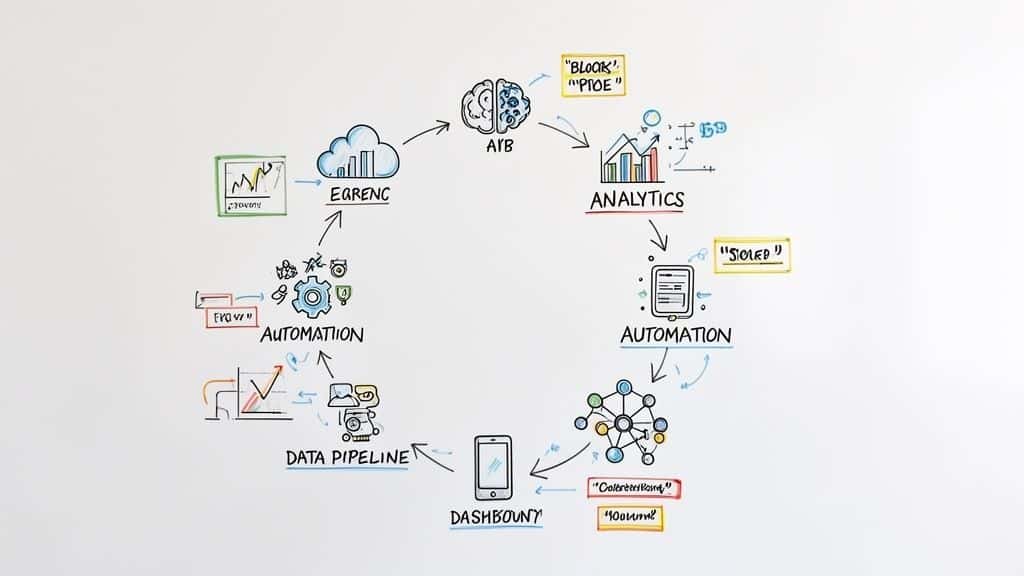
This flowchart breaks down the essential steps for measuring the impact of your AI initiatives, covering everything from operational KPIs to financial returns and strategic gains.
It’s a great reminder that a truly successful AI project delivers value across the board—from making daily workflows smoother to helping achieve long-term business goals.
A Phased AI Implementation Roadmap
To help you visualize the journey, here’s a simple checklist breaking down the key actions for both executives and technical teams at each stage. This ensures everyone is aligned and knows their role from the start.
Phase
Key Actions for Executives
Key Actions for Technical Teams
1. Discovery & Strategy
Champion the initiative, secure budget for a pilot, and define the business problem.
Identify data sources, assess data quality, and evaluate potential tech stacks.
2. Pilot & PoC
Set clear success metrics (KPIs), protect the team from distractions, and manage stakeholder expectations.
Build and train the MVP model, set up a testing environment, and collect performance data.
3. Scaling & Integration
Approve the scaled-up budget, lead change management efforts, and communicate the wider vision.
Plan for infrastructure needs, integrate the model with existing systems, and document everything.
4. Optimization & Governance
Establish an AI governance committee, monitor long-term ROI, and identify the next big opportunity.
Implement model monitoring tools, create a retraining schedule, and ensure ongoing compliance.
Think of this table as your shared playbook. When leadership and tech are on the same page, you sidestep a ton of the common roadblocks that derail AI projects.
Phase 3: Scaling and Integration
Once your pilot has proven its worth, you can finally hit the accelerator with confidence. This phase is all about rolling out the successful solution into your core business workflows and plugging it into your existing technology stack.
For a deeper dive into the technical nuts and bolts, our guide on the best practices for successful machine learning model deployment is a must-read to ensure a smooth transition from pilot to production.
Phase 4: Optimization and Governance
Here’s a secret: your AI journey doesn’t end at launch. The final phase is a continuous cycle of monitoring, refining, and governing your AI systems.
This means keeping models sharp to prevent performance drift, staying on top of compliance and regulations, and always looking for new ways to improve. This proactive mindset is what ensures your AI solutions deliver value for years to come, not just for a single quarter.
Got Questions? We’ve Got Answers.
When you start digging into AI, a lot of questions pop up. It’s totally normal. Leaders and their tech teams often get stuck on the same handful of practical hurdles. Let’s clear the air on some of the most common ones we hear from folks who are just getting started.
Where on Earth Do We Start? How Do We Pick the Right AI Project?
The sweet spot is where a real business need meets what’s actually possible. It’s tempting to go after some huge, flashy “moonshot” project, but that’s usually a mistake right out of the gate.
Instead, find a nagging, persistent problem that your team complains about all the time. Is it something you have the data and resources to tackle? A fantastic first project is often something that automates a mind-numbingly repetitive task or gives you a predictive edge on a core metric. Think about a focused “quick win” that can show real value in a few weeks, not a few years. That’s how you build momentum.
Should We Buy an Off-the-Shelf Tool or Build Our Own AI?
This really comes down to one thing: how unique is your problem?
Buy it: If you’re dealing with a common business issue—like needing a customer service chatbot or doing standard financial forecasts—an off-the-shelf tool is your best friend. They’re way faster to get up and running and won’t break the bank, as long as your needs fit inside their box.
Build it: If your secret sauce is a one-of-a-kind process or you’re sitting on a goldmine of proprietary data, you’ll need a custom solution. When a pre-built tool just can’t handle the weird quirks of your business, it’s time to partner with an AI and data consulting firm to build something that fits you perfectly.
What Are the “Gotcha” Costs People Forget to Budget For?
That initial software license or development contract? That’s just the down payment. The real costs, the ones that sneak up on you, are wrapped up in all the work around the technology.
The biggest hidden cost in any AI project is almost always people. You have to account for the massive amount of time your best people will spend cleaning up data. Then there’s the ongoing investment in training and change management to make sure your team actually uses the new tool.
When you’re building your budget, don’t forget these big ones:
Data Janitor Duty: Cleaning, labeling, and whipping your data into shape can eat up a shocking amount of time and money.
Model Upkeep: AI models aren’t “set it and forget it.” They get stale and need constant monitoring and retraining to stay sharp.
Plugging It In: The cost of actually connecting the AI to your existing tech stack and beefing up your infrastructure can be a hefty line item.
Ready to stop wrestling with these AI implementation challenges and start seeing real results? NILG.AI is all about building clear, strategic roadmaps and custom AI solutions that actually move the needle. Request a proposal
Like this story?
Subscribe to Our Newsletter
Special offers, latest news and quality content in your inbox.
Signup single post
Recommended Articles
Article
Digital business transformation examples: 10 Real-World Case Studies
Feb 10, 2026 in
Listicle: Examples
Discover digital business transformation examples and how AI, data, and strategy fuel growth with practical, actionable insights.
Master customer retention rate calculation with this practical guide. Learn the formulas, see real-world examples, and get actionable tips for business growth.
We use cookies on our website to give you the most relevant experience by remembering your preferences and repeat visits. By clicking “Accept All”, you consent to the use of ALL the cookies. However, you may visit "Cookie Settings" to provide a controlled consent.
This website uses cookies to improve your experience while you navigate through the website. Out of these, the cookies that are categorized as necessary are stored on your browser as they are essential for the working of basic functionalities of the website. We also use third-party cookies that help us analyze and understand how you use this website. These cookies will be stored in your browser only with your consent. You also have the option to opt-out of these cookies. But opting out of some of these cookies may affect your browsing experience.
Necessary cookies are absolutely essential for the website to function properly. These cookies ensure basic functionalities and security features of the website, anonymously.
Cookie
Duration
Description
cookielawinfo-checkbox-analytics
11 months
This cookie is set by GDPR Cookie Consent plugin. The cookie is used to store the user consent for the cookies in the category "Analytics".
cookielawinfo-checkbox-functional
11 months
The cookie is set by GDPR cookie consent to record the user consent for the cookies in the category "Functional".
cookielawinfo-checkbox-necessary
11 months
This cookie is set by GDPR Cookie Consent plugin. The cookies is used to store the user consent for the cookies in the category "Necessary".
cookielawinfo-checkbox-others
11 months
This cookie is set by GDPR Cookie Consent plugin. The cookie is used to store the user consent for the cookies in the category "Other.
cookielawinfo-checkbox-performance
11 months
This cookie is set by GDPR Cookie Consent plugin. The cookie is used to store the user consent for the cookies in the category "Performance".
viewed_cookie_policy
11 months
The cookie is set by the GDPR Cookie Consent plugin and is used to store whether or not user has consented to the use of cookies. It does not store any personal data.
Functional cookies help to perform certain functionalities like sharing the content of the website on social media platforms, collect feedbacks, and other third-party features.
Performance cookies are used to understand and analyze the key performance indexes of the website which helps in delivering a better user experience for the visitors.
Analytical cookies are used to understand how visitors interact with the website. These cookies help provide information on metrics the number of visitors, bounce rate, traffic source, etc.
Advertisement cookies are used to provide visitors with relevant ads and marketing campaigns. These cookies track visitors across websites and collect information to provide customized ads.