AI Automations • AI Strategy • AI4business • AI4tech •
Decoding Custom Software Development Costs: A Practical Guide
NILG.AI on Dec 15, 2025
?>
The honest truth? Real custom software development costs can land anywhere from $50,000 for a straightforward app to well over $500,000 for a complex system designed to run an entire enterprise.
That’s a huge range, I know. But once you understand what drives those numbers, the conversation shifts from “how much does it cost?” to “what kind of strategic asset are we building?”
Why Custom Software Is Your New Competitive Edge
Let’s get straight to the point. Custom software isn’t just another line item in your IT budget; it’s a serious competitive weapon.
Think of off-the-shelf software like a rental suit. Sure, it gets the job done for a formal event, but it never really fits. It’s a little tight in the shoulders, a bit long in the sleeves. Custom software, on the other hand, is the bespoke, perfectly tailored suit—it’s designed to fit your business processes, your team’s workflow, and your specific goals like a glove.
This isn’t about just getting a new tool. It’s about creating a solution that works for you, instead of forcing your team to contort their processes around a tool’s built-in limitations. When you build from the ground up, you can solve those nagging operational headaches, unlock new efficiencies, and even carve out revenue streams that generic software could never support.
From Operational Bottleneck to Strategic Asset
So many businesses are running on a messy patchwork of off-the-shelf apps that don’t talk to each other. The result? A whole lot of manual data entry, clunky workflows, and a foggy, incomplete picture of what’s actually happening in the business.
Custom software is designed to tear down those silos.
Instead of shelling out cash for annual licenses packed with features you’ll never touch, you’re investing in the exact functionality your business needs to thrive. This pivot in thinking pays off in a few huge ways:
Solve Your Actual Problems: You get to zero in on the unique pain points holding you back, whether that’s automating a soul-crushing manual report or building a single, unified view of your customer data.
Scale on Your Own Terms: A custom app grows as you do. When your business needs change, your software can be adapted and expanded without waiting on a third-party vendor’s rigid product roadmap.
You Own It. Period: The intellectual property is yours. That means you have total control over its future, its security, and how it connects with other systems, ensuring it always aligns with where your company is headed.
Embracing the Future with Custom AI
Businesses are catching on. The demand for solutions that provide a real leg up on the competition is skyrocketing. The global custom software development market was valued at USD 35.42 billion in 2023 and is expected to explode to USD 146.18 billion by 2030. That’s not just growth; it’s a fundamental shift in how businesses approach technology. You can dig into the full report from Grand View Research to see the trend lines for yourself.
And now, artificial intelligence is taking that advantage to a whole new level.
By partnering with a specialized AI and data consulting firm, you can embed intelligence right into your core operations. This is about more than simple automation; it’s about building systems that deliver predictive analytics, enable smarter decision-making, and create deeply personalized customer experiences.
Custom software with AI isn’t just about doing things faster; it’s about doing things smarter. It turns your data from a static record of the past into a predictive asset that fuels real growth.
Getting a handle on the costs is simply the first step. It reframes the entire discussion, moving it away from a simple expense and toward the deliberate construction of a core asset for your company’s future. To get a better sense of the bigger picture, take a look at our guide on building a successful digital transformation roadmap.
The Core Factors That Drive Your Software Costs
Figuring out the cost of custom software is a lot like pricing a custom-built house. You can’t just pull a number out of thin air. The final price tag is a sum of its parts: the size of the house (your project’s scope), the complexity of the architecture (how intricate the features are), the materials you use (the tech stack), and the crew you hire (your development team).
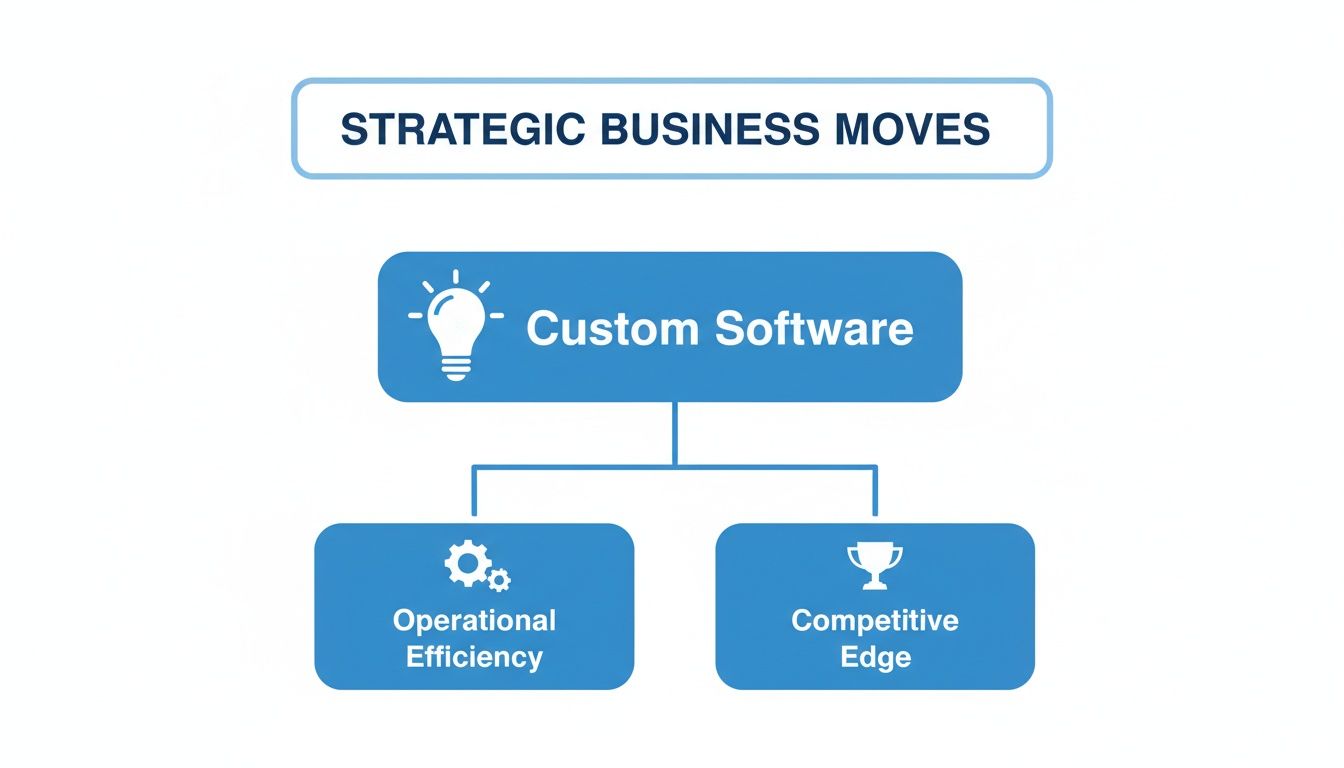
Thinking about your software project in these terms takes the mystery out of the cost. It helps you have much smarter conversations with potential development partners because you’ll know exactly which levers to pull to manage your budget. As you can see, this isn’t just about code; it’s a strategic move to make your business more efficient and competitive.
Ultimately, building custom software is a direct path to hitting your biggest business goals. So, let’s get into the nitty-gritty of what actually shapes your project’s budget.
Project Scope: The Blueprint Of Your Build
Your project scope is easily the biggest factor driving the cost. It’s the “what” of your project—the total amount of work that needs to get done. Are you building a simple marketing website or a full-blown e-commerce platform with an AI recommendation engine? The difference in scope is huge, and so is the price.
A bigger scope simply means more features, more screens, and more user journeys to design, build, and test.
Small Scope Example: A basic five-page website with a contact form and a simple way to update content.
Large Scope Example: A marketplace connecting buyers and sellers, complete with user profiles, private messaging, payment processing, and a back-end dashboard for you to manage everything.
Nailing down your scope right from the start is the single best thing you can do to avoid nasty budget surprises down the road. It’s the blueprint for everything that follows.
Complexity: The Intricacy Of The Work
If scope is the “what,” complexity is the “how.” This is all about the technical difficulty of bringing your features to life. It’s why two projects that look similar on the surface can have wildly different price tags.
Take a simple user login. An email and password form is pretty straightforward. But what if you want to add two-factor authentication, social sign-ins with Google or LinkedIn, and single sign-on (SSO) for corporate clients? That one feature just got a whole lot more complex—and expensive.
Complexity is the hidden variable that can quickly inflate custom software development costs. It’s not just about the number of features, but the depth of engineering required to make them work seamlessly and securely.
Here are a few other things that ramp up the complexity:
Third-Party Integrations: Does your new software need to talk to other systems you already use, like Salesforce, Stripe, or HubSpot?
Custom Algorithms: Are you building something proprietary, like a unique pricing engine or a predictive analytics model?
Data Migration: Do you need to move a ton of sensitive data from an old, clunky system into your new one?
Managing these moving parts is critical. If you’re wading into a technically deep project, understanding the principles behind good https://nilg.ai/202507/data-science-project-management/ can give you a solid framework for keeping things on track.
Technology Stack: The Tools For The Job
The “tech stack” is just the collection of programming languages, frameworks, and tools your team uses to build the software. Think of them as the building materials for your house. Using common, well-supported materials like Python or JavaScript is usually cheaper than going with something niche or old-school that requires finding—and paying for—highly specialized developers.
For mobile apps, for instance, your choice of framework has a big impact. Digging into understanding React Native app development costs can shed more light on these kinds of budget decisions. The tech you choose doesn’t just affect the initial build; it also impacts how easy (and expensive) it will be to maintain and scale your software in the future. You’re not just building for today, you’re building for tomorrow.
Ballpark Estimates for Your Software Project
Alright, let’s talk numbers. This is usually the first question on everyone’s mind, and while every project is different, we can look at some real-world ranges to get you in the right ballpark.
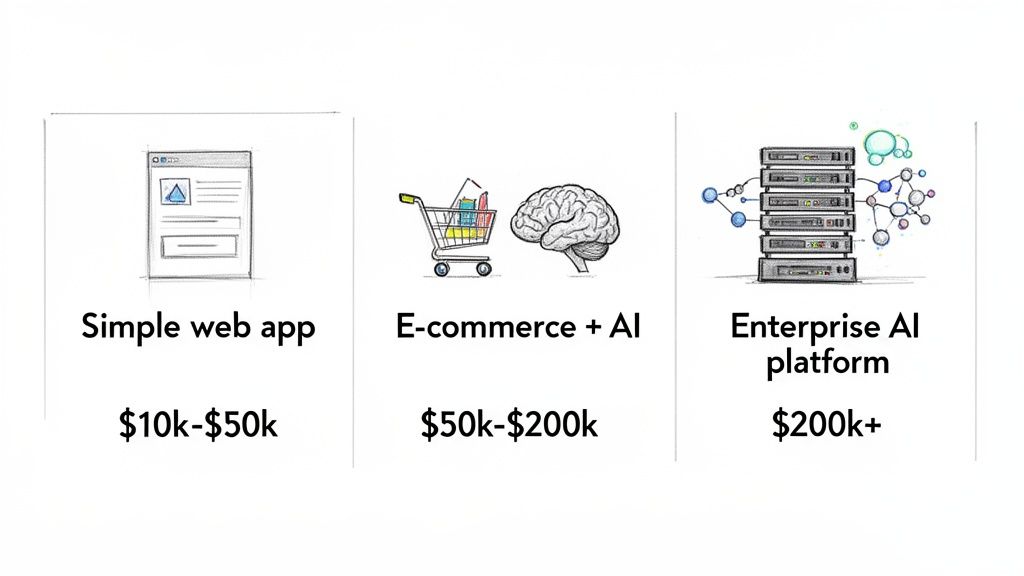
Think of these as starting points, not final quotes. The real custom software development costs will always tie back to the big drivers we’ve discussed: your project’s scope, its complexity, the team you hire, and the technology you choose. A straightforward app with a few core features is going to be in a completely different league than a massive, multi-platform system with custom AI.
To give you a clearer picture, I’ve broken down typical costs by project type. This table should help connect the dots between what you want to build and what you can expect to invest.
Estimated Custom Software Development Costs by Project Type
Project Type
Typical Complexity
Estimated Cost Range (USD)
Key Features & Considerations
Simple Web App or MVP
Low
$50,000 – $100,000
User login, basic dashboard, content pages. Goal is to test an idea or establish an online presence quickly. Minimal integrations.
Custom Business Platform
Medium
$100,000 – $250,000
Custom business logic, API integrations (CRM, ERP), multiple user roles, advanced UI/UX. Solves a specific operational problem.
AI-Powered E-commerce
Medium-High
$150,000 – $300,000
Product catalogs, payment gateways, plus AI for personalized recommendations, chatbots, or dynamic pricing.
Enterprise-Grade System
High
$250,000 – $500,000+
Complex workflows, heavy integrations, robust security, advanced analytics, and custom machine learning models. A core strategic asset.
These figures give you a frame of reference, but the story behind the numbers is what truly matters. Let’s dive a bit deeper into what you get at each level.
Simple Web Applications and Prototypes
On the entry-level end, you have things like simple customer portals, internal tools, or a Minimum Viable Product (MVP) built to prove a concept. These projects are lean and focused, with a limited feature set and a clean, standard design.
You’re typically looking at features like: User registration, basic dashboards, content management, and contact forms.
The main goal here is speed: Get a digital presence up or validate your business idea without breaking the bank.
Estimated Cost Range:$50,000 – $100,000
Think of this as building a solid foundation. You’re not constructing a skyscraper on day one. Instead, you’re building a functional, well-built structure that you can easily add to later. It’s the perfect play for getting to market fast and gathering real user feedback before you go all-in.
Mid-Complexity Platforms with Custom Features
Moving up a notch, we get into more sophisticated platforms. These require custom business logic, need to talk to other systems you already use (like a CRM or ERP), and have more advanced features baked in. This could be a custom e-commerce site with a slick recommendation engine or a SaaS product with different access levels for different users.
These projects naturally need a bigger team and more time to tackle the complexity. They’re built to solve tougher business problems and often become a central part of a company’s daily operations.
Custom software development costs vary dramatically by project complexity. Simple apps might start around $20,000-$50,000, while medium-scale solutions often fall into the $50,000-$200,000 range, and enterprise platforms can easily exceed $400,000. You can explore more detailed pricing breakdowns in this expert software cost analysis.
Large-Scale Enterprise Systems with AI Integration
At the top of the pyramid are the heavy-hitters: enterprise-grade platforms designed for complex, high-stakes operations. These projects are defined by intricate architecture, Fort Knox-level security, tons of integrations, and often, custom-built AI and machine learning models.
This is where you see features like: Predictive analytics, process automation, advanced data visualization, natural language processing, and deep integrations across multiple systems.
The goal is ambitious: Create a serious competitive advantage through automation and deep operational intelligence.
Estimated Cost Range:$250,000 – $500,000+
For a project like this, you’re not just hiring developers; you’re partnering with a specialized AI and data consulting business. The investment is significant, but the potential payoff in efficiency, smarter decisions, and market leadership is even bigger. These aren’t just tools—they’re powerful engines for growth.
Choosing The Right Pricing Model For Your Project
Figuring out how you’ll pay for your project is just as important as the final price tag. The pricing model you choose isn’t just a line item in a contract; it shapes the entire relationship with your development partner, sets expectations, and can either align everyone toward a common goal or create friction.
Picking the wrong model is a recipe for disaster, often leading to blown budgets, missed deadlines, and a whole lot of frustration.
In the world of software development, you’ll mainly run into two options: Fixed Price and Time & Materials (T&M).
Think of it like a home renovation. A Fixed Price contract is like getting a single, all-in quote to remodel a standard bathroom. The scope is locked in—this tub, that tile, those fixtures—and you know the exact cost upfront. On the other hand, T&M is like building a custom kitchen. You pay your contractor by the hour and for the materials they use, giving you the freedom to pick out different countertops on the fly or decide to add a fancy new island halfway through.
Neither one is universally “better.” The right choice really hinges on how well-defined your project is, how complex it is, and frankly, how much uncertainty you’re comfortable with.
The Fixed Price Model Explained
A Fixed Price contract is as straightforward as it gets. You and your development partner agree on a detailed scope of work for one, single, unchanging price. This model lives and dies by the quality of the upfront planning. Every single feature, screen, and user interaction has to be documented in painstaking detail before a single line of code gets written.
The big draw here is predictability. You know exactly what you’ll spend before the project even starts, which is a huge plus for finance departments and stakeholders who need hard numbers.
But that rigidity is a double-edged sword. What if you’re halfway through development and have a breakthrough idea? Or what if early user feedback tells you to pivot? With a Fixed Price deal, any change, no matter how tiny, kicks off a formal change request. That usually means going back to the table to renegotiate the price and timeline, which can bog the whole project down.
Best For: Smaller, well-understood projects where the requirements are set in stone. Think a simple marketing website or a basic internal tool.
Risks: You might end up with a product that perfectly matches the original spec but completely misses what users actually need. It can also create a “check-the-box” mentality, where the focus is on fulfilling the contract instead of building the best possible product.
The Time and Materials Model Advantage
With a Time & Materials (T&M) model, you pay for the actual work done. You agree on an hourly or daily rate for the developers’ time, and you’re billed for the hours they put in, plus the cost of any resources used. This approach is all about flexibility, which is an absolute necessity for complex or innovative projects where things are guaranteed to change.
This is how most modern software gets built, especially when you’re dealing with anything involving AI or machine learning. These projects are all about discovery and experimentation. You rarely know the exact final solution when you begin; you start with a hypothesis and need the freedom to test, learn, and iterate.
T&M naturally gets everyone on the same side of the table, working toward a shared goal: creating the most valuable product possible. It encourages a true partnership focused on adapting and improving, which is the secret sauce for building software that actually wins in the market.
This model lets you pivot based on real feedback, explore new ideas, and tweak priorities without the bureaucratic nightmare of renegotiating a contract. You’re always in the driver’s seat, steering the project toward what delivers the most value.
While some might worry that the custom software development costs are less predictable, T&M often delivers a much higher return on investment because you build what the market actually wants, not just what you thought it wanted six months ago.
Smart Ways to Keep Your Development Budget in Check
Knowing what drives custom software development costs is half the battle. The other half? Actually controlling them. Managing your budget isn’t about nickel-and-diming your developers or hunting for the absolute cheapest quote. It’s about making smart, strategic calls that get you the biggest bang for your buck and ensure every dollar pushes you closer to your business goals.
This is your chance to be an active partner in the project, not just a client cutting a check. With the right game plan, you can build a fantastic product without your budget spiraling out of control. It all starts with a clear focus on what truly matters.
Launch Lean with a Minimum Viable Product
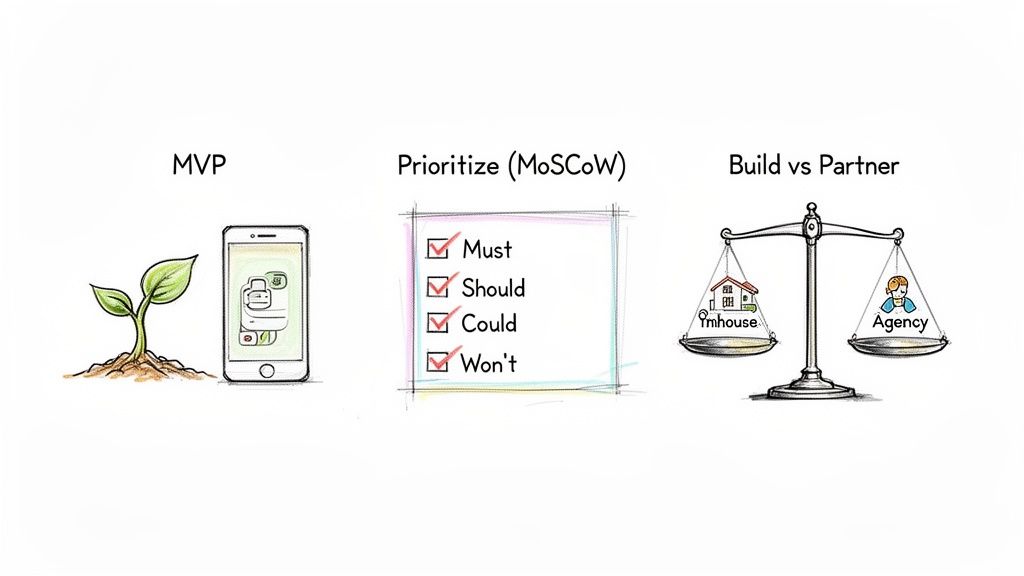
One of the single most effective ways to manage costs is by launching a Minimum Viable Product (MVP) first. Think of it as the most basic, bare-bones version of your software that solves one core problem for your ideal customer. It’s not a buggy prototype; it’s a focused, working product with just enough features to be genuinely useful.
Starting with an MVP gives you some serious financial advantages:
Lower Upfront Cost: You’re not paying to build every bell and whistle. You focus only on the absolute must-haves, saving the “nice-to-have” features for later.
Get to Market Faster: A smaller scope means a faster build. This lets you start bringing in revenue or, just as importantly, gathering real feedback from actual users much sooner.
Test the Waters: An MVP is the ultimate reality check. It proves if there’s a real market for your idea before you pour hundreds of thousands of dollars into a massive platform built on assumptions.
This approach takes a lot of the risk out of the equation. You’re building your roadmap based on what people actually do, not what you think they want.
Prioritize Ruthlessly to Avoid Scope Creep
Scope creep is the silent killer of budgets. It’s that slow, sneaky process where one “small” feature request after another gets added, bloating your timeline and your invoice. The best defense is a good offense: a rock-solid plan for prioritizing features right from the start.
A fantastic and simple framework for this is MoSCoW, which sorts every potential feature into four categories:
Must-have: Non-negotiable. The software is useless without these.
Should-have: Important features that add a ton of value, but the app could technically launch without them.
Could-have: Desirable, but not that important. These are the first to go if time or money gets tight.
Won’t-have (this time): Features that are officially off the table for this version of the product.
This simple exercise forces everyone to have honest, and sometimes tough, conversations. It gets all the stakeholders and the dev team on the same page about what really matters, giving you a clear path forward and preventing every new idea from derailing the project.
Make the Smart “Build vs. Partner” Decision
Finally, you have to answer the biggest cost question of all: who is actually going to build this thing? For most companies, it boils down to hiring an in-house team or partnering with a specialized AI and data consulting firm. While having your own team gives you total control, the costs can be astronomical.
Just think about it. Recruiting, salaries, benefits, and overhead for a full-time team of top-tier developers and data scientists can easily climb into the high six figures every single year. Partnering with an outside firm, on the other hand, gives you access to a bench of seasoned experts without that long-term financial burden. If you’re wrestling with this choice, our guide on hiring data teams can offer some clarity.
This strategic partnership provides access to specialized expertise precisely when you need it, allowing your internal teams to stay focused on core business functions. It’s not just about cost savings; it’s about leveraging external talent as a flexible, high-impact extension of your own capabilities to accelerate your AI projects.
Answering Your Lingering Questions About Software Costs
Okay, so we’ve broken down what goes into the cost of custom software. But I’m willing to bet you still have a few nagging questions buzzing around. Let’s tackle them head-on.
Think of this as the FAQ section you actually want to read—straight talk for business leaders trying to make a smart investment.
How Much Should I Actually Budget for Maintenance?
Once your software is launched, you’re not done spending. A safe bet is to earmark 15-20% of the initial development cost for annual maintenance. And no, that’s not just a “break-glass-in-case-of-emergency” fund. It’s the budget that keeps your new digital asset healthy and valuable.
What does that money actually pay for?
Fixing What Breaks: Inevitably, bugs will pop up. This covers squashing them and patching security holes before they become a problem.
Keeping the Lights On: Think server fees, hosting costs, and all the background infrastructure that makes the application run.
Staying Current: This covers small but critical updates, like making sure your software doesn’t break when a new iOS version is released or a third-party API changes.
Heads up: if your project involves complex systems like AI, that percentage might creep up. AI models sometimes need retraining, and data pipelines need tending to, which adds to the upkeep.
Is It Way More Expensive to Add AI and Machine Learning?
In short, yes. Bringing AI and machine learning into the mix definitely bumps up the price tag, both upfront and over time. The main reason is talent. You need specialized—and expensive—experts like data scientists and ML engineers. Plus, the whole process of gathering, cleaning, and labeling data to train a model is a heavy lift.
But here’s the flip side: the ROI can be massive. AI can automate tedious work, saving you a fortune in operational costs. It can predict what your customers want next, opening up entirely new ways to make money. The trick is working with an AI and data consulting business that knows how to connect the tech investment to real, measurable business goals.
What’s the #1 Reason Projects Go Over Budget?
One culprit stands above all others: scope creep. It’s the slow, insidious process where a project’s requirements just keep growing after development has already started. A stakeholder has a “great idea” here, a “small tweak” there, and before you know it, you’ve blown your budget and timeline.
The absolute best defense against scope creep is a rock-solid discovery phase. You need to map out your project and get ruthless about your feature list before a single line of code gets written. It’s the most important step for keeping your software development costs under control.
This is why starting with a focused MVP (Minimum Viable Product) is so effective. It forces you to decide what’s truly essential, building a strong foundation instead of an endless wish list.
How Do I Get a Cost Estimate I Can Actually Trust?
If you want a precise quote, you need to give your potential dev partner a detailed brief. The more you tell them, the less they have to guess, and the more accurate your estimate will be.
Make sure your brief covers these bases:
Your “Why”: What specific business problem is this software solving? What does a “win” look like?
Your Users: Who is this for? What do they need?
The “Must-Haves”: What are the absolute core features needed for launch?
The Connections: Does this need to plug into any of your existing systems?
Your Inspiration: Point to a few apps or platforms you like. What do you admire about them?
Pro-tip: A discovery workshop is the perfect setting to hash this all out with a potential partner. It gets everyone on the same page from the get-go, which is exactly where you want to be.
Ready to turn your vision into a strategic asset? At NILG.AI, we specialize in building custom AI-powered software that solves real business problems and drives growth. Request a proposal
Like this story?
Subscribe to Our Newsletter
Special offers, latest news and quality content in your inbox.
Signup single post
Recommended Articles
Article
Transform Your Growth with custom ai software development in 2026
Apr 1, 2026 in
Guide: Explainer
Explore how custom ai software development can boost efficiency, cut costs, and deliver measurable value - find trusted partners and practical steps for 2026.
Discover how AI for customer service can transform your support operations. Learn practical strategies to reduce costs, improve satisfaction, and drive growth.
How Might We Statements: Turn Challenges into Opportunities
Mar 15, 2026 in
Guide: Explainer
Discover how might we statements transform complex challenges into real opportunities. Learn practical crafting tips, workshops, and real-world examples.
We use cookies on our website to give you the most relevant experience by remembering your preferences and repeat visits. By clicking “Accept All”, you consent to the use of ALL the cookies. However, you may visit "Cookie Settings" to provide a controlled consent.
This website uses cookies to improve your experience while you navigate through the website. Out of these, the cookies that are categorized as necessary are stored on your browser as they are essential for the working of basic functionalities of the website. We also use third-party cookies that help us analyze and understand how you use this website. These cookies will be stored in your browser only with your consent. You also have the option to opt-out of these cookies. But opting out of some of these cookies may affect your browsing experience.
Necessary cookies are absolutely essential for the website to function properly. These cookies ensure basic functionalities and security features of the website, anonymously.
Cookie
Duration
Description
cookielawinfo-checkbox-analytics
11 months
This cookie is set by GDPR Cookie Consent plugin. The cookie is used to store the user consent for the cookies in the category "Analytics".
cookielawinfo-checkbox-functional
11 months
The cookie is set by GDPR cookie consent to record the user consent for the cookies in the category "Functional".
cookielawinfo-checkbox-necessary
11 months
This cookie is set by GDPR Cookie Consent plugin. The cookies is used to store the user consent for the cookies in the category "Necessary".
cookielawinfo-checkbox-others
11 months
This cookie is set by GDPR Cookie Consent plugin. The cookie is used to store the user consent for the cookies in the category "Other.
cookielawinfo-checkbox-performance
11 months
This cookie is set by GDPR Cookie Consent plugin. The cookie is used to store the user consent for the cookies in the category "Performance".
viewed_cookie_policy
11 months
The cookie is set by the GDPR Cookie Consent plugin and is used to store whether or not user has consented to the use of cookies. It does not store any personal data.
Functional cookies help to perform certain functionalities like sharing the content of the website on social media platforms, collect feedbacks, and other third-party features.
Performance cookies are used to understand and analyze the key performance indexes of the website which helps in delivering a better user experience for the visitors.
Analytical cookies are used to understand how visitors interact with the website. These cookies help provide information on metrics the number of visitors, bounce rate, traffic source, etc.
Advertisement cookies are used to provide visitors with relevant ads and marketing campaigns. These cookies track visitors across websites and collect information to provide customized ads.