AI Automations • AI Strategy • AI4business • AI4tech • Artificial Intelligence •
A Practical Guide to Resource Allocation Optimization
NILG.AI on Dec 8, 2025
?>
Picture your business as a top-tier sports team. You’ve got your star players (your A-team), a budget for gear and training (your capital), and a full season of games ahead (your market opportunities). Think of resource allocation optimization as your master playbook—the strategy that puts your best assets on the field exactly when and where you need them to score the win.
The High Cost of Not Knowing Where Your Resources Go
What happens when your star quarterback is benched during the championship, or you blow the entire equipment budget on things you don’t even use? That’s the painful reality for businesses that rely on pure guesswork to decide where their resources go.
This isn’t some minor hiccup; it’s a massive drain on your company’s potential. Projects start bleeding money, your best people burn out on tasks that don’t move the needle, and huge, game-changing opportunities pass you by completely.
Moving Beyond Guesswork and Spreadsheets
For a long time, spreadsheets and old-school manual planning were the only tools in the shed. But in today’s world, things move way too fast for that. These static methods just can’t keep up with sudden market shifts, hidden project dependencies, or what your teams can actually handle.
The result? A constant, chaotic scramble. Resources get shuffled around in a reactive, fire-fighting frenzy instead of being deployed with a clear, proactive strategy. This approach almost always leads to the same expensive problems.
Resource allocation isn’t just about pinching pennies. It’s about building a rock-solid foundation for growth and carving out a real competitive edge by getting the absolute most out of every limited resource you have.
The Real-World Consequences of Poor Allocation
When your resource planning is off, the damage starts showing up all over the business. These problems create a nasty ripple effect that can bring growth to a screeching halt and tank team morale.
Here are the most common consequences:
Project Delays and Budget Overruns: It’s a classic. Without a clear picture of who’s doing what, projects constantly blow past deadlines and budgets. This is what happens when your key people are double-booked or when critical tasks are handed off to someone who isn’t the right fit.
Employee Burnout and Turnover: Piling all the work on your top performers while others are underutilized is a fast track to frustration. Burnout crushes productivity and, sooner or later, leads to you losing your best talent.
Missed Opportunities: When all your resources are bogged down in poorly planned or low-value projects, you have zero bandwidth to jump on new, more profitable ventures. Your business gets stuck in the mud, unable to adapt or innovate.
Hidden Inefficiencies: Often, the biggest resource drains are the ones you can’t easily see. Finding them takes more than a spreadsheet. For example, specialized techniques can uncover process slowdowns, which we dive into in our guide to bottleneck analysis, showing you how to pinpoint and fix these critical chokepoints.
Ultimately, getting resource allocation optimization right is about making a fundamental shift. It’s about moving away from a reactive, “gut-feel” management style to one that’s proactive and driven by real data. It’s the art of putting your best assets—your people, your money, and your time—in the perfect position to win.
What Is Resource Allocation Optimization, Really?
Forget the dry, academic definitions for a moment. Let’s get practical.
Think about packing a backpack for a tough, multi-day hike. You have limited space and weight capacity. You can’t just toss in everything you might need. You have to be strategic. You carefully select the essentials—the lightweight tent, the water filter, the first-aid kit—that deliver the most value and give you the best chance of a successful trip.
Resource allocation optimization is that same exact thinking, but applied to your business. It’s the art and science of matching what you have (like a developer’s time, a marketing budget, or a factory machine’s uptime) to the tasks and projects that will deliver the biggest payoff.
It’s about graduating from the “who’s free right now?” method of management to a smarter system that weighs the true impact of every decision. This means no more accidentally assigning your star engineer to a low-impact bug fix just because their calendar was open. It means no more letting a million-dollar piece of equipment sit idle while a mission-critical project stalls.
The Core Goals of Smart Allocation
When you get resource allocation right, you’re not just chasing a single outcome. You’re balancing several key business objectives at once, creating a positive ripple effect that touches every corner of the organization.
The main targets you’re really aiming for are:
Maximizing Project ROI: Making sure your most valuable resources—both your people and your equipment—are always focused on the projects that will generate the most revenue or strategic value.
Improving On-Time Delivery: When you have a clear, data-driven picture of who is doing what and when they’ll be done, you can build realistic timelines and slash frustrating delays.
Balancing Team Workloads: Smart allocation is a powerful tool against burnout. It helps you distribute work more evenly, avoiding the all-too-common trap of piling everything onto a few top performers while others are left with too little to do. This is a game-changer for team morale and long-term productivity.
This shift is more critical than ever. A recent study found that a staggering 64% of organizations say improving resource allocation is a top priority. Yet, only 16% were actually planning to invest in the advanced tools needed to do it properly. You can explore the full research from Runn to see just how big that gap is. It shows that most companies know there’s a problem but are leaving a ton of value on the table by not managing their most important assets—people and time—effectively.
The central idea is simple but powerful: Make the absolute best use of your limited resources to achieve your most important goals.
From Spreadsheets to Strategy
Ultimately, this is about changing how you view resource management. It stops being a reactive, administrative chore and becomes a proactive, strategic weapon. Instead of just plugging names into a schedule, you’re actively steering the entire company toward its most important outcomes.
By adopting a more intelligent approach, you ensure every dollar spent, every hour worked, and every machine powered on is contributing as much as possible to moving the business forward. It’s how you finally stop fighting fires and start building a more resilient, efficient, and profitable operation from the ground up. And that strategic mindset is the true meaning of resource allocation optimization.
Comparing Manual Planning with AI-Powered Strategy
For years, businesses have relied on spreadsheets and basic project management tools to handle resource planning. It’s a system we all know, but it’s a bit like using a paper road map in the era of live GPS. It gives you a route, but it can’t warn you about the traffic jam just around the corner or find a faster shortcut that just opened up.
This static approach has real limitations. A spreadsheet won’t alert you that your top engineer is on the verge of burnout from being over-assigned, nor will it flag that a small delay on one project is about to cause a massive bottleneck for three others next month. You’re left finding out about problems after they’ve already hit.
That’s the fundamental difference between old-school planning and a modern, AI-driven strategy. One is a fixed picture; the other is a living, breathing system that adjusts on the fly. It’s the jump from reactive firefighting to proactive, intelligent resource allocation optimization.
To get a clearer picture, let’s look at how these two worlds operate.
Traditional vs AI-Powered Resource Allocation
The move from manual spreadsheets to AI-driven systems isn’t just an upgrade—it’s a complete shift in how businesses can plan, adapt, and grow. Traditional methods are static and reactive, while AI introduces a dynamic, predictive capability that turns resource allocation into a strategic advantage.
Feature
Traditional Methods (e.g., Spreadsheets, Manual Planning)
Poor; becomes overwhelmingly complex with more resources/projects.
Excellent; easily manages thousands of variables and constraints.
Forecasting
Reactive; based on past performance and educated guesses.
Proactive; uses predictive models to forecast future needs.
Adaptability
Rigid; difficult to adjust to unexpected events or changes.
Highly flexible; automatically reroutes and reallocates on the fly.
Optimization
Sub-optimal; often finds “good enough” solutions within human limits.
Optimal; continuously seeks the best possible outcome.
Ultimately, AI doesn’t just do the old job faster; it enables a level of strategic foresight and operational agility that manual methods simply can’t match.
Classic Optimization: The Scalpel Approach
Long before AI became a household name, businesses used mathematical techniques to crack the resource allocation puzzle. These algorithmic methods are incredibly precise and powerful for specific, well-defined problems. Think of them as a surgeon’s scalpel—perfect for making a very specific, calculated incision.
One of the most common is Linear Programming (LP). Picture a consulting firm trying to maximize billable hours with a limited pool of specialists. LP is the math that figures out the exact project assignments to generate the most revenue without overbooking anyone. It’s brilliant for finding the single best answer when your constraints are clear and don’t change.
Other methods like Integer Programming (for when you can’t assign half a consultant) and heuristics (clever shortcuts for messy problems) also offer structured ways to find good solutions. Their big weakness? They’re rigid. The real world is messy and rarely sticks to the plan, and that’s where they can fall short.
AI and Machine Learning: The Intelligent GPS
AI-powered strategies don’t just find one “best” path—they are constantly on the lookout for better ones. This modern approach uses data to learn, predict, and adapt, acting much more like a live GPS that reroutes you around that unexpected traffic.
Instead of solving a static puzzle once, AI systems are always analyzing new data to improve their suggestions. For businesses operating in complex environments where things are always changing, this dynamic capability is a total game-changer.
AI and Machine Learning shift resource allocation from a one-time calculation to a continuous, adaptive process. The system gets smarter over time, learning from past successes and failures to make better decisions for the future.
Predictive Analytics: Forecasting What’s Next
One of the most powerful tools in the AI arsenal is predictive analytics. By digging into historical project data—timelines, team performance, budget burn rates—machine learning models can forecast future resource needs with surprising accuracy.
For instance, an AI model might notice that projects of a certain type consistently need 20% more developer time in the final phase than originally planned. With that insight, you can proactively allocate those extra hours from the start, avoiding the last-minute scramble and budget blowouts. This is especially vital for complex operations, which you can see in action by learning more about the role of AI in supply chain management.
Reinforcement Learning: The Self-Improving Strategist
Taking things a step further, reinforcement learning (RL) enables a system to learn by trial and error, just like a person picking up a new skill. An RL agent can run thousands of different resource allocation simulations to figure out which strategies deliver the best results over the long run.
It might discover, for example, that pairing a senior designer with a junior developer on a specific project type consistently leads to faster completion and better outcomes. Over time, the system refines its own rules of thumb, constantly improving its knack for making optimal assignments without a human needing to step in. This evolution from static planning to a dynamic, forward-looking strategy is how modern AI- and data-consulting businesses help clients build a real competitive edge.
Your Roadmap to an Intelligent Allocation Strategy
Jumping into an AI-powered resource strategy isn’t a quick fix; it’s a journey. You’re essentially building a system that gets smarter over time, learning from your operations and turning your data into your most powerful asset. Let’s walk through the practical steps for any leader looking to shift from reactive planning to truly intelligent resource allocation optimization.
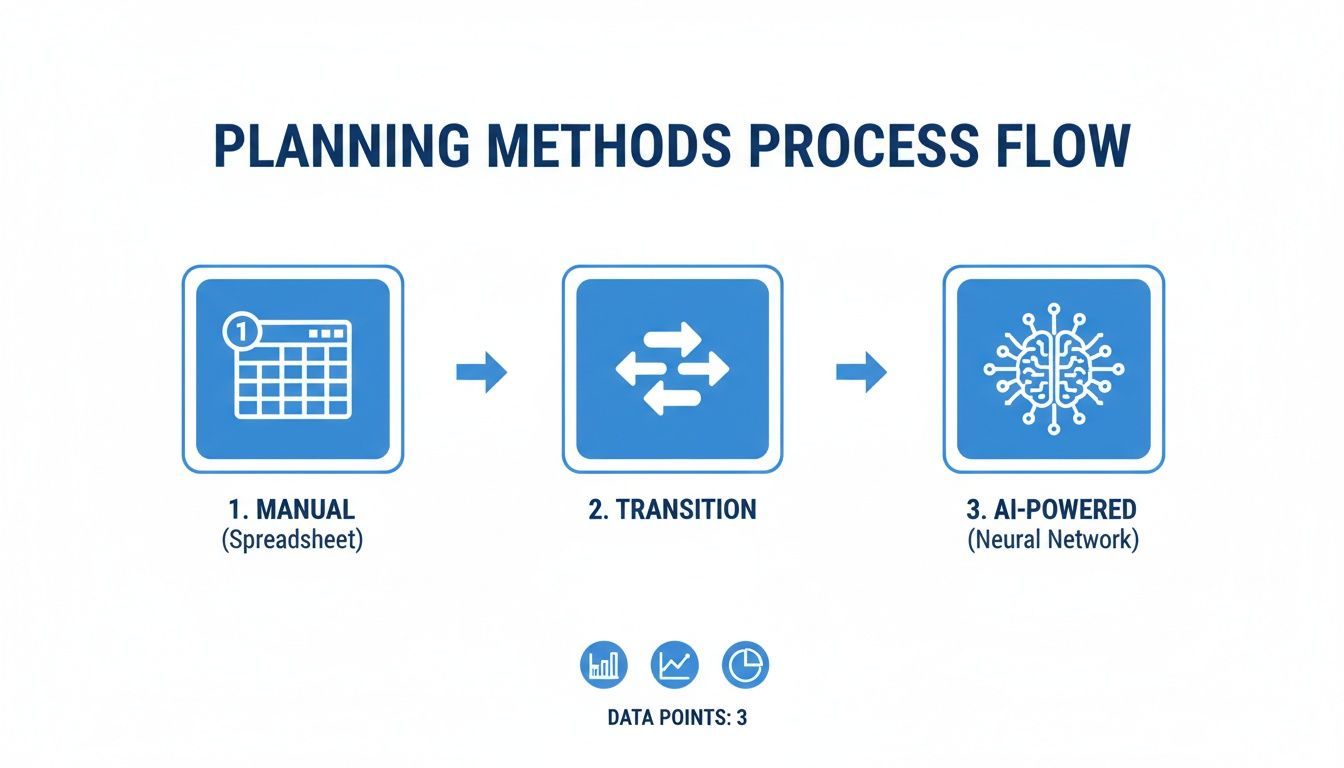
This whole process is an evolution. You start with manual spreadsheets and gradually move toward a fully integrated, AI-powered system that does the heavy lifting for you.
The big idea here is that this is a phased transition. You’re moving away from static, manual inputs and toward a dynamic, intelligent system that can eventually make decisions on its own.
Building a Solid Data Foundation
Everything, and I mean everything, starts with good, clean data. An AI system is only as smart as the information you feed it, so this step is completely non-negotiable. Think of it like cooking: if you start with low-quality ingredients, you can’t expect a gourmet meal.
You’ll need to pull key information together in a structured way. This usually includes:
Project Histories: Detailed records of past projects—what went right, what went wrong, timelines, and budget performance.
Employee Skills and Availability: A real-world inventory of who can do what, their certifications, and their actual capacity.
Budget and Financial Data: Clean records of project costs and resource expenses so you can actually measure ROI later.
This initial data audit is critical. It’s where you find the inconsistencies, fill the gaps, and get everything prepped for analysis. For a deeper look at this foundational work, check out our guide on the key steps for implementing AI in business, which really gets into the nitty-gritty of data preparation.
Choosing the Right Model for the Job
Once your data is in order, it’s time to pick the right analytical model. It’s so tempting to reach for the shiniest, most complex tool on the shelf, but that’s often a mistake. The best model is the one that solves your specific problem and can grow with you.
For some businesses, a straightforward predictive model is the perfect entry point. It can look at your past data to forecast future resource needs, helping you see around corners and avoid bottlenecks. In more dynamic environments where things change on a dime, a more sophisticated approach like reinforcement learning might be the answer. This kind of system can run thousands of “what-if” scenarios to find the best allocation strategy and adapt in real time.
The trick is to match the tool to the task. This is where an AI and data partner can be a huge help, guiding you through your unique challenges to pick a model that delivers results without over-engineering the solution.
Measuring Success Beyond Cost Savings
So, how do you know if this new strategy is actually working? Cutting costs is great, but a successful implementation touches every part of the organization. You need to track metrics that capture that broader value.
A successful resource optimization strategy doesn’t just cut costs—it boosts productivity, improves team morale, and accelerates your ability to deliver value to customers.
Think about tracking these key performance indicators (KPIs):
Resource Utilization Rate: What percentage of your team’s available time is spent on productive work?
Project Velocity: How fast are you actually getting projects out the door and delivering results?
Team Satisfaction and Burnout Rates: Are your people happy? You need to ensure workloads are balanced and sustainable.
These metrics paint a complete picture of your strategy’s impact, proving its worth far beyond the bottom line.
Deployment and Change Management
The final piece of the puzzle is bringing your intelligent allocation system to life. This is way more than just flipping a switch. Deployment is about integrating the new system with your existing tools, making sure it plays nicely with your project management software and other platforms. As you build out your strategy, it’s a good idea to look into the best resource management software options to ensure a smooth technical fit.
Just as important is change management—the human side of the equation. You have to get your teams on board, showing them how data-driven decisions will make their jobs easier, not replace them. Clear communication, hands-on training, and celebrating small wins are crucial for getting everyone excited and making sure the new tech is embraced, not resisted.
How Different Industries Win with Optimization
Theory is great, but let’s talk about what really matters: real-world results. Seeing resource allocation optimization in action is the best way to understand just how powerful it can be. This isn’t some one-size-fits-all software; it’s a strategic tool that gets to the heart of specific industry challenges, turning complex operational puzzles into a serious competitive edge.
Whether you’re running a consulting firm or a factory floor, the core principles are the same, but how you apply them—and the rewards you get—are totally unique to your world. The common thread is making the jump from reactive, fire-fighting mode to proactive, data-driven decisions that deliver real, measurable value.
Professional Services Smart Staffing
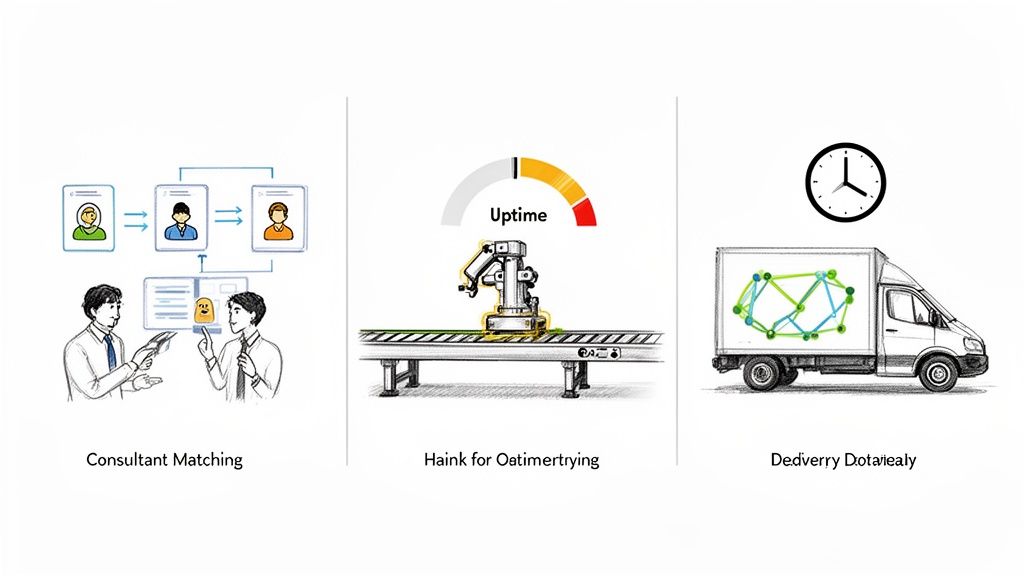
In professional services, your people are everything. Their skills, their experience, their time—that’s your inventory. For a consulting firm, a data science shop, or a creative agency, the line between a profitable quarter and a painful one often comes down to a single metric: billable utilization.
Picture a consulting firm with hundreds of experts. Trying to manually match the right person to the right project is a chaotic game of Tetris with spreadsheets, availability charts, and shifting client demands. An AI-powered system completely changes this.
It can analyze a new project’s needs and instantly scan your entire talent pool to find the perfect fit based on skills, experience, and current workload. It can even start to predict future project pipelines, giving leadership a heads-up when it’s time to hire or cross-train their teams. This proactive approach ensures your best talent is always deployed on high-value work, maximizing revenue and boosting client satisfaction.
Walk onto a factory floor, and you’ll see a complex dance of machinery, raw materials, and skilled workers. If one key machine goes down or a supply shipment is late, the entire production line can grind to a halt. Every minute of downtime costs a fortune.
This is where AI-driven resource allocation optimization acts like the plant’s central nervous system. It creates dynamic production schedules that squeeze every last drop of performance out of your equipment, automatically routing jobs to the most efficient machines based on live data. If a sensor indicates a machine is about to fail, the system can reroute its workload to other machines before it breaks down, keeping things moving.
By continuously analyzing constraints and opportunities, AI helps manufacturers move from a fixed schedule to a fluid, self-optimizing production flow. This builds resilience and boosts efficiency in ways manual planning never could.
Getting your physical assets in order is just as crucial. Exploring smart warehouse optimization strategies ensures that your inventory and space are managed just as efficiently as your production line.
For any company in logistics and delivery, the battle is won or lost on the road. Fuel, vehicle capacity, and driver hours are the critical resources, and tiny inefficiencies add up to staggering costs when you’re covering millions of miles.
Intelligent allocation systems tackle this head-on with dynamic route planning. Forget fixed daily routes. AI algorithms can look at real-time traffic, weather patterns, and new delivery priorities to map out the most efficient path for every single truck, every single day.
The system also optimizes the fleet itself. It can match the right-sized vehicle to each route’s payload, making sure you’re not sending a half-empty semi-truck across town. This doesn’t just slash fuel costs; it means faster, more reliable deliveries and happier customers.
This relentless focus on efficiency is top of mind for executives everywhere. A recent report found that while global leaders are laser-focused on managing costs, they only hit about 48% of their savings targets. The study points to resource allocation optimization as the missing piece for unlocking huge efficiencies, particularly in supply chain and operations. You can learn more about how tailored cost-saving approaches are delivering results in different markets.
Dodging the Common Roadblocks on Your AI Journey
Jumping into an AI-driven optimization project is a fantastic move, but let’s be real—the road can get bumpy. Even the most well-intentioned teams can hit a few common hurdles on the way to smarter resource allocation optimization. Knowing what these are ahead of time is your best defense against costly missteps and a project that never quite delivers.
One of the biggest project-killers? Bad data. The old saying “garbage in, garbage out” has never been more true than in the world of AI. If your historical data is a mess—full of gaps, errors, or inconsistencies—your model will learn all the wrong things. The result is recommendations that are useless at best and damaging at worst.
Another trap is picking a model that’s way too complicated for the job at hand. It’s tempting to grab the shiniest new tech off the shelf, but sometimes a straightforward predictive model is all you need to get moving and see a quick win. Overengineering the solution from day one just means longer timelines, bigger budgets, and a headache-inducing system to maintain.
Getting Your Team on Board
The tech is only half the story. The people side of the equation is just as important, if not more so. Expect some pushback from teams who are used to doing things the old way. Change is hard, and if your staff views a new AI system as a threat instead of a helpful tool, getting them to actually use it will be an uphill battle.
This feeds right into the “black box” problem. It’s tough for a manager to trust a recommendation when they have no idea how the AI came up with it. Without that transparency, you can’t build the confidence needed for people to act on the system’s advice.
An AI partner’s job isn’t just to write code. It’s to be the bridge between complex technology and the people who have to use it every day. The real goal is a solution your team understands, trusts, and sees as an indispensable part of their work.
This is exactly why partnering with a team of AI and data experts like NILG.AI can make all the difference. We don’t just build a model and walk away. We live and breathe these challenges and know how to guide you through them.
Here’s how we tackle it:
Building a Rock-Solid Data Foundation: We always start with a deep dive into your data. We’ll help you clean, organize, and prep your information so it’s ready to power a model you can actually rely on.
Choosing the Right Tool for the Job: We sit down with you to truly understand your business goals. From there, we pick the right level of technology—strong enough to solve the problem, but simple enough to manage and grow with you.
Winning Over Hearts and Minds: We are big believers in explainable AI (XAI) that shows its work. By providing clear reasons for its recommendations, we demystify the process. Combine that with practical, hands-on corporate training, and you turn skeptics into champions.
Sticking with outdated, manual strategies means leaving money on the table and falling behind competitors who embrace data-driven decision-making. By carefully navigating these common pitfalls with an experienced partner, you can ensure your resource allocation optimization project actually delivers the results you’re looking for.
Frequently Asked Questions
Thinking about making the switch to a smarter allocation strategy? You’re not alone. Here are a few of the most common questions we get from business leaders, answered simply.
What’s the First Step to Improving Resource Allocation?
Honestly, the most important first step is getting a brutally honest look at how you’re using your resources right now. Before you can even think about resource allocation optimization, you have to know your starting point. This means doing a full audit of where your people, money, and tools are actually going.
Start by tracking time spent on specific projects. Figure out which tasks are the biggest resource hogs and what skills you have on your team. This initial data-gathering isn’t the glamorous part, but it’s the foundation for everything else. Without it, you’re flying blind.
How Does AI Handle Unexpected Changes on a Project?
This is where AI really shines and leaves static, spreadsheet-based plans in the dust. AI-powered systems use live data to adjust resource plans in real time. If a key person calls in sick or a client suddenly expands the scope of a project, the system can instantly figure out the new best way to assign everything.
An AI system doesn’t just react—it anticipates. It might suggest reassigning a task to another person with the right skills or flag that a deadline is now at risk, giving managers the chance to be proactive instead of constantly putting out fires.
Do I Need a Big Data Science Team to Implement This?
Absolutely not. While having your own data science crew is great, plenty of companies get started by partnering with a specialized AI consulting firm. A good partner will do the heavy lifting—building the models, integrating the data, and getting the system running—all while collaborating with your team.
The goal is to give your managers powerful AI tools that are easy to use, without them needing a Ph.D. in statistics. This usually includes hands-on training to get everyone comfortable, turning the technology into a real asset for the entire team.
Ready to stop guessing and start optimizing? The team at NILG.AI specializes in building custom AI solutions that turn your data into a strategic advantage, helping you cut costs and drive growth. Request a proposal
Like this story?
Subscribe to Our Newsletter
Special offers, latest news and quality content in your inbox.
Signup single post
Recommended Articles
Article
Transform Your Growth with custom ai software development in 2026
Apr 1, 2026 in
Guide: Explainer
Explore how custom ai software development can boost efficiency, cut costs, and deliver measurable value - find trusted partners and practical steps for 2026.
Discover how AI for customer service can transform your support operations. Learn practical strategies to reduce costs, improve satisfaction, and drive growth.
How Might We Statements: Turn Challenges into Opportunities
Mar 15, 2026 in
Guide: Explainer
Discover how might we statements transform complex challenges into real opportunities. Learn practical crafting tips, workshops, and real-world examples.
We use cookies on our website to give you the most relevant experience by remembering your preferences and repeat visits. By clicking “Accept All”, you consent to the use of ALL the cookies. However, you may visit "Cookie Settings" to provide a controlled consent.
This website uses cookies to improve your experience while you navigate through the website. Out of these, the cookies that are categorized as necessary are stored on your browser as they are essential for the working of basic functionalities of the website. We also use third-party cookies that help us analyze and understand how you use this website. These cookies will be stored in your browser only with your consent. You also have the option to opt-out of these cookies. But opting out of some of these cookies may affect your browsing experience.
Necessary cookies are absolutely essential for the website to function properly. These cookies ensure basic functionalities and security features of the website, anonymously.
Cookie
Duration
Description
cookielawinfo-checkbox-analytics
11 months
This cookie is set by GDPR Cookie Consent plugin. The cookie is used to store the user consent for the cookies in the category "Analytics".
cookielawinfo-checkbox-functional
11 months
The cookie is set by GDPR cookie consent to record the user consent for the cookies in the category "Functional".
cookielawinfo-checkbox-necessary
11 months
This cookie is set by GDPR Cookie Consent plugin. The cookies is used to store the user consent for the cookies in the category "Necessary".
cookielawinfo-checkbox-others
11 months
This cookie is set by GDPR Cookie Consent plugin. The cookie is used to store the user consent for the cookies in the category "Other.
cookielawinfo-checkbox-performance
11 months
This cookie is set by GDPR Cookie Consent plugin. The cookie is used to store the user consent for the cookies in the category "Performance".
viewed_cookie_policy
11 months
The cookie is set by the GDPR Cookie Consent plugin and is used to store whether or not user has consented to the use of cookies. It does not store any personal data.
Functional cookies help to perform certain functionalities like sharing the content of the website on social media platforms, collect feedbacks, and other third-party features.
Performance cookies are used to understand and analyze the key performance indexes of the website which helps in delivering a better user experience for the visitors.
Analytical cookies are used to understand how visitors interact with the website. These cookies help provide information on metrics the number of visitors, bounce rate, traffic source, etc.
Advertisement cookies are used to provide visitors with relevant ads and marketing campaigns. These cookies track visitors across websites and collect information to provide customized ads.