AI Automations • AI Strategy • AI4business • Artificial Intelligence •
Unlocking Growth with AI and Innovation
NILG.AI on Jan 20, 2026
?>
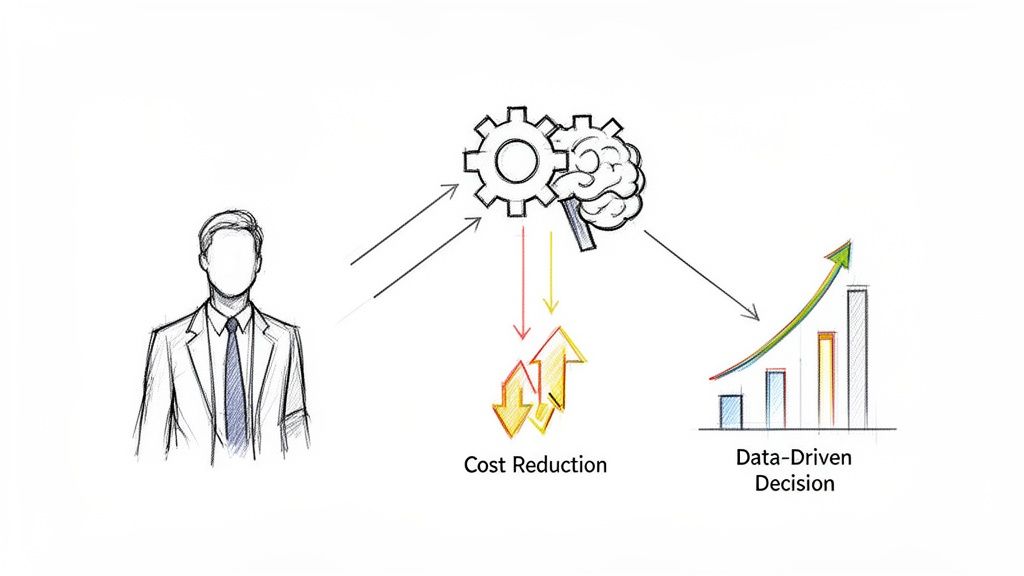
It’s impossible to talk about innovation these days without talking about AI. The two are completely intertwined. Think of AI as the engine that’s not just speeding things up, but fundamentally changing how businesses grow. It handles the grunt work through automation and, more importantly, uncovers insights from data that would otherwise stay hidden. It’s not just another tool in the box; it’s becoming a core part of business strategy.
Unlocking Growth Through AI and Innovation
Let’s cut through the hype. This isn’t some far-off, futuristic concept. This guide is for business leaders who need to understand how AI and innovation actually connect on the ground, right now. We’re going to skip the jargon and focus on actionable strategies for real companies, from growing startups to established enterprises.
The whole conversation around AI is changing. It’s moved out of the R&D lab and into the boardroom. We’re now seeing it as a primary engine for driving growth, boosting efficiency, and carving out a real competitive advantage. This requires a different way of thinking—seeing AI not just as a piece of software, but as a strategic asset for solving your biggest business problems.
The Shift from Experimentation to Integration
For years, AI was all about “potential.” Now, that potential is being realized. Companies are moving past small pilot projects and are embedding AI across their entire operations to gain a strategic edge.
The numbers back this up. A recent report found that 88% of organizations are now using AI regularly in at least one part of their business. That’s a huge jump from 78% just one year ago. This tells us AI is no longer an experiment; it’s a critical piece of the puzzle for staying competitive and driving innovation. If you want to dive deeper into these trends, you can explore what they mean for your strategy.
Moving to a business-centric AI approach is what makes the difference. It’s all about using AI with a clear purpose and a way to measure success.
Think of it this way: You wouldn’t build a new factory without knowing what you’re going to make. In the same way, you shouldn’t bring in AI without a clear idea of the specific business problem you want it to solve, whether that’s cutting costs, finding new customers, or just making smarter decisions.
AI as Your Innovation Catalyst
So, how does AI actually spark innovation in the real world? It really comes down to giving your business superpowers in two key areas:
Doing More with Less: AI is a master at automating tedious, repetitive tasks. This frees up your team to focus on the stuff that actually requires human creativity and critical thinking—the high-value strategic work.
Seeing Around Corners: AI can sift through massive datasets to spot patterns and predict what’s coming next. This allows you to stop reacting to the market and start making proactive decisions based on solid data.
This one-two punch is what makes AI such a powerful catalyst. It doesn’t just make you faster at what you’re already doing. It gives you the breathing room and the insights to invent entirely new ways to run your business.
How AI Actually Fuels Business Innovation
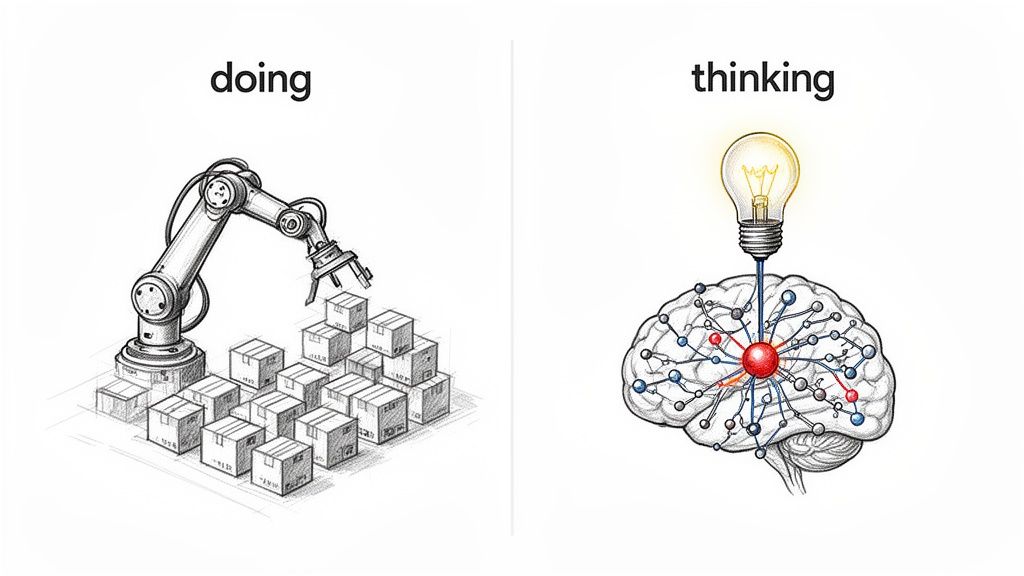
To really get how AI and innovation go hand-in-hand, it helps to think of AI as a two-stroke engine for your business. It handles both the “doing” and the “thinking,” and that combination is where the magic happens.
First up is the ‘doing’—automating and fine-tuning tasks at a scale and speed humans just can’t keep up with. This is the side of AI most people recognize. It takes on all the repetitive, predictable work and frees your team from the grind.
When your best people aren’t stuck doing manual data entry or pulling the same reports every week, their brainpower is unleashed. They can finally focus on creative strategy, solving tough problems, and talking to customers—the stuff that actually builds value.
Amplifying What Your Team Can Do
But automation is only half the story. The real breakthrough comes from AI’s ability to ‘think.’ It’s like giving your team an analytical superpower that can sift through mountains of data to find patterns and connections that are completely invisible to us.
This is how AI directly sparks innovation. It gives you the evidence you need to make smarter, faster decisions. Instead of going with a gut feeling or what worked last year, your strategy is built on what the data is telling you right now. This clarity slashes risk and dramatically shortens the time it takes to get from an idea to a finished product.
An AI and innovation strategy isn’t about replacing people; it’s about augmenting them. It gives your team the tools to perform at a higher level, turning raw data into a clear competitive advantage.
Core AI Technologies Driving Innovation
Several key AI technologies are doing the heavy lifting behind this innovation push. You don’t need to be a data scientist, but knowing what they are helps take the mystery out of it. Let’s look at the main players you’ll come across.
AI Technology
What It Does (Simple Analogy)
How It Drives Innovation
Machine Learning (ML)
A GPS for your business goals.
It predicts future trends, identifies at-risk customers, and optimizes supply chains before problems even pop up.
Generative AI
A creative brainstorming partner.
It can draft marketing copy, mock up product designs, or even write code, slashing development time.
Natural Language Processing (NLP)
A universal language translator for computers.
Powers 24/7 customer service chatbots and analyzes social media comments to measure brand sentiment in real-time.
These technologies aren’t islands; they often team up to solve complex problems. For example, ML might identify a customer group, and Generative AI could then write personalized marketing emails for them.
Understanding their roles helps you see how they fit into different business innovation models and pinpoint where they can make the biggest difference in your own operations. Each one offers a clear path to turning a business challenge into a real opportunity for growth.
So, What’s the Real Payoff of an AI Innovation Strategy?
Alright, we’ve talked about the “how,” but let’s get down to the “why.” What’s the actual, measurable return you get when you build your business strategy around AI and innovation? The conversation isn’t about hype anymore; it’s about real, proven results that show up on the balance sheet.
Think of it this way: this isn’t about chasing a shiny new toy. It’s a hard-nosed financial decision. A smart AI strategy acts like a force multiplier for your entire business, creating value you can see in revenue reports, productivity stats, and your standing in the market. It’s the difference between guessing what your customers want and knowing, or between getting sideswiped by market shifts and causing them.
Driving Real, Measurable Financial Growth
The most powerful argument for an AI innovation strategy is its direct impact on your financials. Companies that are deliberate about weaving AI into their operations aren’t just seeing a few percentage points of improvement—they’re creating serious economic value. It’s what separates the leaders from the laggards.
The ROI is no longer a “what if.” The proof is right there in the numbers. We see that businesses with a clear AI plan are twice as likely to report revenue growth compared to those winging it. This shakes out to an average annual value gain of around $19,000 per user—a figure that has massive ripple effects across any industry. You can dig into more of these AI adoption statistics and their impact on business outcomes to see the full picture.
Where does this financial lift come from? It’s not just one thing.
Smarter Resource Allocation: AI helps you put your money where it’ll work hardest, whether that’s fine-tuning your marketing spend or using predictive analytics to stop tying up cash in excess inventory.
New Revenue Streams: By sifting through your data, AI can spot gaps in the market and unmet customer needs, pointing the way to brand-new products or services you hadn’t even considered.
Better Customer Lifetime Value: When you use AI to deliver personalized experiences and solve problems before they happen, customers stick around. That loyalty directly boosts your long-term revenue.
Making Your Operations Way More Efficient
Beyond making more money, a solid AI strategy helps you spend less time, effort, and cash just to get things done. It goes after the bottlenecks and inefficiencies that drain your team’s energy, automating the tedious tasks and untangling complex workflows. It’s like giving every department a super-smart assistant.
For instance, AI can take over manual data entry, a classic time-sink that’s begging for human error. It can also map out the most efficient shipping routes, predict when a machine needs maintenance before it breaks down, or field thousands of customer questions at once without breaking a sweat.
An investment in AI is really an investment in your people. When you get rid of the operational friction, you free them up to do the creative, high-impact work that actually pushes the business forward.
This isn’t just a minor tweak to productivity; it’s a massive leap. Projections show that by 2035, AI is on track to significantly boost labor productivity in major economies like Sweden (37%), the United States (35%), and Japan (34%).
Building an Edge That Actually Lasts
When you add it all up, the revenue growth and operational wins create the most important benefit of all: a real, sustainable competitive advantage. In a world where every one of your competitors is looking for an edge, a well-executed AI strategy is no longer a luxury. It’s a core requirement for staying in the game and leading the pack.
This advantage is built on three key pillars:
Speed: AI lets you analyze information, make decisions, and bring products to market faster than you ever could before.
Agility: With predictive insights, you can see market changes coming and adjust your strategy ahead of time, instead of just reacting after the fact.
Intelligence: You develop a much deeper, more nuanced understanding of your customers, your operations, and your industry, which leads to smarter decisions everywhere.
By embracing AI as a central part of how you do business—not just a tool you use—you build a company that is more resilient, more intelligent, and ready for whatever comes next. This proactive approach ensures you’re not just keeping up with the competition, but setting the pace.
Real-World Examples of AI Driving Innovation
It’s one thing to talk about AI in theory, but seeing it in action is where the lightbulb really goes on. Effective AI strategies are not exclusive to large tech corporations; they are being deployed right now by diverse businesses—logistics firms, service companies, and manufacturers—who identified a specific problem and applied AI with precision.
These stories show that innovation with AI isn’t about some far-off, futuristic moonshot. It’s about making smart, practical changes that deliver real results, whether that’s saving a ton of money, closing deals faster, or making a better product. Let’s dig into how companies are actually putting these ideas to work.
Optimizing Logistics with Predictive Analytics
Picture a mid-sized logistics company trying to manage a fleet of hundreds of delivery trucks every single day. Their two biggest headaches were out-of-control fuel costs and the constant pressure to shrink their carbon footprint. The root of the problem? Their routing system was rigid; it couldn’t adapt to things happening in the real world, like sudden traffic jams, bad weather, or last-minute changes to a delivery.
The AI Solution: They decided to stop reacting to problems and start predicting them. Working with an AI consulting firm, they rolled out a predictive analytics model. This wasn’t your average GPS. The system chewed on historical traffic data, weather forecasts, and even vehicle maintenance records to figure out the absolute best route for every truck, every day.
Data Inputs: Live GPS feeds, past delivery times, weather patterns, and local traffic data.
AI Model: A machine learning algorithm that was always learning and fine-tuning its own suggestions.
Output: Dynamic routes sent straight to the drivers’ tablets.
The Measurable Outcome: The results were huge, and they showed up fast. The company slashed its annual fuel consumption by 15%, which translated into millions of dollars in savings. Just as important, that efficiency boost took a big bite out of their carbon emissions, helping them hit their sustainability targets and build a much stronger brand. It’s a perfect example of turning a daily operational pain into a serious competitive edge.
Accelerating Sales with Generative AI
Next up, let’s look at a B2B services firm. Their sales cycle was painfully long and clunky. It took their sales reps days to write up detailed, personalized proposals for every potential client, and that lag time meant they were losing deals. They had to find a way to get back to leads quicker without sacrificing the personal touch their clients expected.
The AI Solution: They brought in a generative AI system and fed it all of their past winning proposals, product manuals, and client case studies. Now, when a new lead comes in, a salesperson just has to plug in the client’s needs, industry, and company size. The AI then spits out a highly customized first draft of the proposal in a matter of minutes.
This was never about replacing the sales team. It was about giving them superpowers. The AI did all the time-sucking grunt work, freeing up reps to do what they do best: build relationships and close deals.
The Measurable Outcome: The change was dramatic. The average time it took to get a proposal out the door went from three days to less than an hour. This new speed let them talk to way more prospects, leading to a 30% jump in their close rate in the first six months. By getting the proposal process on autopilot, they didn’t just shorten the sales cycle—they also made their client communication more consistent and professional across the board.
Enhancing Quality Control with Computer Vision
Finally, imagine a manufacturer that makes intricate electronic components. No matter how good their quality control team was, tiny, almost invisible defects were slipping through. This led to expensive recalls and unhappy customers. At the speed of a modern production line, the human eye just can’t catch every microscopic flaw.
The AI Solution: The company installed a computer vision system right on their assembly line. High-resolution cameras snapped pictures of every single component that passed by. An AI model, which had been trained on thousands of images of both perfect and flawed parts, analyzed each photo instantly.
The Measurable Outcome: The AI system was able to spot defects with 99.9% accuracy—a level no human could ever hope to match. This led to a huge drop in waste and basically made product recalls a thing of the past. Better yet, the data from the AI gave their engineers incredible insights, helping them spot patterns in the production process so they could fix the root cause and stop defects from happening in the first place. Quality control went from being a final check to a proactive engine for innovation.
Building Your AI Innovation Roadmap
Alright, let’s get practical. An AI innovation strategy isn’t something you can just download or buy. It’s a roadmap you build, piece by piece, tailored specifically to your business’s headaches and ambitions.
Think of it as a journey broken down into manageable steps. This isn’t just for data scientists; it’s a clear, step-by-step path for business leaders to follow without getting lost in the technical weeds.
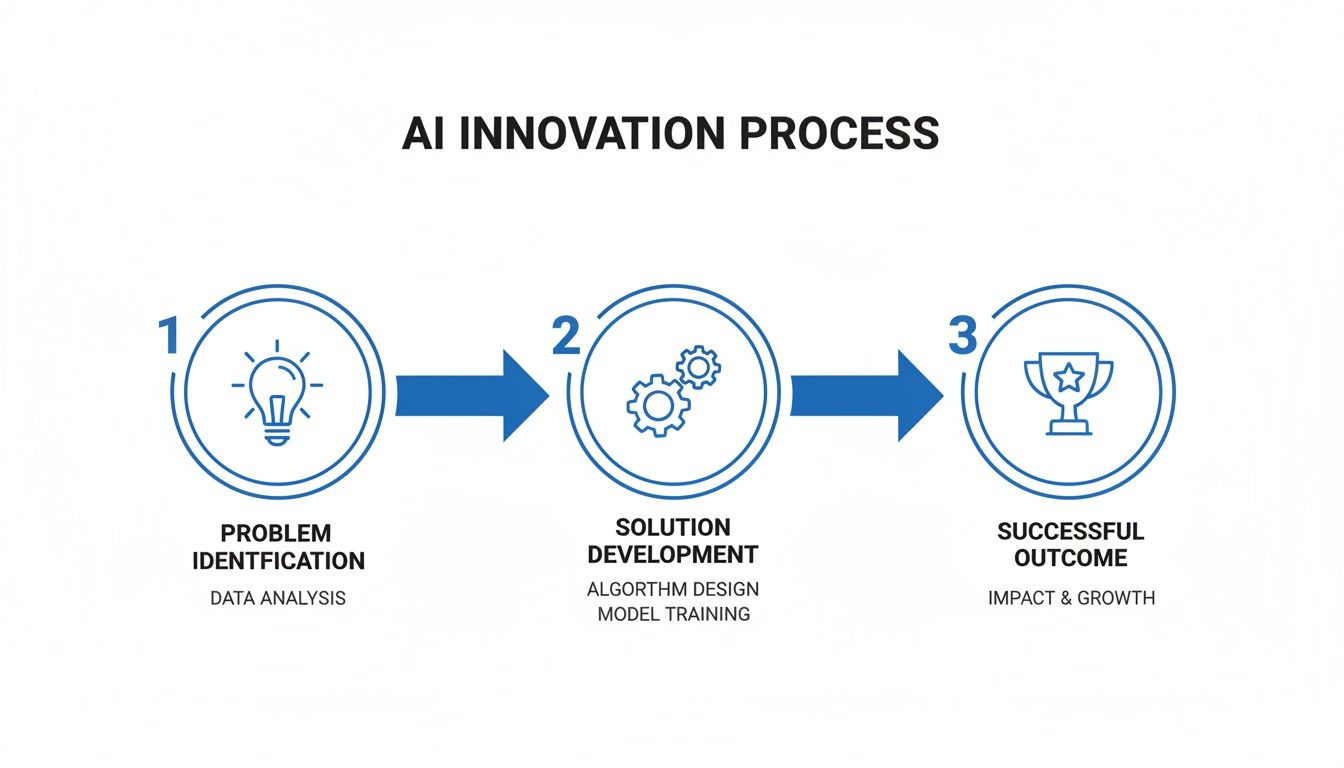
This simple flow chart nails the core idea: you start with a real problem, build a targeted AI solution, and end with a clear win for the business.
The big takeaway? Successful AI projects never start with a cool piece of tech. They start with a problem that needs solving.
Phase 1: Identify High-Impact Opportunities
Here’s where most people get it wrong: they start with the technology. Don’t. Start with a real business problem. Hunt for the friction points in your company—the bottlenecks, the expensive manual work, the stuff that drives your team and your customers crazy. This is your treasure map.
Your first goal is to find the “low-hanging fruit.” You’re looking for a project where AI can deliver a clear, immediate, and easy-to-explain win. Forget about reinventing your entire company overnight.
Ask yourself these questions to find the perfect starting point:
What repetitive, manual tasks are eating up our team’s time?
Where are we bleeding money from simple inefficiencies or human error?
What’s the one complaint we hear from customers over and over again?
Which critical business decision do we wish we had better data for?
Answering these helps you lock onto a project that solves a genuine pain point. That’s how you build momentum. If you want a more structured way to map out these ideas, our guide on the Three Horizons Framework for innovation is a great resource.
Phase 2: Secure and Prepare Your Data
Once you’ve got a problem in your sights, it’s time to talk about data. Think of data as the fuel for your AI engine. Without clean, high-quality fuel, the whole project is going to stall out. This part isn’t glamorous, but it is absolutely essential.
Your data doesn’t have to be perfect, but it does need to be relevant to the problem and accessible. This means tracking down the right data sources, checking them for quality, and setting up a secure space for your AI model to do its work.
Clean data is the bedrock of any successful AI project. The old saying “garbage in, garbage out” isn’t just a cliché; it’s a fundamental law of machine learning. A little extra time spent cleaning up your data now will save you a world of hurt later on.
This is often where the reality check happens. A recent study found that while 42% of companies feel they have a solid AI strategy, many admit their data infrastructure just isn’t ready. This is precisely why taking things one step at a time is so important.
Phase 3: Start Small with a Pilot Project
You have a clear problem. You have your data ready to go. Now, it’s time to launch a small pilot project. The whole point of a pilot is to prove the concept works and deliver value quickly, but on a small scale. It’s your chance to test your ideas, learn a few things, and build a rock-solid case for doing more.
A great pilot project does two things. First, it solves the problem you set out to fix. Second, it creates fans and champions for AI inside your company. Nothing gets buy-in from the executive team faster than a tangible result, like seeing costs drop or project timelines shrink.
Here’s what every successful pilot needs:
A clear finish line: Define exactly what success looks like before you even start.
A tight scope: Keep it focused. This ensures you can actually deliver results without it dragging on forever.
A mixed team: Pull in people from IT, the business unit you’re helping, and operations.
Phase 4: Scale and Integrate
A successful pilot is fantastic, but it’s just the start. The final phase is all about taking what you’ve learned and scaling it up across the rest of the organization. You’re moving from a one-off solution to weaving AI into the fabric of your company’s culture and daily operations.
Scaling isn’t just about deploying more tech. It means having a real plan for training your people, updating old workflows, and showing everyone—from the front lines to the C-suite—how AI is making their work better. This is the point where AI stops being a “project” and becomes just part of how you do business.
The ultimate goal is to create a flywheel of innovation. Each successful AI deployment gives you the data and insights to find the next big opportunity. This is how you build a smarter, faster, and more data-driven company that’s ready for whatever comes next.
Common Questions About AI and Innovation
Even with a solid plan, stepping into the world of AI and innovation is bound to bring up some questions. It’s totally normal to feel a mix of excitement and maybe a little apprehension when you’re looking at a shift this big. Let’s walk through three of the most common questions business leaders ask and get you some straight answers.
Think of this as your no-nonsense FAQ, designed to cut through the jargon and give you the clarity you need to move forward. These aren’t just theories; they’re based on what works—and what doesn’t—in the real world.
Where Should We Start with AI to Drive Innovation?
This is the big one, right? And the answer is probably simpler than you think. The best place to start isn’t with the tech itself; it’s with a business problem. Forget the algorithms for a minute and think about the biggest points of friction in your day-to-day operations.
Find a specific, high-pain process. Are slow customer service responses hurting your reputation? Is a clunky supply chain eating into your profit margins? Or are you losing great employees because they’re buried under hours of mind-numbing manual data entry?
The key is to zero in on a single, measurable problem where automation or better insights can deliver a clear and immediate win. A successful pilot project builds confidence, gets buy-in from your team, and creates a blueprint you can use again and again.
Don’t try to boil the ocean. Your goal is to find one small “puddle” where you can prove the value fast. This approach takes a lot of the risk out of the equation and builds the momentum you’ll need to tackle bigger challenges later. It’s all about starting small to win big.
What Are the Biggest Mistakes to Avoid in an AI Strategy?
Knowing what not to do is often just as important as knowing what to do. Many promising AI projects fizzle out, and it’s rarely because the technology failed. It’s usually due to a few common strategic blunders.
The biggest mistake, hands down, is treating AI like it’s just another IT project. Your tech team is essential, of course, but AI is a business strategy, plain and simple. It requires tight collaboration between IT, operations, marketing, and leadership right from the start. If AI gets stuck in the IT department, it’s almost guaranteed to miss the mark on solving actual business needs.
Another huge pitfall is underestimating the importance of your data. An AI model is only as good as the data you feed it. If you give it garbage—incomplete, messy, or biased information—you’re going to get garbage out. Investing time in data governance and cleanup isn’t just a preliminary step; it’s the non-negotiable foundation for everything else.
Finally, don’t forget the people. The most brilliant AI tool is useless if your team doesn’t get it, trust it, or know how to use it. A winning AI strategy has to include a plan for:
Training your team on how to work alongside new AI tools.
Managing the cultural shift to build trust and encourage adoption.
Clearly communicating how AI will help them in their roles, not replace them.
Do We Need a Team of In-House Data Scientists?
This question stops a lot of businesses cold, but the answer should be a relief: not necessarily. Especially not when you’re just starting out. The AI world has grown up a lot, and building everything from scratch is no longer the only way to go.
For many companies, bringing in a specialized AI and data consulting partner is a much smarter and faster way to get moving. These partners live at the intersection of AI and innovation and bring a ton of experience in strategy, execution, and all sorts of AI tech. They act as a catalyst, getting you from an idea to a working solution much more quickly.
An expert partner can help you:
Build a practical AI roadmap that makes sense for your business.
Run a high-impact pilot project to prove the ROI.
Provide corporate training to get your existing team up to speed.
This route gives you a much faster path to real value without the massive cost and long recruitment slog of building a specialized team from day one. You get to tap into world-class expertise when you need it, making sure your first steps into AI are confident, strategic, and successful.
Ready to turn your business challenges into growth opportunities? NILG.AI specializes in creating business-centric AI strategies that deliver clear results. From process automation to predictive analytics, we provide the expertise and roadmap to help you innovate with confidence. Request a proposal
Like this story?
Subscribe to Our Newsletter
Special offers, latest news and quality content in your inbox.
Signup single post
Recommended Articles
Article
How to Improve Team Productivity: A Simplified Guide
Apr 8, 2026 in
Guide: How-to
Discover how to improve team productivity with AI-driven processes, engaged teams, and practical steps you can start today.
Transform Your Growth with custom ai software development in 2026
Apr 1, 2026 in
Guide: Explainer
Explore how custom ai software development can boost efficiency, cut costs, and deliver measurable value - find trusted partners and practical steps for 2026.
Discover how AI for customer service can transform your support operations. Learn practical strategies to reduce costs, improve satisfaction, and drive growth.
We use cookies on our website to give you the most relevant experience by remembering your preferences and repeat visits. By clicking “Accept All”, you consent to the use of ALL the cookies. However, you may visit "Cookie Settings" to provide a controlled consent.
This website uses cookies to improve your experience while you navigate through the website. Out of these, the cookies that are categorized as necessary are stored on your browser as they are essential for the working of basic functionalities of the website. We also use third-party cookies that help us analyze and understand how you use this website. These cookies will be stored in your browser only with your consent. You also have the option to opt-out of these cookies. But opting out of some of these cookies may affect your browsing experience.
Necessary cookies are absolutely essential for the website to function properly. These cookies ensure basic functionalities and security features of the website, anonymously.
Cookie
Duration
Description
cookielawinfo-checkbox-analytics
11 months
This cookie is set by GDPR Cookie Consent plugin. The cookie is used to store the user consent for the cookies in the category "Analytics".
cookielawinfo-checkbox-functional
11 months
The cookie is set by GDPR cookie consent to record the user consent for the cookies in the category "Functional".
cookielawinfo-checkbox-necessary
11 months
This cookie is set by GDPR Cookie Consent plugin. The cookies is used to store the user consent for the cookies in the category "Necessary".
cookielawinfo-checkbox-others
11 months
This cookie is set by GDPR Cookie Consent plugin. The cookie is used to store the user consent for the cookies in the category "Other.
cookielawinfo-checkbox-performance
11 months
This cookie is set by GDPR Cookie Consent plugin. The cookie is used to store the user consent for the cookies in the category "Performance".
viewed_cookie_policy
11 months
The cookie is set by the GDPR Cookie Consent plugin and is used to store whether or not user has consented to the use of cookies. It does not store any personal data.
Functional cookies help to perform certain functionalities like sharing the content of the website on social media platforms, collect feedbacks, and other third-party features.
Performance cookies are used to understand and analyze the key performance indexes of the website which helps in delivering a better user experience for the visitors.
Analytical cookies are used to understand how visitors interact with the website. These cookies help provide information on metrics the number of visitors, bounce rate, traffic source, etc.
Advertisement cookies are used to provide visitors with relevant ads and marketing campaigns. These cookies track visitors across websites and collect information to provide customized ads.