AI Strategy • AI4business • Artificial Intelligence •
The 12 Best Predictive Analytics Tools for Strategic Growth in 2026
NILG.AI on Jan 13, 2026
?>
In today’s market, looking backward isn’t enough. You need to anticipate customer needs, foresee market shifts, and preempt operational issues before they happen. That’s where predictive analytics comes in; it’s less about having a crystal ball and more about using smart, data-driven technology to make calculated forecasts. But with a sea of options, how do you choose?
This guide cuts through the noise. We’re diving deep into the best predictive analytics tools available, focusing on what really matters: strategic value and practical application. We’ll explore everything from enterprise-grade platforms to specialized consulting partners, helping you find the perfect fit to transform your business challenges into strategic advantages. The goal is to move beyond just understanding your data to actively predicting what comes next. To grasp the profound impact and evolving landscape of these technologies, exploring resources like “Predictive Analytics in Banking: Future Innovation” can provide invaluable insights into sector-specific applications.
We’ve done the heavy lifting so you don’t have to. For each tool, we’ll provide a straightforward breakdown covering:
Core Strengths: What does this tool do exceptionally well?
Ideal Use Case: Who is this platform built for?
Key Considerations: What are the potential limitations or implementation hurdles?
Every entry includes screenshots for a quick visual feel and direct links to get you where you need to go faster. This isn’t just a list; it’s a practical guide to help you stop guessing and start making informed, future-focused decisions. Let’s get started.
1. NILG.AI
Best For: Custom, Business-Centric Predictive Analytics Solutions
Kicking off our list is NILG.AI, a standout choice for businesses that need more than just an off-the-shelf tool. Instead of providing a one-size-fits-all platform, NILG.AI operates as an end-to-end AI partner, designing and deploying custom predictive models that are meticulously aligned with specific business goals. This approach is ideal for organizations looking to convert operational inefficiencies into measurable growth and competitive advantages.
Their process begins with strategic roadmapping to identify the highest-impact opportunities, ensuring that every predictive analytics project is tied to a clear ROI. This business-first methodology makes them one of the best predictive analytics tools providers for companies wanting a solution built for their unique data ecosystem and challenges, rather than trying to fit their problems into a pre-built software.
Why It Stands Out
What truly distinguishes NILG.AI from other data consulting firms is its combination of deep technical expertise with a practical, hands-on execution model. The team’s capabilities span machine learning, generative AI, forecasting, and computer vision, allowing them to tackle a wide array of predictive challenges. Whether you’re aiming to forecast customer churn, optimize inventory with demand prediction, or implement predictive maintenance for machinery, they have the technical depth to deliver.
Moreover, their service extends beyond model development to include go-to-market integration and corporate training. This ensures the predictive solution is not only technically sound but also successfully adopted by your team, accelerating time-to-value. By understanding the core benefits of predictive analytics in a business context, they deliver systems designed for real-world impact.
Key Strengths
Primary Use Cases
Business-Centric Strategy
Custom churn prediction models
End-to-End Execution
Supply chain & demand forecasting
Broad Technical Expertise
Predictive maintenance scheduling
Focus on Adoption & Training
Customer lifetime value (CLV) analysis
Pricing & Implementation
NILG.AI does not offer public pricing tiers. As a tailored service provider, costs are scoped based on project complexity, goals, and required resources. You’ll need to contact them directly and request a proposal for a detailed estimate. While this requires a larger upfront investment compared to SaaS tools, the result is a fully customized, production-ready system built to solve your most critical business problems.
Think of G2 not as a single tool, but as your strategic command center for evaluating the entire predictive analytics market. Instead of giving you one solution, it gives you access to hundreds, all ranked and reviewed by verified, real-world users. This is your starting point for creating a shortlist of the best predictive analytics tools tailored to your specific needs.
G2’s strength lies in its crowdsourced data. You can filter solutions by company size, industry, or specific features like demand forecasting or churn prediction. The side-by-side comparison tables are invaluable for quickly seeing how top contenders stack up on everything from usability to implementation time. This platform helps you cut through the marketing noise and see what actual users are saying.
Key Features & User Experience
The interface is clean and built for discovery. Its core value comes from:
Crowdsourced Ratings: In-depth reviews from verified users provide candid insights.
Comparison Grids: Visually compare features, satisfaction scores, and market presence.
Filtering: Narrow your search by use case, deployment type (cloud vs. on-premise), and tech stack integrations.
Practical Tips for Use
To get the most out of G2, start by filtering for your company size and industry first. Pay close attention to reviews from users in similar roles. Be aware that sponsored placements can appear at the top, so always sort by “G2 Score” or “Highest Rated” to get a more objective view. While pricing is often hidden, the reviews frequently mention value for money, offering clues.
Pros: Fresh, authentic user data; excellent for discovering both niche and established tools.
Cons: Sponsored listings can skew initial results; pricing information is often limited.
Similar to G2, Capterra serves as a comprehensive discovery platform rather than a standalone tool. It’s a curated software marketplace that excels at helping businesses compare vendors based on practical considerations like pricing models, deployment options, and feature sets. Think of it as a detailed buyer’s guide, specifically designed to help you find solutions that fit your budget and infrastructure from the get-go.
Capterra’s real strength is its practical filtering system. You can immediately narrow the field to see only tools with free trials, specific pricing tiers (like subscription or one-time license), or certain deployment needs (cloud vs. on-premise). This focus on logistics makes it an essential resource for operations managers and IT teams who need to find the best predictive analytics tools that align with existing corporate policies and financial constraints.
Key Features & User Experience
The user experience is geared toward efficient comparison and selection. Its primary value is delivered through:
Practical Filters: Easily sort solutions by pricing model, deployment type, and available free trials.
Verified Reviews: Moderated user reviews provide insights into real-world performance and support quality.
Buyer’s Guides: In-depth guides and articles offer advice on how to select the right software for your use case.
Practical Tips for Use
Start your search by applying the “Pricing Options” and “Deployment” filters to immediately eliminate tools that don’t fit your company’s financial or technical requirements. Pay attention to the “Features” checklist to ensure a tool has the specific capabilities you need, such as customer segmentation or risk assessment. Sponsored profiles are clearly marked, so you can easily distinguish them from organic results.
Pros: Excellent filtering for budget and deployment needs; clear disclosure of sponsored profiles.
Cons: Technical detail can be inconsistent across listings; some profiles lean heavily on marketing claims.
For teams already embedded in the Amazon Web Services ecosystem, the AWS Marketplace isn’t just a store; it’s an integrated launchpad for deploying third-party solutions. Instead of vetting vendors one by one, you can procure and launch pre-configured predictive analytics and machine learning tools directly into your AWS account. This makes it one of the best predictive analytics tools discovery platforms for businesses that prioritize centralized billing and streamlined deployment.
The key advantage is speed and governance. You can find everything from automated ML platforms to specialized data preparation tools, all deployable as SaaS, containers, or Amazon Machine Images (AMIs). The marketplace simplifies procurement, allowing you to use your existing AWS billing and enterprise agreements, which is a massive win for corporate finance and IT departments looking to maintain control over software spend.
Key Features & User Experience
The interface is functional and designed for procurement, focusing on:
Centralized Purchasing: Consolidate third-party software costs onto your single AWS bill.
Flexible Deployment: Supports SaaS, AMIs, containers, and private offers for enterprises.
Verified Solutions: Find tools for automated ML, data preparation, and collaboration that are ready to run on AWS.
Practical Tips for Use
Start by using the search filters to find solutions that match your specific use case, like churn prediction or fraud detection. Pay close attention to the deployment type (SaaS vs. AMI) as it impacts your team’s management overhead. While many listings have public pricing, don’t hesitate to use the “Private Offer” feature for custom pricing and terms, especially for enterprise-level deployments.
Pros: Streamlined deployment into existing AWS environments; helps consolidate costs and compliance under AWS agreements.
Cons: Options are AWS-centric and less suitable for multi-cloud buyers; not all listings show full pricing publicly.
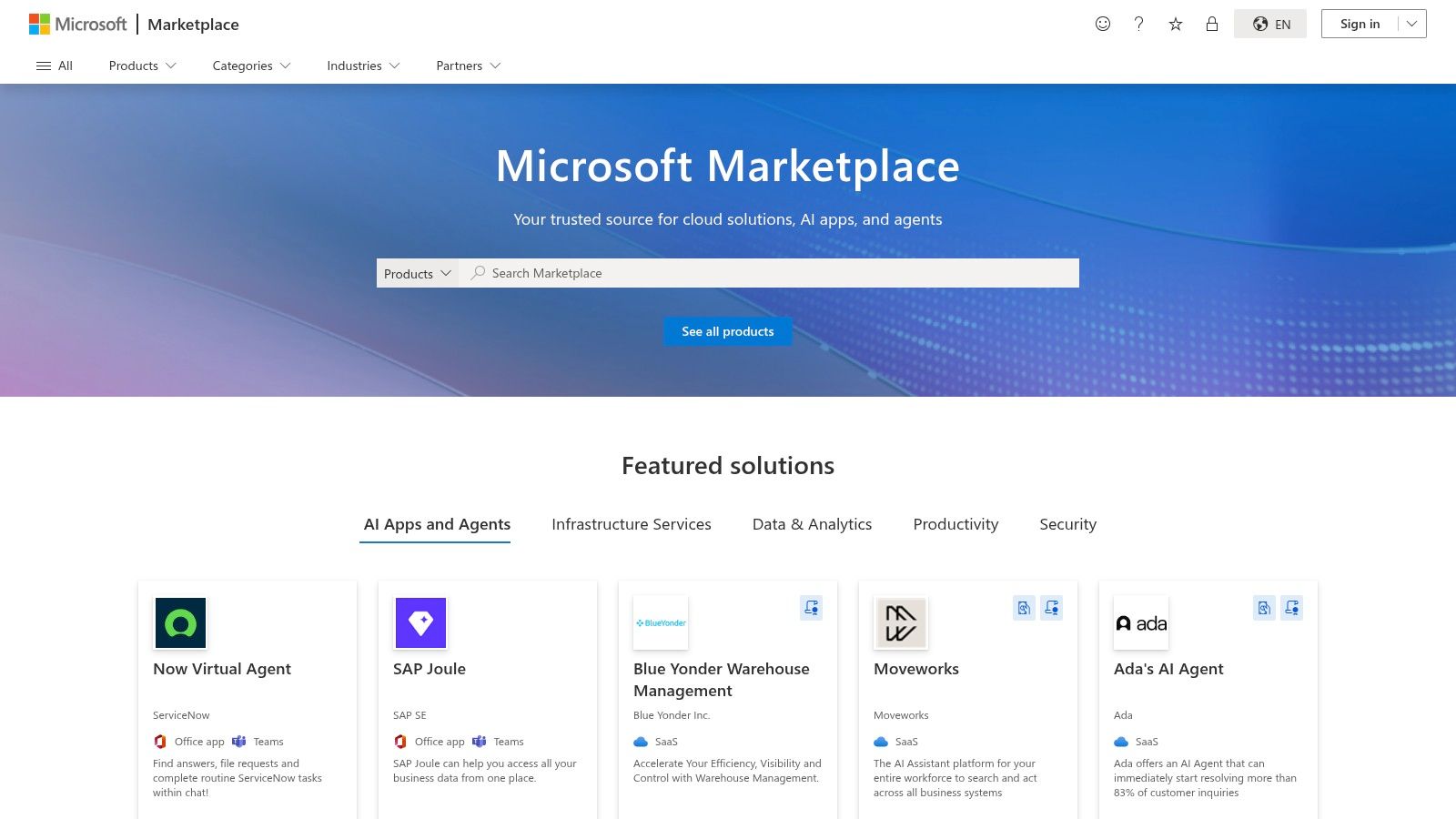
5. Microsoft Marketplace (Azure Marketplace + AppSource)
For organizations already embedded in the Microsoft ecosystem, the Microsoft Marketplace is less of a discovery platform and more of an integrated deployment hub. It unifies Azure Marketplace and AppSource, offering a centralized catalog to find, try, and deploy AI and analytics solutions that are pre-configured to work with the Microsoft Cloud. This makes it a go-to resource for teams looking to extend their Azure, Dynamics 365, or Power Platform capabilities.
The core advantage here is seamless integration. Instead of sourcing a tool and then figuring out how to connect it, you can find solutions designed for rapid provisioning directly into your existing Azure environment. This tight coupling accelerates deployment and often simplifies procurement, as many purchases can count toward your organization’s Azure Consumption Commitments (ACC).
Key Features & User Experience
The interface feels familiar to anyone who has used Azure, focusing on technical specifications and deployment. Key elements include:
Integrated Catalog: A massive library of AI, Data, and Analytics applications built for the Microsoft Cloud.
Rapid Provisioning: Deploy solutions directly into your Azure environment with a few clicks.
Consumption Commitment: Many purchases can be applied to your existing Microsoft Azure Consumption Commitment (MACC).
Practical Tips for Use
Start your search by filtering for solutions certified for your specific Microsoft services (e.g., Power BI, Azure Synapse). Pay close attention to the publisher details and reviews, as the quality of listing information can vary. While many tools offer straightforward pricing, some require you to contact the vendor, so be prepared for a sales conversation. Use the “Test Drive” or “Free Trial” options whenever available to validate a tool’s fit before committing.
Pros: Excellent for Microsoft-centric organizations; simplifies procurement and deployment within Azure.
Cons: Discovery can be challenging if you don’t know what you’re looking for; pricing isn’t always transparent.
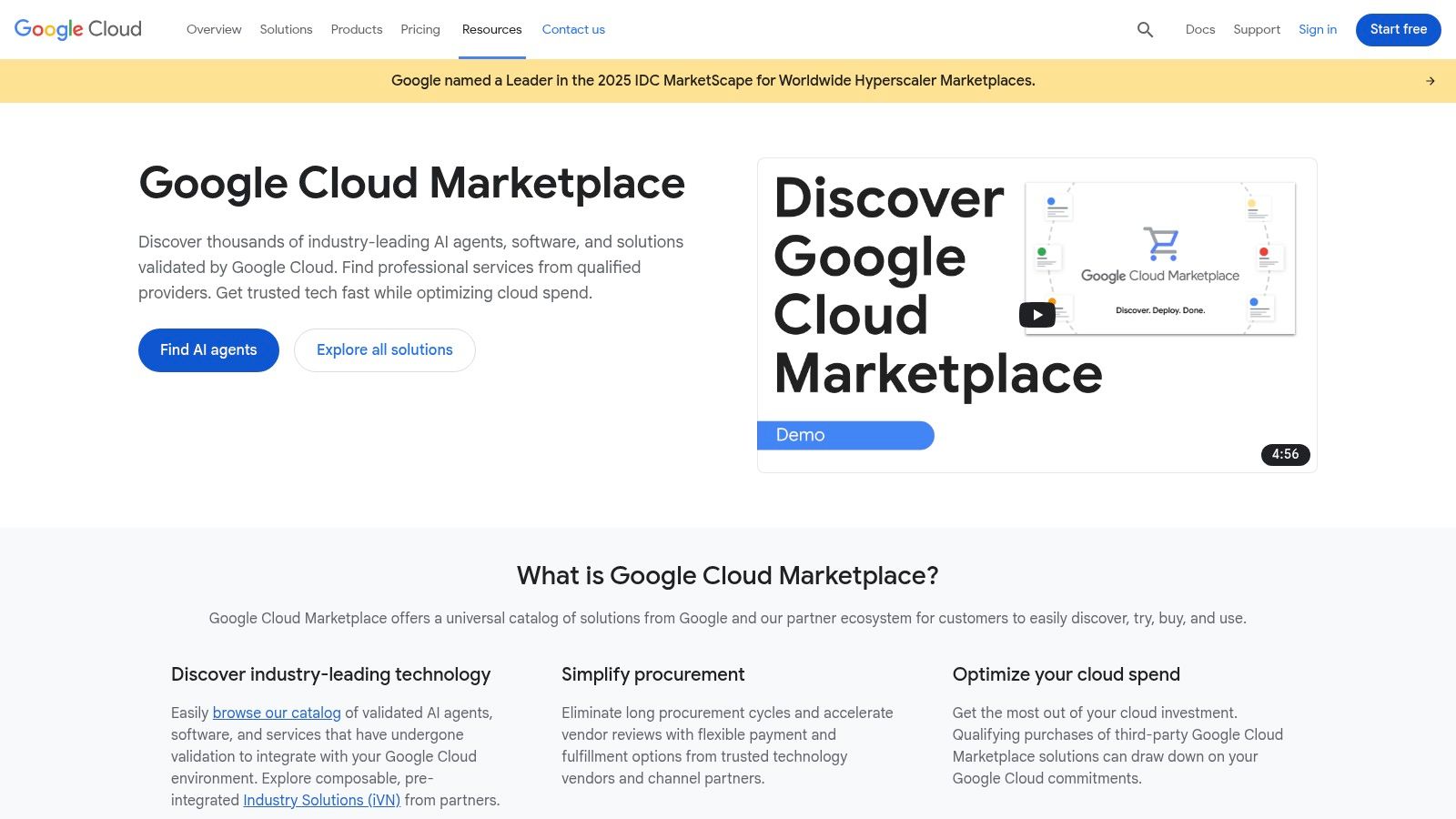
6. Google Cloud Marketplace — AI/ML solutions and models
Think of the Google Cloud Marketplace as a curated app store specifically for enterprise-grade AI and machine learning models. For teams already embedded in the Google Cloud Platform (GCP) ecosystem, this isn’t just another tool; it’s a seamless extension of their existing workflow. It allows you to discover, procure, and deploy pre-built predictive models directly into your GCP projects, transforming how you access advanced analytics.
This platform shines by centralizing the procurement process. Instead of navigating separate contracts and billing with multiple vendors, you can leverage standardized terms and unified billing through your existing GCP account. This makes it one of the best predictive analytics tools for organizations looking to scale their AI capabilities without the typical procurement headaches. Its tight integration with Vertex AI means you can go from discovery to deployment with remarkable speed.
Key Features & User Experience
The interface is clean and integrated directly within the familiar Google Cloud console. Its primary value stems from:
Vertex AI Integration: Directly enable and manage marketplace models within Vertex AI for a unified development experience.
Centralized Procurement: Consolidate terms, billing, and purchasing roles under your main GCP account.
Pre-Built Solutions: Access a catalog of specialized models for tasks like fraud detection, customer segmentation, or sentiment analysis.
Practical Tips for Use
To maximize its value, start by filtering solutions based on your specific industry and use case. Always check regional availability and pricing, as these can vary significantly between models and locations. Be prepared for some listings to require additional contact forms or approvals before deployment. Use the platform to discover specialized models from AI consulting businesses that solve niche problems your team doesn’t have the resources to build from scratch.
Pros: Smooth integration with GCP and Vertex AI; simplifies enterprise procurement and model management.
Cons: Model availability and pricing can be inconsistent across different regions; some solutions require extra approval steps.
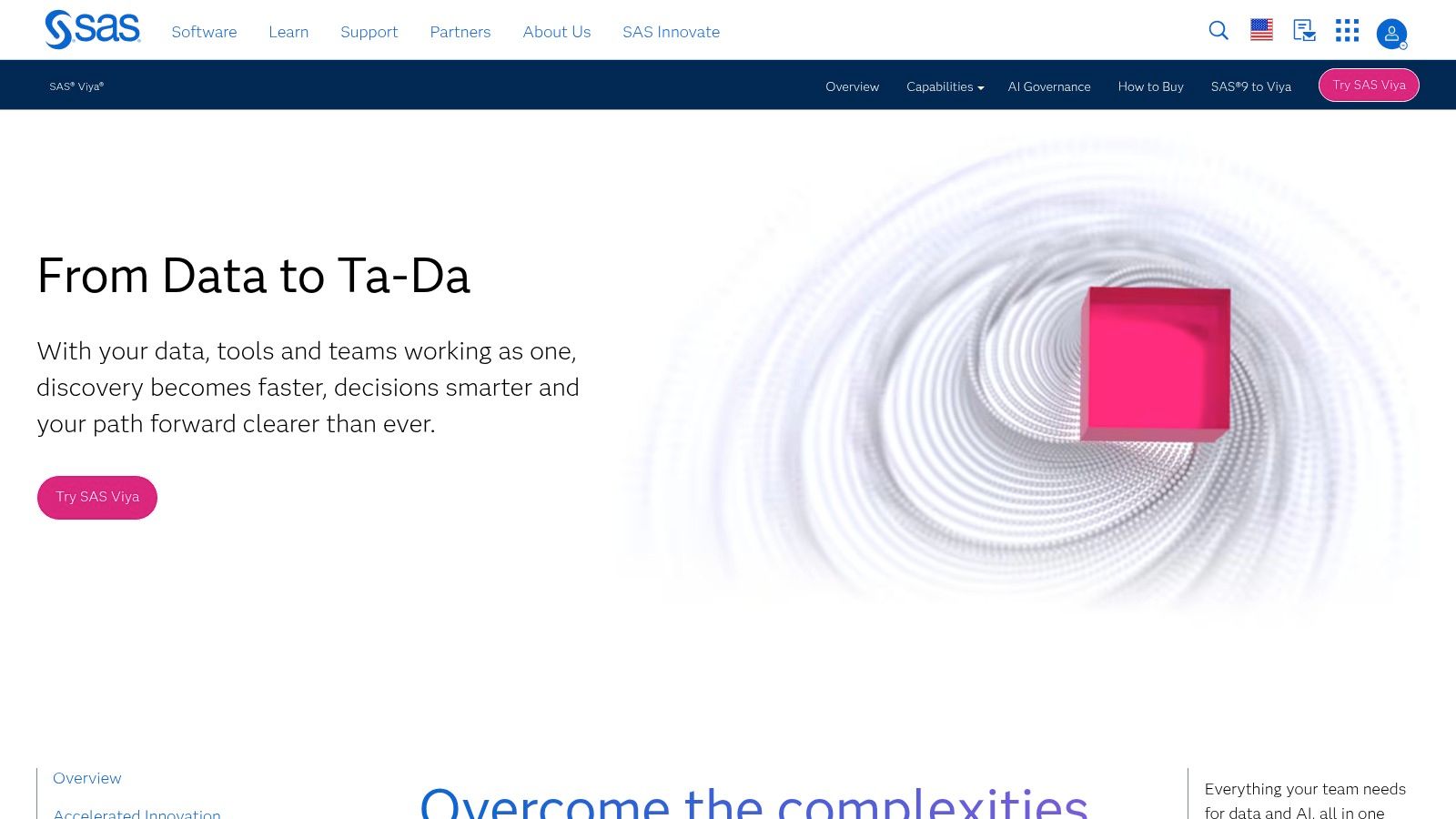
7. SAS Viya — Cloud‑native AI & Analytics Platform
For organizations where governance, security, and compliance are non-negotiable, SAS Viya stands as an enterprise-grade powerhouse. This isn’t just a tool; it’s a comprehensive, cloud-native analytics platform designed for large-scale operations in highly regulated industries like finance, healthcare, and the public sector. Its core strength is providing robust, auditable AI and machine learning from data management to model deployment and monitoring.
SAS Viya offers a unified environment that lets teams collaborate on the entire analytics lifecycle. It excels at complex tasks like fraud detection, risk management, and large-scale forecasting where accuracy and explainability are critical. If your organization needs one of the best predictive analytics tools that combines powerful automation with deep enterprise controls, SAS Viya is built to meet those demanding requirements.
Key Features & User Experience
The platform integrates everything from data prep to visualization and model management in a cohesive interface. Its standout features include:
Automated ML: End-to-end automation for building, validating, and deploying models, which is a great starting point if you’re exploring how to build predictive models.
Model Governance: Advanced capabilities for managing model risk, detecting bias, and ensuring regulatory compliance.
Flexible Deployment: Run on your preferred cloud (AWS, Azure, GCP) or on-premise infrastructure without re-coding.
Practical Tips for Use
SAS Viya is a significant investment, so leverage their extensive documentation and training resources. Start by identifying a high-impact business problem that requires strong governance, as this is where the platform delivers maximum value. Engage with their support and professional services teams early to plan the implementation, ensuring it aligns with your existing IT and data governance frameworks.
Pros: Unmatched enterprise controls and risk management features; proven scalability in compliance-sensitive sectors.
Cons: Enterprise pricing is not public and can be substantial; the learning curve and implementation effort are significant.
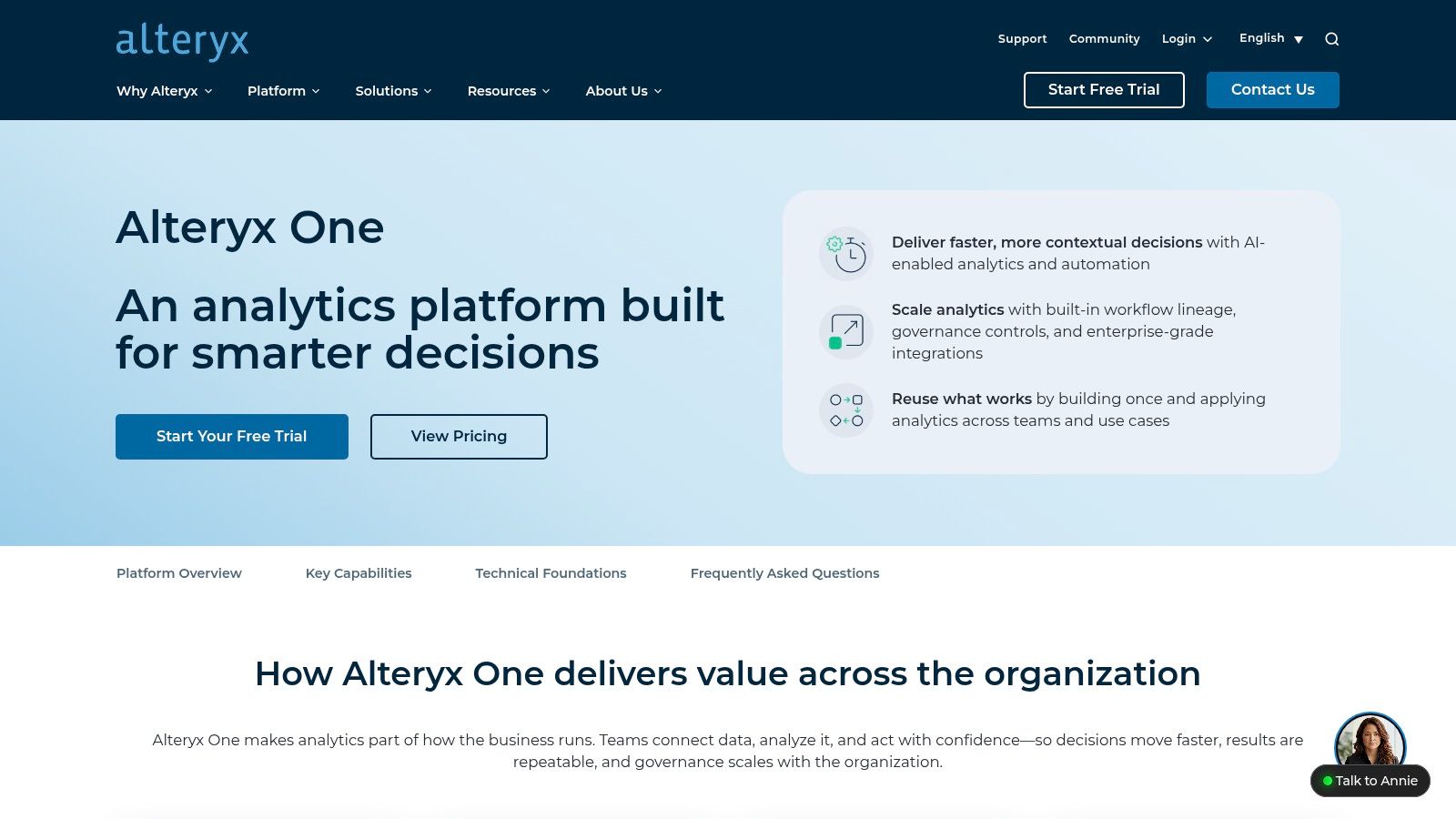
8. Alteryx — Analytics Automation with Predictive Tooling
Alteryx is a powerful analytics automation platform that excels at bridging the gap between business analysts and data scientists. It provides a low-code, drag-and-drop environment for complex data preparation, blending, and predictive modeling, making it one of the best predictive analytics tools for teams with mixed technical skills. Its core strength is its ability to democratize data science, allowing users to build and deploy sophisticated models without writing extensive code.
The platform empowers analysts to move beyond simple reporting and into forecasting and classification by leveraging an extensive library of R-based predictive tools. You can construct end-to-end workflows that clean messy data, build a regression model, and generate a report, all within a single visual canvas. This approach dramatically speeds up the analytics lifecycle, from initial data access to final business insight.
Key Features & User Experience
The user experience is centered around its visual workflow designer, which makes complex processes intuitive and easy to follow. Key features include:
Drag-and-Drop Predictive Tools: Access a wide range of models for regression, time series forecasting, decision trees, and more without coding.
In-Database Processing: Pushes processing down to the source database for certain algorithms, improving performance on large datasets.
R and Python Integration: Allows data scientists to extend the platform’s capabilities with custom scripts and models.
Practical Tips for Use
To get started, explore the free “Starter Kits” that Alteryx provides for common use cases like market basket analysis or customer lifetime value. For more complex predictive tasks, you may need to download and install additional predictive tool packs built on R. While the platform is user-friendly, enterprise rollouts benefit from its mature documentation and established best practices for governance and model management.
Pros: Significantly speeds up analytics for mixed-skill teams; mature documentation and strong community support.
Cons: Advanced features can require separate licenses or add-on installs; public pricing is limited for enterprise editions.
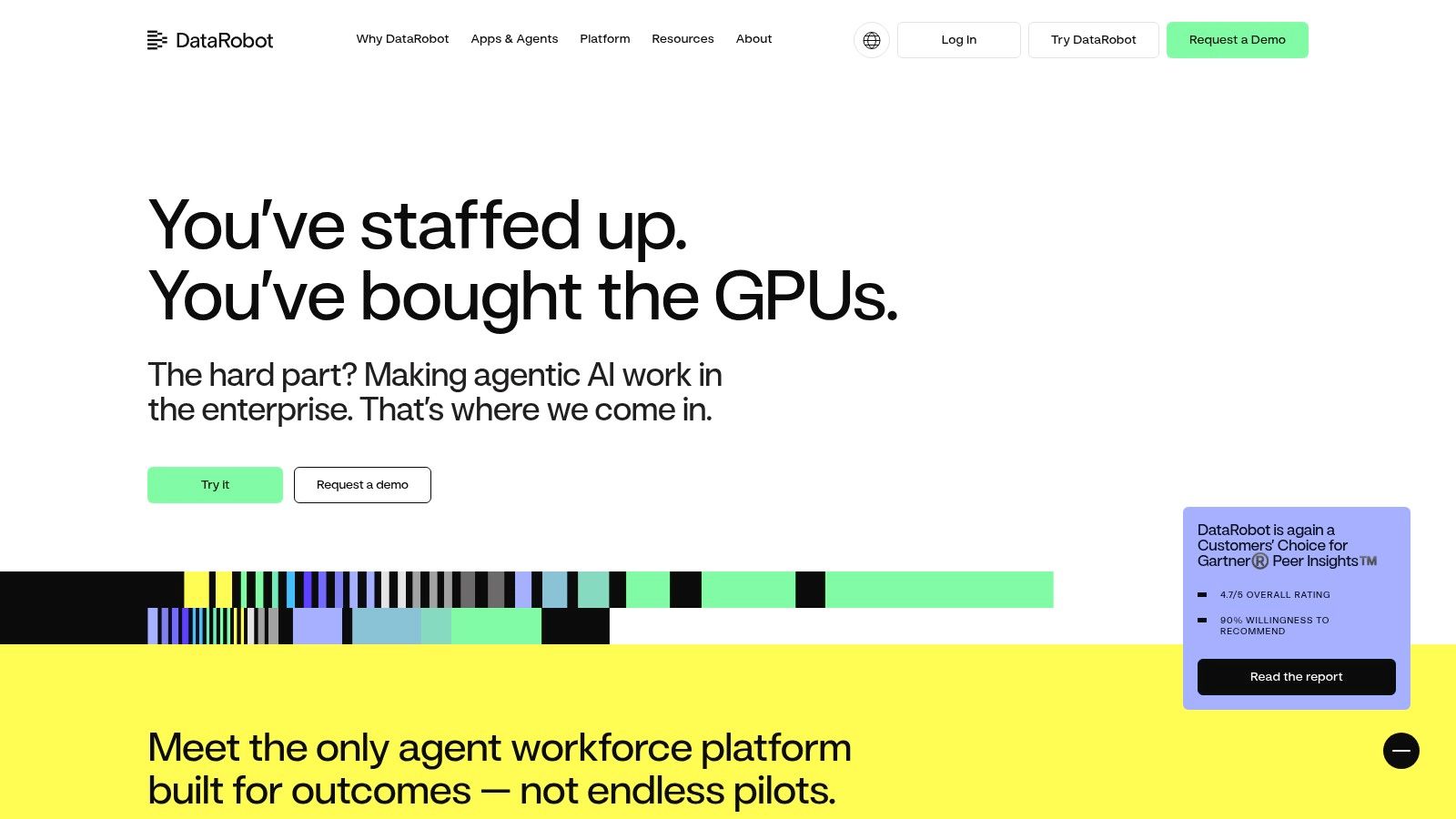
DataRobot is an end-to-end enterprise AI platform designed to take projects from proof-of-concept to full-scale production quickly. It combines traditional predictive modeling (like classification and regression) with generative AI capabilities, all managed under a unified MLOps framework. This makes it one of the best predictive analytics tools for large organizations that need robust governance, observability, and scalability across their entire AI portfolio.
Its core strength is accelerating deployment. With foundational app templates for common use cases like demand forecasting and tools to help you with predicting customer churn, teams can avoid reinventing the wheel. The platform is built for serious enterprise needs, offering multiple deployment options from SaaS to on-premise and full GPU support.
Key Features & User Experience
The platform provides a cohesive experience, managing the full AI lifecycle. Key value comes from:
Unified AI Platform: Combines predictive and generative AI tools in one place.
AI Foundation: Features managed notebooks, role-based access control, and one-click deployment for streamlined operations.
Deployment Flexibility: Supports SaaS, VPC, on-premise, and hybrid cloud environments to fit any IT infrastructure.
Practical Tips for Use
DataRobot is best suited for organizations aiming to operationalize multiple AI models, not just run a single experiment. Start by exploring the pre-built application templates to understand how you can accelerate your specific use cases. Given its enterprise focus, expect the pricing to be tailored to your needs, so engaging with their sales team early is the best path to understanding cost. It’s ideal for companies that prioritize governance and MLOps from day one.
Pros: Strong governance and observability; accelerators significantly reduce time to production.
Cons: Enterprise-level pricing is not public; may be overly complex for smaller teams or single projects.
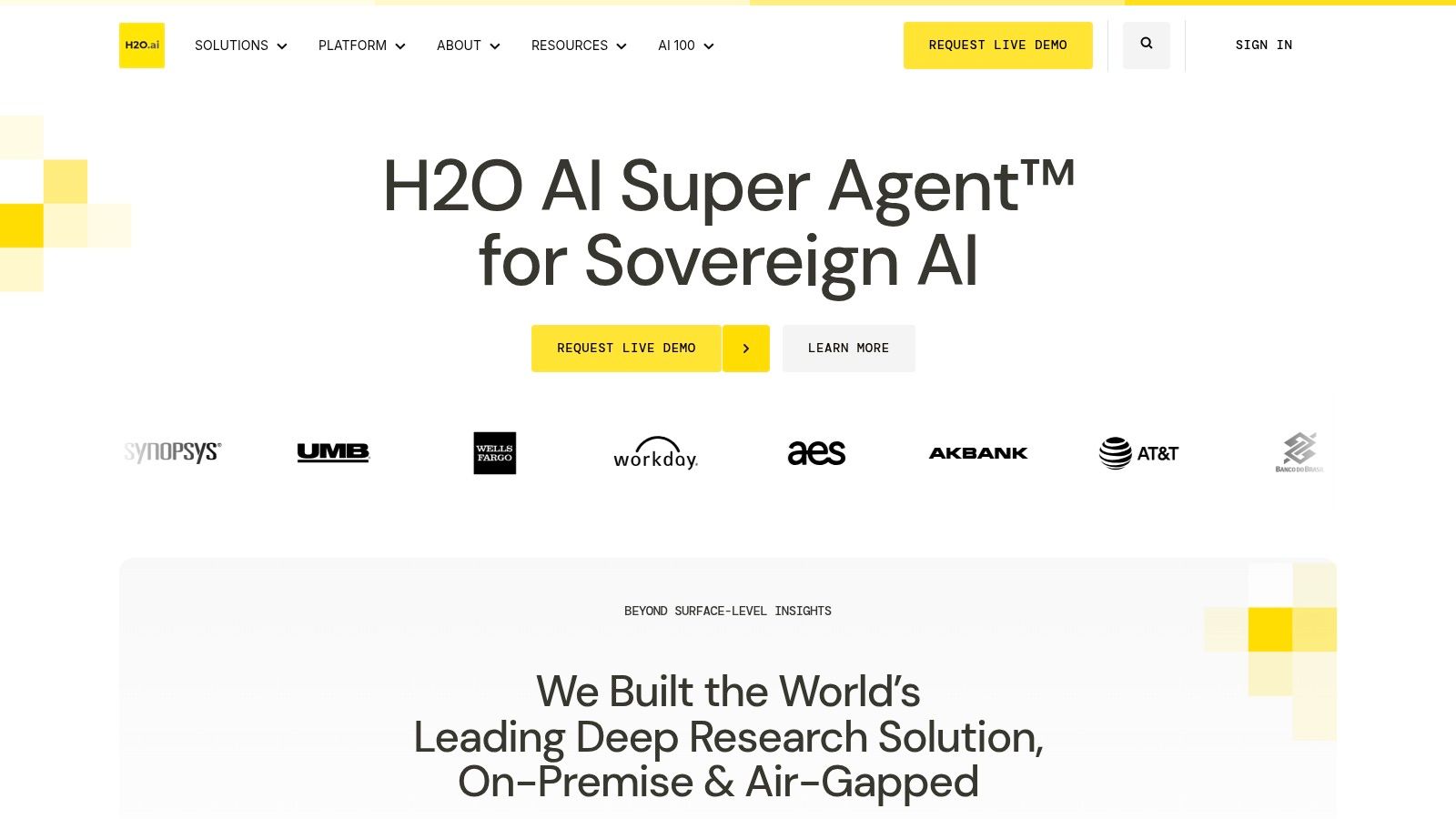
H2O.ai bridges the gap between the flexibility of open-source machine learning and the demands of enterprise-grade deployment. It offers a powerful ecosystem built around its open-source H2O-3 platform, complemented by its commercial Driverless AI product. This dual approach makes it one of the best predictive analytics tools for organizations that want to start with a strong community-backed foundation and scale into a fully supported, automated solution.
Its standout feature is Driverless AI, which automates much of the complex data science workflow, including feature engineering, model selection, and explainability. This is especially valuable for regulated industries like finance and healthcare, where model transparency is non-negotiable. The platform’s emphasis on security, offering air-gapped and on-premise deployments, provides an extra layer of confidence for handling sensitive data.
Key Features & User Experience
The platform caters to both data scientists who love coding and business users who need automated insights. Core strengths include:
Driverless AI: An advanced AutoML platform that automatically generates models and provides explainable AI dashboards.
Open-Source Core: H2O-3 is a widely adopted, distributed in-memory machine learning platform supported by a large community.
Security-First Deployments: Options for on-premise, virtual private cloud, or fully air-gapped environments to meet strict compliance needs.
Practical Tips for Use
Start by exploring the extensive documentation and tutorials for the open-source H2O-3 to understand the core mechanics. If your organization operates in a regulated field, the commercial Driverless AI is your logical next step for its built-in explainability and enterprise support. Pricing is quote-based, so be prepared to engage with their sales team to get a clear picture of the investment required for the commercial offerings.
Pros: Powerful AutoML with explainability; strong open-source foundation and community; ideal for regulated, privacy-sensitive industries.
Cons: Enterprise pricing is not public; some of the most advanced features are exclusive to the commercial version.
11. KNIME — KNIME Analytics Platform and KNIME Hub
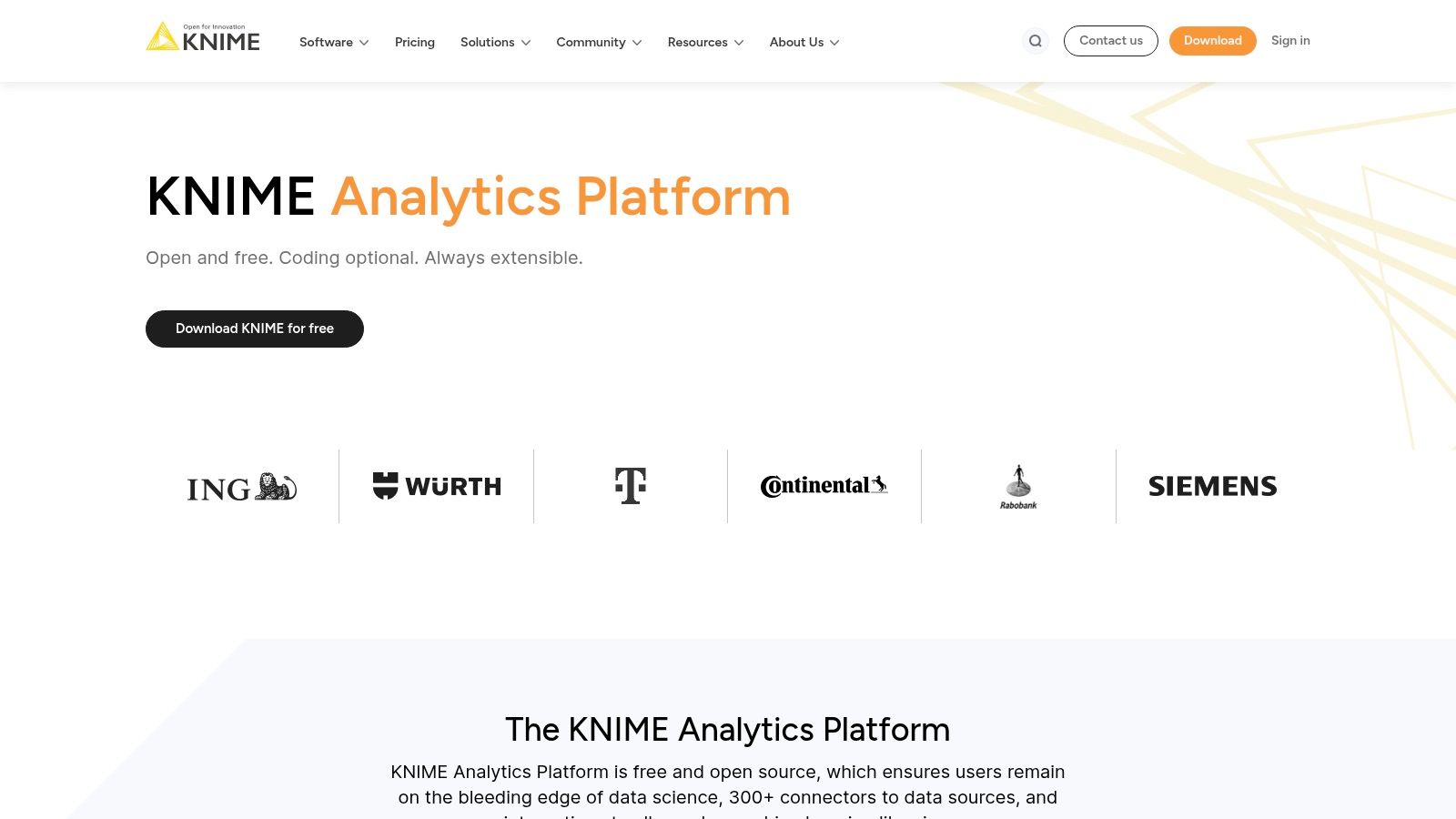
KNIME stands out by making powerful data science accessible to everyone, regardless of their coding expertise. Its core offering, the KNIME Analytics Platform, is a free and open-source tool that uses a visual, drag-and-drop interface. This allows you to build sophisticated predictive models without writing a single line of code, making it one of the best predictive analytics tools for teams with mixed technical skills.
The platform’s strength is its modular, workflow-based approach. You connect nodes to build a data pipeline, from data ingestion and cleaning to model training and deployment. For those who need more, it seamlessly integrates with Python and R, offering the best of both low-code simplicity and high-code power. The KNIME Hub then acts as a central repository for sharing, collaborating on, and reusing these workflows.
Key Features & User Experience
The visual interface is intuitive, allowing users to literally see their data science process unfold. Key elements include:
Visual Workflows: Build end-to-end analytics pipelines using a drag-and-drop system of nodes.
Extensive Connectors: Over 300 connectors to pull data from virtually any source, including databases, cloud services, and APIs.
KNIME Hub: A collaborative space to share workflows, components, and best practices with your team or the wider community.
Code Integration: Embed Python, R, or Java snippets directly into your visual workflows for custom logic.
Practical Tips for Use
Start by downloading the free Analytics Platform and exploring the pre-built example workflows available on the KNIME Hub; they are excellent learning resources. When you’re ready to scale, KNIME’s paid tiers offer transparent, credit-based pricing for automation and collaboration features. This makes it easy to start small and grow without a massive initial investment. Remember that the cloud version currently works best with cloud-accessible data sources.
Pros: Generous free and open-source platform; highly scalable from individual use to enterprise deployment with transparent entry-level pricing.
Cons: Enterprise governance features are reserved for paid tiers; cloud version doesn’t yet support on-premise private network access.
12. SAP Analytics Cloud — Embedded Predictive & Planning
SAP Analytics Cloud (SAC) excels by tightly integrating business intelligence (BI), augmented analytics, and enterprise planning into a single solution. This makes it one of the best predictive analytics tools for organizations already invested in the SAP ecosystem. Instead of exporting data to a separate tool, SAC allows users to run predictive scenarios directly on top of their live business data, from finance to supply chain.
Its strategic advantage is its ability to embed predictive insights directly into planning workflows. For instance, a financial planner can use the “Smart Predict” feature to automatically forecast revenue for the next quarter and then immediately use that forecast to adjust budgets within the same interface. This seamless transition from insight to action is what sets SAC apart for enterprise-level decision-making.
Key Features & User Experience
The user experience is designed for business users, providing guided workflows for complex tasks. Key features include:
Smart Predict: An automated machine learning feature that lets business users create predictive models for classification, regression, and time-series forecasting without deep statistical knowledge.
Embedded Analytics: Predictive capabilities are woven directly into dashboards and planning modules, not siloed in a separate environment.
Live Data Connectivity: Connects directly to SAP data sources like S/4HANA and BW/4HANA, eliminating data duplication and ensuring insights are based on the latest information.
Practical Tips for Use
To leverage SAC effectively, start with a clear business planning use case, such as sales forecasting or headcount planning. This allows you to see the immediate value of integrating predictive insights with your planning processes. While Smart Predict is user-friendly, the best results come from collaboration between business analysts who understand the context and data specialists who can ensure data quality.
Pros: Unmatched integration with SAP data sources; empowers business users with embedded, automated predictive tools.
Cons: Primarily beneficial for companies within the SAP ecosystem; may be less flexible for non-SAP data environments.
SAP Analytics Cloud — Embedded predictive, planning & BI for SAP users
★★★★
💰 Subscription/enterprise pricing
👥 SAP-centric enterprises, finance & ops teams
✨ Smart Predict, live data connection, unified planning
Beyond the Tool: When a Strategic Partner Makes All the Difference
Navigating the world of predictive analytics is a bit like planning a major expedition. You’ve just reviewed the map, scouted the best gear, and compared a dozen top-tier vehicles from comprehensive platforms like SAS Viya and DataRobot to more specialized open-source options like KNIME and H2O.ai. Each of these tools offers a powerful engine to get you where you want to go. But having the best engine doesn’t guarantee you’ll reach your destination.
The real journey begins now, and it’s defined by the decisions you make next. The most common pitfall isn’t choosing the wrong tool; it’s assuming the tool alone is the solution. The best predictive analytics tools are only as effective as the strategy behind them, the quality of the data fueling them, and the team guiding them.
From Tool Selection to True Transformation
Think back to the tools we covered. Alteryx excels at empowering business analysts with automated workflows, while SAP Analytics Cloud embeds forecasting directly into enterprise planning. Marketplaces like AWS and Google Cloud offer a vast ecosystem of ready-to-deploy models. The key takeaway is that there is no single “best” tool for everyone. The right choice is deeply personal to your business context.
Your decision should hinge on a few core questions:
What is the specific business problem you need to solve? Are you trying to reduce customer churn, optimize inventory, or predict equipment failure? The problem dictates the required complexity.
What does your internal team look like? Do you have a dedicated data science department ready to customize open-source models, or do you need a low-code platform that your existing analysts can master quickly?
How will this tool integrate with your current systems? A powerful predictive model is useless if it lives in a silo. It needs to feed insights directly into your CRM, ERP, or operational software to drive real-time action.
Answering these questions honestly often reveals a critical gap. It’s the space between what an off-the-shelf product can do and what your unique business actually needs to create a competitive advantage.
The Build vs. Buy Dilemma: When to Call in the Experts
This brings us to the ultimate strategic choice: build or buy? For many standard, well-defined problems, “buying” a subscription to one of the platforms we’ve discussed is a fantastic, cost-effective choice. They provide the infrastructure and pre-built components to get you started fast.
However, when you’re tackling a core business challenge that is unique to your market, your customers, or your operational processes, a generic solution will only get you so far. This is where a strategic partner becomes invaluable. AI and data consulting firms don’t just sell you software; they partner with you to build a custom solution. They help you:
Define the Right Problem: They dig deep to ensure you’re solving a problem that will deliver maximum ROI, not just chasing a tech trend.
Build a Bespoke Model: Using your unique data, they can construct a predictive model tailored precisely to your business logic, creating an asset that competitors can’t easily replicate.
Ensure Seamless Integration: A partner handles the complex engineering work of weaving the model into your existing workflows, ensuring it’s not just a dashboard but an active part of your decision-making process.
Upskill Your Team: The best partners don’t create dependency. They empower your team with the knowledge and skills to manage, interpret, and evolve the solution over time.
Choosing one of the best predictive analytics tools is a crucial first step. But turning that tool into a genuine, market-leading advantage often requires a guide who knows the terrain inside and out. The real magic happens when you pair the right technology with the right expertise, transforming a powerful tool into a game-changing business strategy.
Ready to move beyond off-the-shelf solutions and build a predictive analytics strategy that drives real business value? The team at NILG.AI specializes in crafting custom AI solutions that solve your most complex challenges, from initial strategy to full-scale deployment. Request a proposal
Like this story?
Subscribe to Our Newsletter
Special offers, latest news and quality content in your inbox.
Signup single post
Recommended Articles
Article
Digital business transformation examples: 10 Real-World Case Studies
Feb 10, 2026 in
Listicle: Examples
Discover digital business transformation examples and how AI, data, and strategy fuel growth with practical, actionable insights.
Master customer retention rate calculation with this practical guide. Learn the formulas, see real-world examples, and get actionable tips for business growth.
We use cookies on our website to give you the most relevant experience by remembering your preferences and repeat visits. By clicking “Accept All”, you consent to the use of ALL the cookies. However, you may visit "Cookie Settings" to provide a controlled consent.
This website uses cookies to improve your experience while you navigate through the website. Out of these, the cookies that are categorized as necessary are stored on your browser as they are essential for the working of basic functionalities of the website. We also use third-party cookies that help us analyze and understand how you use this website. These cookies will be stored in your browser only with your consent. You also have the option to opt-out of these cookies. But opting out of some of these cookies may affect your browsing experience.
Necessary cookies are absolutely essential for the website to function properly. These cookies ensure basic functionalities and security features of the website, anonymously.
Cookie
Duration
Description
cookielawinfo-checkbox-analytics
11 months
This cookie is set by GDPR Cookie Consent plugin. The cookie is used to store the user consent for the cookies in the category "Analytics".
cookielawinfo-checkbox-functional
11 months
The cookie is set by GDPR cookie consent to record the user consent for the cookies in the category "Functional".
cookielawinfo-checkbox-necessary
11 months
This cookie is set by GDPR Cookie Consent plugin. The cookies is used to store the user consent for the cookies in the category "Necessary".
cookielawinfo-checkbox-others
11 months
This cookie is set by GDPR Cookie Consent plugin. The cookie is used to store the user consent for the cookies in the category "Other.
cookielawinfo-checkbox-performance
11 months
This cookie is set by GDPR Cookie Consent plugin. The cookie is used to store the user consent for the cookies in the category "Performance".
viewed_cookie_policy
11 months
The cookie is set by the GDPR Cookie Consent plugin and is used to store whether or not user has consented to the use of cookies. It does not store any personal data.
Functional cookies help to perform certain functionalities like sharing the content of the website on social media platforms, collect feedbacks, and other third-party features.
Performance cookies are used to understand and analyze the key performance indexes of the website which helps in delivering a better user experience for the visitors.
Analytical cookies are used to understand how visitors interact with the website. These cookies help provide information on metrics the number of visitors, bounce rate, traffic source, etc.
Advertisement cookies are used to provide visitors with relevant ads and marketing campaigns. These cookies track visitors across websites and collect information to provide customized ads.