

Guide: Explainer
What Is Agile Transformation? A Strategic Guide to Faster, Smarter Change
NILG.AI · April 15, 2026
Let's be honest, "agile transformation" gets thrown around a lot. So, what does it actually mean for your business strategy?
Forget the buzzwords for a second. At its core, agile transformation is about redesigning your company to not just survive change, but to actually thrive on it. It’s a fundamental shift from rigid, long-term plans to a more fluid system where teams can deliver value fast and pivot the moment new information comes in.
What Is Agile Transformation Anyway?
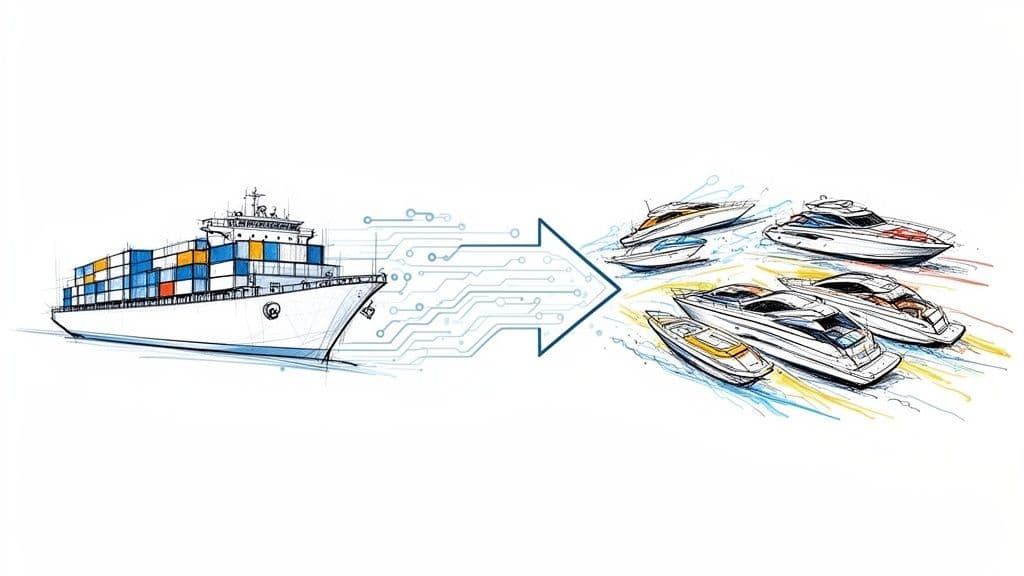
Think of a traditional business as a massive cargo ship. It’s powerful, for sure, but turning it around is a slow, monumental task. If you need to change course, it takes miles.
An agile transformation is like trading that single, cumbersome ship for a fleet of nimble, interconnected speedboats. Each one can react instantly to shifting currents, navigate tight spots, and get where it's going much, much faster. That’s the whole idea: making your business quick and precise enough to respond to what customers want and what the market is doing right now.
This isn't just about adopting a few new project management tools. It’s a complete cultural and operational overhaul, moving away from a top-down, command-and-control structure. Instead, you build your organization around empowered, self-sufficient teams. You’re essentially changing the company’s operating system from "follow the plan" to "achieve the goal."
From Rigid Rules to Flexible Frameworks
The difference between a traditional company and an agile one is night and day. Gone are the days of annual planning cycles and projects that drag on for years. Agile organizations work in short, focused cycles (often called "sprints") that allow them to get constant feedback, adjust on the fly, and deliver real value to the customer over and over again.
An agile transformation isn't just about changing what you do; it's about changing how you think. It's about embracing uncertainty, prioritizing customer collaboration, and empowering teams to make decisions.
This isn’t some niche trend, either. The market for enterprise agile transformation services was valued at $27,621.57 million in 2022 and is expected to explode to $141,985.14 million by 2032. That’s a clear signal that businesses everywhere are scrambling to become more flexible and responsive.
A quick look at how these two models operate side-by-side makes the difference crystal clear.
Traditional Operations vs Agile Transformation
This table gives a snapshot of the fundamental shift in thinking, structure, and results.
| Aspect | Traditional Approach | Agile Approach |
|---|---|---|
| Planning | Long-term, fixed plans created at the top and passed down. | Adaptive planning in short cycles (sprints); priorities adjust based on feedback. |
| Structure | Hierarchical and siloed departments (e.g., Marketing, IT, Sales work separately). | Cross-functional, self-organizing teams focused on a common goal. |
| Execution | Follows a strict, linear "waterfall" process from start to finish. | Iterative and incremental; a working product is delivered and improved upon in each cycle. |
| Feedback | Customer feedback is gathered at the end of the project, often too late to change course. | Continuous feedback loops with customers and stakeholders throughout the process. |
| Risk | High risk; major issues are often discovered late in the process, leading to costly fixes. | Lower risk; problems are identified and addressed early in each sprint, minimizing impact. |
As you can see, the agile approach is designed to reduce risk and increase responsiveness by breaking down big, intimidating goals into small, manageable steps.
A Mindset for Lasting Change
Ultimately, this is a profound change in how people think and work together. The goal isn’t a temporary project; it’s about embedding a new way of operating into your company’s DNA. This kind of deep-seated shift is similar in spirit to what happens in Transformational Coaching, where the focus is on creating changes that stick. You want adaptability to become a reflex, not a forced initiative.
Why Your Business Needs to Transform Now
Let's be blunt: the main reason to even think about an agile transformation is survival. In a world where customer tastes and market trends can shift on a dime, companies that can't adapt get left behind. Sticking to a rigid, five-year plan is like trying to navigate a constantly changing city using an old, paper map.
Going agile is about building the ability to react right into the DNA of your business. It means you can steer confidently, no matter how wild the currents get. But this isn't just about playing defense—it's how you go on the offensive to find new growth.
Accelerate Your Time to Market
In most markets, being first or being fastest is a massive advantage. An agile way of working can radically shorten the time it takes to get from a bright idea to a launched product. You stop spending months (or years!) building a "perfect" product behind closed doors. Instead, your teams get a working version out there fast and then make it better in short, focused cycles.
This means real customers are using your product sooner. You start grabbing market share, answering competitors, and bringing in revenue while others are still stuck in planning meetings. Every one of these short cycles, or sprints, is a chance to launch something, learn from it, and pull ahead of the pack.
The data tells a compelling story. Projects run with agile methods see a 75% success rate, which is a huge leap from the 56% rate of traditional "waterfall" projects. With 98% of businesses saying they found success after making the switch, it’s easy to see why agile is no longer just a trend. You can dig into more data on the state of agile to see just how widespread its impact has become.
Boost Team Productivity and Morale
An agile transformation can completely re-energize your people. When you break down the walls between departments and create cross-functional teams, you get rid of the frustrating bottlenecks and handoffs that bring work to a grinding halt. You give teams a clear goal and the freedom to figure out the best way to hit it.
That sense of ownership is a game-changer for motivation. When people can see the direct results of their work, their engagement and morale go through the roof.
Agile gets rid of a "wait for permission" culture and replaces it with one of "let's get this done." It builds a foundation of trust and accountability, creating teams that aren't just more productive but are genuinely invested in the company's success.
This new way of working also creates a much healthier atmosphere. Constant feedback and regular check-ins help teams sort out small issues before they blow up, which helps prevent burnout and makes collaboration feel natural, not forced.
Dramatically Improve Product Quality
Have you ever launched a product, held your breath, and then realized it completely missed the mark with your customers? Agile is built to stop that from ever happening again. At its heart, the whole process is one big, continuous feedback loop.
By delivering work in small, testable pieces and keeping customers and stakeholders in the loop, you make sure you're building something people actually want. This constant reality check lets your team adjust course based on real-world feedback, not just assumptions made in a conference room months ago.
This iterative approach to quality control gives you a few key advantages:
- Early Defect Detection: Bugs get squashed within a sprint, not months down the line when they've become a costly, tangled mess.
- Customer-Centric Design: The product gets better based on what users are actually doing, which leads to happier customers who stick around.
- Reduced Risk: Instead of making one giant bet on a single launch, agile minimizes risk by letting you test and prove your ideas in small, safe-to-fail steps.
Amplify Your Agility with AI
For forward-thinking leaders, an agile transformation is the perfect launchpad for intelligent automation. The real competitive advantage emerges when you combine operational speed with data-driven insights. By weaving AI into your agile framework, you don’t just react to market changes faster—you begin to anticipate them.
Imagine your agile teams using AI-powered tools to automate repetitive tasks, freeing them to focus entirely on creative problem-solving and strategic initiatives. Think about using predictive analytics to generate more accurate sprint forecasts or automatically prioritize your product backlog based on projected customer value. This is where specialized AI and data consulting firms like NILG.AI help businesses build a decisive edge. By layering AI onto an agile foundation, you’re not just reacting faster—you’re creating the future.
The Four Stages of Agile Transformation Maturity
Think of an agile transformation not as flipping a switch, but as a journey with a clear map. Knowing the different stages of maturity helps you pinpoint exactly where you are, see the roadblocks ahead, and chart a realistic course forward. It’s a process.
The real goal isn't just to start "doing" agile by adopting a few new ceremonies. It's to fundamentally "be" agile, weaving that flexibility and quick response time right into the fabric of your company's DNA. This perspective is crucial because you don't leap from a single team's experiment to a fully adaptive organization overnight. Each stage is built on the one before it, demanding shifts in how people think, work, and lead.
Stage 1: Ad Hoc Agile
This is where almost everyone starts. Agility usually bubbles up from the ground floor, driven by a handful of motivated teams or even just one passionate individual who knows there’s a better way to get things done. You’ll often see a team experimenting with Scrum or Kanban for a specific project, but they’re usually operating in a silo.
At this point, you're likely seeing:
- Isolated Pockets: Agile practices are stuck in one or two teams, typically in software development or IT.
- No Formal Support: There’s no official strategy or budget from the top; it’s all happening organically.
- Inconsistent Practices: Teams are making it up as they go, leading to mixed results and no standard playbook.
The main objective here is simply exploration—proving that this agile thing can actually work in your company’s unique environment. The biggest hurdle is the friction that inevitably comes from these agile teams bumping up against traditional departments that run on entirely different schedules and approval processes.
Stage 2: Intentional Agile
Okay, so those early experiments worked. They’ve caught the eye of a few leaders who are starting to see the potential. At this stage, the company decides to get more deliberate, moving from isolated trials to a more structured rollout, usually within an entire department or business unit.
This is where the game changes. Agile stops being a "team thing" and starts becoming a "departmental strategy." You absolutely need an executive sponsor to secure the resources and provide the air cover for a wider implementation.
This is when things get more formal. You might see the first real investment in agile coaching and training. Roles like Product Owner and Scrum Master get clearly defined, and teams start standardizing on shared tools. The goal is to standardize and scale what’s working to get more predictable results. The trap here? Creating a brand-new silo—an "agile department" that still struggles to work smoothly with the rest of the business.
Stage 3: Systemic Agile
Now we’re talking. This stage is a huge leap forward. Agile finally breaks free from its departmental confines and becomes a cross-functional way of working across the whole company. It’s not just for the tech folks anymore; teams in marketing, HR, finance, and operations are all starting to work in agile ways.
This kind of alignment is what unlocks the big-picture benefits everyone is after.
As you can see, the true magic happens when agile starts driving company-wide improvements in speed and quality, not just making individual teams more efficient.
The focus here shifts to achieving true business agility. Everyone, regardless of their title, is aligned around a single mission: delivering value to the customer. You start seeing teams organized around value streams instead of old-school functional hierarchies. The biggest challenge is the deep, difficult work of cultural change—dismantling old power structures and getting leaders to move from directing work to empowering their teams.
Stage 4: The Adaptive Organization
This is the holy grail of agile maturity. Here, agile is no longer a project or an initiative—it's just how business is done. The agile mindset is second nature to everyone, from the C-suite to the front lines. The entire company operates like a network of empowered, self-managing teams that can sense and react to market shifts with incredible speed.
An adaptive organization truly lives and breathes:
- A Pervasive Agile Mindset: Everyone defaults to learning, feedback, and collaboration.
- Continuous Improvement: The company is always looking for ways to get better, tweaking its own processes and structures on the fly.
- Customer-Centricity: Every single decision is weighed against how it impacts the customer.
The goal is no longer just adaptation, but sustainable innovation. The business has effectively become a learning machine, capable of evolving on its own. It's a long road, and navigating the complexities of each stage is where expert partners like NILG.AI can make all the difference, helping ensure your journey builds a real, lasting competitive advantage.
Your Roadmap to a Successful Agile Transformation
Alright, so you get the idea of an agile transformation. But how do you actually pull it off without it all fizzling out? It’s one thing to talk theory, but it’s another thing entirely to make it stick. You don't need a vague mission statement; you need a practical, step-by-step game plan that leaders can use to guide everyone through the change.
Think of this less like a rigid, top-down mandate and more like a series of smart moves. Each step is designed to build momentum and show real value, creating a solid foundation for everything that comes next.
Step 1: Secure Executive Buy-In and Define the Vision
Before you change a single process, you have to start at the top. An agile transformation is a massive cultural shift, and it’s dead in the water without genuine, visible support from your leadership team. This is about more than just signing off on a budget; it means the C-suite needs to be the biggest cheerleaders for the change.
Leaders have to spell out the "why." Why are we doing this? To ship products faster? To make customers happier? To out-innovate the competition? This clear vision becomes the North Star for the entire company, giving everyone a shared purpose to rally around.
A successful agile transformation is never just a grassroots effort. It requires unwavering executive sponsorship to break down organizational barriers, secure resources, and model the new, agile mindset.
Step 2: Form a Core Transformation Team
Once you have leadership's full support, your next move is to assemble a dedicated team to lead the charge. You can think of this group as your agile special-ops team, sometimes called a Lean-Agile Center of Excellence (LACE). They're the ones who will act as the engine for this whole transformation.
This team should be a mix of respected people from different departments who are genuinely excited about agile. Their mission is to:
- Create the initial game plan: Decide which agile practices and tools the company will start with.
- Coach and guide the teams: Be the go-to experts for anyone making the switch.
- Clear the roadblocks: Find and remove the organizational hurdles that are slowing people down.
- Share the wins: Keep the rest of the company in the loop and excited about the progress.
This core team gives the transformation direction and stops it from dissolving into chaos.
Step 3: Launch a Pilot Project
Now it's time to get your hands dirty. Instead of trying to flip the entire company to agile at once—a recipe for disaster—you start small. The goal is to pick a pilot project to prove that this agile thing can actually work here, in your company, and to score a quick, visible win.
The perfect pilot project has high visibility but manageable risk. You want something important enough that people will notice its success, but not so mission-critical that a few early bumps in the road would be catastrophic. The success of this pilot becomes your best internal marketing tool, building the credibility you need for a wider rollout.
If you're looking to build out your initial strategy, our guide to crafting a modern digital transformation roadmap can give you a great head start.
Step 4: Develop an Internal Training Program
When your pilot project starts showing results, people will get curious. This is the perfect time to roll out a formal training program. This needs to be more than a one-off workshop on Scrum ceremonies; it has to be about teaching the agile mindset.
A solid training program should really hit on three things:
- The Agile Mindset: The why behind collaboration, customer feedback, and adapting to change.
- Key Practices: The how of running core agile processes like Sprints (short, focused work cycles), Daily Standups (quick 15-minute check-ins), and Retrospectives (meetings to reflect and improve).
- Essential Roles: What it actually means to be a Product Owner (who prioritizes the work) or a Scrum Master (who acts as the team's coach).
Good training creates a common language and understanding, which makes everything much easier as you start to scale.
Step 5: Scale and Refine Incrementally
With a successful pilot in the books, a core team running point, and a training program in motion, you're ready to start scaling. But "scaling" doesn't mean forcing every team to switch overnight. The rollout should be gradual and iterative—just like agile itself.
The key is to expand to the next group of teams that are ready and willing, learning and adapting as you go. A huge part of this stage is building a governance model that actually supports agility instead of crushing it. This means shifting away from rigid, top-down control and toward a system that empowers teams while still keeping everyone aligned with the bigger business goals. By scaling thoughtfully, you make sure your agile transformation becomes a lasting part of your company’s DNA.
How AI Creates a Strategic Advantage in Agile Transformation
Adopting an agile framework gives your company a serious speed boost, but what if you could make it smarter, too? This is where an agile transformation becomes a true strategic lever. While agile provides the structure to deliver work quickly, Artificial Intelligence (AI) provides the insights to make every single cycle better and more effective than the last.
For any business going through an agile transformation, bringing in AI and data expertise isn't just some "nice-to-have" add-on. It's the fuel that accelerates the whole process. This isn’t about jumping on a bandwagon; it’s about making your new agile system actually work harder and smarter for you right from the start.
From Doing Agile to Thinking Smarter
It's a common trap. A company adopts all the agile ceremonies—the daily stand-ups, the sprints, the retrospectives—but they’re still making decisions based on the same old data and gut feelings. Real agility isn't just about moving faster; it's about making better choices while you're moving fast. This is exactly where AI completely changes the game.
Instead of just looking backward at historical data, your teams can start making decisions that are forward-looking. AI helps you answer the tough questions with a lot more confidence:
- Which of these new features will customers actually value the most?
- Where are the hidden roadblocks that are secretly slowing us down?
- What tedious tasks can we automate so our best people can focus on innovation?
When you weave AI into your process, you stop just reacting to the market and start proactively shaping what happens next. It’s the difference between being a fast follower and becoming a leader.
Freeing Your Teams with AI Automation
One of the quickest wins you'll see from AI is its ability to take over the repetitive, soul-crushing work. Think about how many hours your teams spend on stuff like manual data entry, pulling reports, or basic quality checks. It's all necessary, but it drains time and energy that would be much better spent solving creative problems.
Picture a professional services firm that's gone agile to speed up project delivery. The new workflow helps, but consultants are still drowning in manual data analysis and report generation. By bringing in an AI automation solution, the company can suddenly:
- Instantly synthesize data from multiple sources using advanced algorithms.
- Automatically generate initial drafts of reports and presentations.
- Flag anomalies or key insights for human experts to investigate further.
This doesn't get rid of the team; it makes them more powerful. Instead of being buried in data grunt work, consultants can now focus on high-level strategy and client relationships—the work that really drives value.
By automating routine tasks, you give your teams back their most valuable resource: time. This reclaimed time is then funneled directly into innovation, strategic thinking, and delivering a better customer experience.
Sharpening Decisions with Predictive Analytics
Agile is all about prioritization, but figuring out what to build next often feels more like an art than a science. Predictive analytics helps replace that guesswork with cold, hard data. By analyzing past performance, user behavior, and market trends, AI models can actually forecast the potential impact of different features you're considering.
This gives a Product Owner the ability to build a backlog that isn't just organized, but truly optimized for business value. To really get this right, it helps to know how the pieces fit together. For a solid primer, learning how AI agents explained in a business setting can execute these kinds of complex jobs is a great place to start. That knowledge helps connect the dots between AI concepts and how they actually work in your day-to-day agile flow.
Predictive models can also make your sprint planning more realistic, giving teams a much better idea of what they can actually get done. This leads to more reliable delivery schedules and builds a ton of trust with stakeholders. As you start mixing in these new tools, remember to manage the human side of the change. Our guide to AI change management offers practical advice for getting your teams on board.
Ultimately, mixing agile with AI creates a powerful feedback loop. Agile gives you the framework to iterate fast, and AI provides the intelligence to make sure every single iteration is smarter than the one before. That’s how an agile transformation becomes a real, lasting competitive advantage.
Common Pitfalls and How to Sidestep Them
Let's be real: an agile transformation is exciting, but it's never a straight line from A to B. Even with a perfect plan on paper, you're going to hit some speed bumps. The secret isn't avoiding every single problem—it's knowing what they look like before you run into them.
Think of it as having a map of the tricky terrain ahead. We're going to walk through the most common traps that can derail an agile effort and talk about practical ways to keep your journey moving forward.
The Pitfall of Cultural Resistance
I've seen it a hundred times: the single biggest hurdle isn't a new tool or process. It's the people. Cultural resistance is a very real, very human reaction to change.
If your company has spent years rewarding individual heroics and operating in rigid hierarchies, you can't just flip a switch and expect everyone to embrace collaboration and experimentation. It feels unnatural and even threatening to long-held ways of working.
To get past this, you have to make the change feel safe and worth the effort.
- Find Your Change Champions: Look for the people in every department who are genuinely excited about this. Their grassroots enthusiasm is far more powerful than any memo from the top.
- Over-Communicate (The Right Way): Get in front of people. Host town halls, run Q&A sessions, and be brutally honest about the "why" behind this shift. Answer the tough questions.
- Celebrate the Small Wins: When one team ships a feature faster or gets great customer feedback, make a big deal out of it. Success stories are contagious and are the best way to win over the skeptics.
Wavering Executive Support
An agile transformation can't survive on a kickoff email and a budget approval. It needs constant, visible backing from your leadership team. When executives get distracted by the next shiny object, it sends a clear signal: this isn't a real priority.
Teams can smell fading support from a mile away and will quickly slide back into their old, comfortable habits.
Executive sponsorship is the fuel for an agile transformation. When it runs out, the entire engine grinds to a halt. Leaders must not only fund the change but actively model the agile behaviors they want to see.
The best way to keep leaders locked in is to connect your agile efforts directly to the business outcomes they obsess over. Show them the data. Show them how pilot teams are delivering value faster, with better quality, and making customers happier. Make the results impossible to ignore.
Treating Agile as a Process, Not a Mindset
It’s incredibly easy to fall into the trap of just going through the motions. You do the daily stand-ups, the retrospectives, and you use all the right jargon. But if you’re only "doing agile" without actually "being agile," you end up with all the meetings and none of the benefits.
This is what we call "zombie Scrum"—teams look like they're agile, but deep down, nothing has fundamentally changed.
Here's how you avoid creating a process zombie:
- Anchor Everything in the 'Why': Every training, every coaching session should circle back to the core agile principles. Remind everyone that this is about customer collaboration and responding to change, not just filling out a Jira ticket.
- Make It Safe to Fail: Real agility is learned through experimentation. You have to build a culture where a team can try something new, have it not work out, and share the lesson without fear of blame.
- Hire for Agility: When you bring new people onto the team, don't just look at their technical skills. Screen for curiosity, a collaborative spirit, and a genuine desire to learn and adapt.
Navigating these challenges is a key part of any major organizational change. You can learn more by reading about the broader digital transformation challenges that often go hand-in-hand with an agile journey.
A Few Common Questions About Agile Transformation
Even with the best game plan, you're going to have questions as you start shifting how your company works. It's only natural. Let's tackle some of the big ones I hear all the time from business leaders.
How Long Does an Agile Transformation Take?
Everyone wants a neat timeline, but the honest answer is: it varies. You can get a pilot team up and running and see some real wins in as little as 3 to 6 months. But to truly change the DNA of an entire organization? You’re realistically looking at 2 to 3 years, maybe even more.
The timeline really depends on your company's size, how complex your operations are, and what your culture is like today.
The real key is to stop thinking about a finish line. Agile isn't a project with an end date; it's a new way of operating. Think of it as a marathon of steady improvements, not a sprint you can just be "done" with.
Is Agile Just for Tech Companies?
Not at all. This is a huge misconception. While Agile was born in the software world, its principles are incredibly effective for just about any team that has to juggle priorities and deliver work in a changing environment.
We've seen marketing, HR, finance, and even manufacturing teams adopt these methods with fantastic results. Imagine a marketing team using two-week "sprints" to launch and test ad campaigns. Instead of waiting months for results, they get feedback right away and can tweak their messaging on the fly. If your department needs to be responsive, it can benefit from Agile.
What's the Single Biggest Factor for Success?
Hands down, it's leadership commitment. An agile transformation is fundamentally a cultural one, and it will absolutely fail without active, visible, and constant support from the top.
And I don't just mean signing off on the budget. Leaders have to walk the walk. They need to model the very behaviors they want to see, like being open to feedback, truly empowering teams to make their own decisions, and personally stepping in to clear roadblocks that get in the way. When people see their leaders living the change, it becomes real.
Ready to turn these ideas into a concrete plan? NILG.AI specializes in guiding businesses through their agile journey, using AI to speed up results and build a real competitive edge. Request a proposal