

Guide: Explainer
Artificial Intelligence Disruption: Guide for Executives
NILG.AI · May 18, 2026
Most advice on artificial intelligence disruption is lazy. It tells executives to “experiment,” “upskill,” and “watch the space.” That’s how companies drift into expensive pilots, fragmented tooling, and internal resistance.
The issue isn’t whether AI matters. It does. The core challenge is whether your operating model can absorb it fast enough to matter. If your workflows, incentives, governance, and data foundations don’t change, you won’t get transformation. You’ll get demos.
I’ll be blunt. Artificial intelligence disruption is not a technology trend to monitor. It’s a management problem to solve. The companies that treat it like a software purchase will stall. The ones that treat it like a redesign of how decisions, service delivery, and execution happen will pull ahead.
What Is Artificial Intelligence Disruption Anyway
Artificial intelligence disruption isn’t just automation with better marketing. It’s a shift in how a business creates value, delivers it, and captures margin.
That distinction matters. A workflow tool helps a team work faster. Artificial intelligence disruption changes which work still needs people, which decisions can be systematized, and which business models become cheaper, faster, and harder to defend against. That’s why this belongs in the boardroom, not just the IT roadmap.
Historically, AI moved from a niche research topic through periods of disappointment in the 1970s and 1980s, then hit major milestones with Deep Blue in 1997, ImageNet in 2012, and AlphaGo in 2016. That progression tracks the move from brittle, rule-based systems to scalable machine learning. The commercial signal is now impossible to ignore. The global AI infrastructure market is projected at $158.3 billion in 2025 and $418.8 billion by 2030, implying a 21.5% CAGR, according to this AI milestone timeline and market context.
It changes the rules, not just the tools
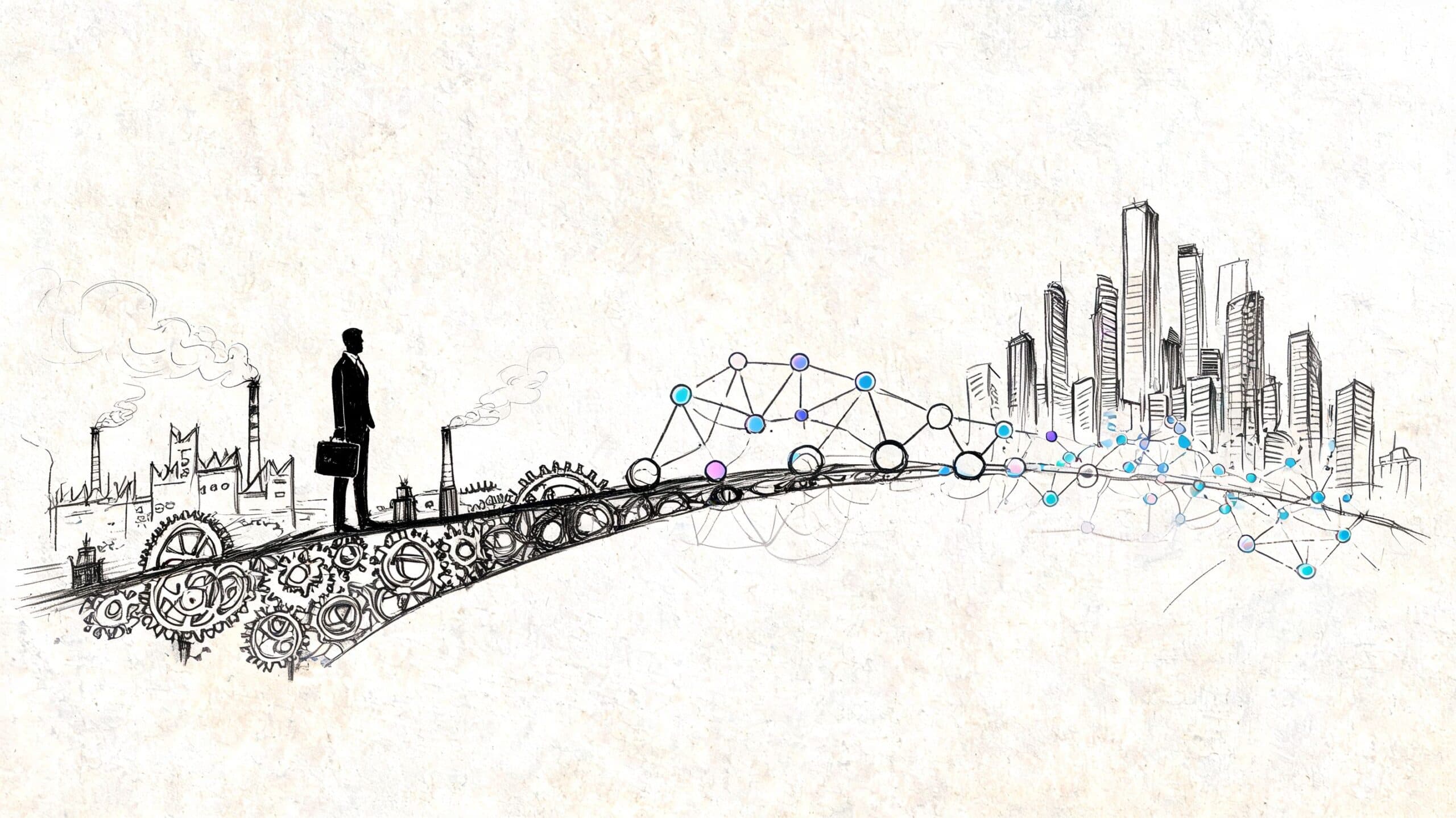
A useful analogy is the shift from steam power to electricity. Early adopters didn’t win because they swapped one machine for another. They won because they redesigned factories around the new capability. AI works the same way.
If your team plugs a language model into an old approval chain, you get minor efficiency. If you redesign the operating flow so AI drafts, classifies, predicts, escalates, and routes work before people touch it, you get a different business.
That’s also why content-heavy functions are changing quickly. Search, internal knowledge access, support, and research workflows now depend on how well your information is structured for machine-mediated discovery. If your team is rethinking how expertise gets surfaced, these essential strategies for AI content are useful because they address the practical side of being found and understood in AI-driven environments.
Artificial intelligence disruption starts when customers, employees, and competitors stop caring how you used to organize work.
What executives should actually ask
Don’t ask, “Where can we use AI?” That question is too broad and usually produces toy projects.
Ask these instead:
- Which decisions are slow and repetitive: Pricing, support routing, forecasting, claims triage, compliance checks, and internal knowledge retrieval are common candidates.
- Where is labor doing system glue work: If people spend time moving information between systems, AI and automation can compress that layer fast.
- Which customer expectations are changing first: Faster responses, personalized recommendations, and always-on service reset the baseline before your annual planning cycle catches up.
The core idea is simple. Artificial intelligence disruption happens when intelligence becomes embedded in operations, not when a team buys access to a model.
Key Drivers Making AI Disruption Inevitable
This wave is different for two reasons. First, the technology got much better. Second, the economics got much cheaper.
That combination is what turns curiosity into deployment pressure.
The technical curve is no longer gradual
The 2025 AI Index Report shows major year-over-year gains on demanding benchmarks. MMMU rose by 18.8 points and SWE-bench rose by 67.3 points, while inference costs for GPT-3.5-level systems fell more than 280-fold from late 2022 to late 2024, according to the 2025 AI Index Report.
You don’t need to care about benchmark acronyms to understand the business effect. Better models now handle more complex reasoning and software tasks. Lower inference costs make those capabilities practical in production. What used to be too expensive, too slow, or too unreliable is now viable in customer support, coding workflows, analytics, and document-heavy operations.
The model jump changed executive expectations
The jump from GPT-2’s 1.5 billion parameters to GPT-3’s 175 billion parameters in 2020 marked a real turning point, then GPT-4 added multimodal capabilities in March 2023. The broader point is that AI moved from narrow automation into a general-purpose productivity layer for writing, coding, research, and support, as outlined in this overview of AI milestones over the last decade.
That changed buyer behavior inside companies. Department heads stopped asking whether AI was relevant and started asking why competitors seemed faster.
A short explainer can help frame that shift for nontechnical leaders:
Market pressure is doing the rest
The technical side explains why AI works. The market side explains why waiting is dangerous.
Three pressures are colliding:
- Customer patience is lower: People expect faster answers, better personalization, and fewer handoffs.
- Data-native competitors move differently: They redesign workflows around prediction and automation from the start.
- Margins get squeezed: A competitor doesn’t need a headline product launch to hurt you. They just need cheaper service delivery, faster turnaround, or better decisions.
Practical rule: If AI can remove delay, inconsistency, or manual routing in a revenue-critical process, your competitor doesn’t need perfection to beat you. They just need to be operationally faster.
Executives sometimes treat disruption like a distant strategic threat. It isn’t. It shows up first in sales cycles, service levels, internal throughput, and pricing discipline. By the time it looks obvious, the gap is already operational.
How AI Is Reshaping Business Models Today
The loudest AI stories usually involve chatbots. The more important stories involve cost structure, workflow redesign, and margin pressure.
That’s where artificial intelligence disruption becomes visible.
Retail is changing from the inside out
Retail stands out because it combines heavy data use, repetitive workflows, and personalization demands. Analysis looking ahead to 2026 suggests retail is especially vulnerable to AI disruption for exactly those reasons, while also noting that many firms are still stuck in pilot mode and haven’t translated experimentation into broad business impact, according to this discussion of which sectors are most vulnerable to AI disruption.
That’s the right lens. Don’t reduce retail AI to a storefront assistant. The bigger shifts are operational:
- Merchandising teams use AI to improve product assortment and campaign targeting.
- Supply chain teams use forecasting and demand signals to make inventory decisions faster.
- Service teams use AI to resolve a larger share of routine customer interactions without increasing headcount.
None of that looks dramatic in a demo. It does change economics. When one retailer gets better at matching inventory to demand and personalizing outreach at scale, competitors feel it through lower conversion, higher waste, or weaker loyalty.
If you’re trying to connect the dots from experiments to actual business impact, this NILG.AI piece on what AI means for your business is a useful way to frame opportunity in commercial terms rather than technical features.
IT operations is becoming a strategic control point
AIOps is one of the clearest examples of disruption that executives underestimate because it sounds too technical.
In practice, AIOps systems ingest logs, metrics, alerts, network traffic, and user behavior signals. They correlate events across disconnected systems, detect anomalies earlier, and support remediation before a failure spreads. The business effect is straightforward. Teams get better visibility, less alert noise, and faster incident response, as described in this overview of AI disruption in IT operations.
The quiet pattern matters most
The strongest AI use cases often don’t look groundbreaking from the outside. They look like this:
- A process gets faster.
- Fewer people are needed to move information around.
- Decision quality improves because the system sees more context.
- Management starts redesigning adjacent workflows around the new baseline.
That last step is where business models shift. A company stops staffing around exceptions and starts staffing around oversight. A service organization stops monetizing effort and starts monetizing outcomes. An operations function stops reacting and starts predicting.
The sectors that change first aren’t always the ones with the flashiest demos. They’re the ones where AI can quietly remove friction from high-volume work.
That’s why leaders need to look beyond visible tools. Artificial intelligence disruption shows up where repetitive decisions, fragmented data, and service expectations collide.
The Four-Phase Framework for AI Adoption
Most AI programs fail because leadership treats adoption like a tooling exercise. It’s not. It’s an organizational change program with a technical core.
The practical bottleneck is usually readiness. AI impact depends on four gates: technology, risk, infrastructure, and culture. Resistance to change is often the fundamental blocker because teams must redesign decision-making and control processes, not just deploy algorithms, as discussed in this analysis of why AI adoption is slower than expected in business.
Phase one assess
Start with process reality, not AI enthusiasm.
Map where work occurs. Identify where people copy data between systems, make repetitive judgments, search for internal information, or wait on approvals. Then separate high-volume tasks from high-value decisions. Those are not the same thing, and executives often confuse them.
Ask leadership teams to score candidate areas against three questions:
- Is the process painful enough to justify change
- Is the data available and usable
- Will a better outcome matter to revenue, cost, risk, or speed
If the answer to the third question is weak, stop there.
Phase two prioritize
You do not need a hundred ideas. You need a short list with business consequence.
A simple portfolio works well. Put use cases into four buckets:
- Fast wins: Low complexity, clear business value
- Strategic bets: Higher complexity, major cross-functional upside
- Foundational enablers: Data, integration, governance, workflow instrumentation
- Bad distractions: Interesting demos with no operational benefit
Many companies need outside help in such situations. A consulting partner should pressure-test use cases, not multiply them. For industrial and quality-heavy environments, practical examples around designing and deploying factory AI can help leadership teams understand what production-grade implementation requires when AI touches physical operations and inspection workflows.
Phase three implement
Pilot theater has to end here.
A real implementation does five things at once:
- It connects to real workflows.
- It assigns process ownership.
- It defines escalation paths for errors and exceptions.
- It sets clear evaluation criteria.
- It changes how work is done on Tuesday morning, not just in a sandbox.
The technical layer matters, but integration matters more. A model that generates useful output but lives outside the actual workflow won’t change the business. Put AI where people already work. CRM, ticketing systems, internal search, planning tools, operations dashboards, document pipelines.
For most companies, this also means structured change management. If managers don’t redefine roles, approval rights, and performance expectations, employees will treat AI as optional. NILG.AI’s article on AI change management is useful here because it focuses on adoption mechanics inside the organization, not just the technology stack.
Don’t ask whether the model is impressive. Ask whether the workflow changed.
Phase four scale
Scaling is not “do more pilots.” Scaling means standardizing how the company selects, governs, and expands successful patterns.
You need a lightweight but real operating model:
- Governance: Define acceptable use, review requirements, and accountability.
- Platform choices: Decide which tools are approved, integrated, and supportable.
- Reusable assets: Prompts, evaluation methods, connectors, and workflow components should not be reinvented by each team.
- Capability building: Train managers to redesign work, not just use tools.
A center of excellence can help, but keep it practical. A COE that only writes policy becomes irrelevant. A good one supports delivery, risk review, vendor choices, and internal enablement.
NILG.AI is one option in this kind of work. The company provides AI strategy, automation, software development, and training services that align use-case selection with implementation and integration. That’s the right shape of support when an organization needs both strategy and execution.
The AI Adoption Framework
| Phase | Objective | Key Activities | Primary Stakeholders |
|---|---|---|---|
| Assess | Identify where AI can create business value | Process mapping, data review, pain-point analysis, readiness evaluation | C-suite, business unit leaders, IT, operations |
| Prioritize | Select initiatives with clear value and feasible delivery | Use-case ranking, risk review, dependency mapping, roadmap design | Executive sponsors, finance, IT, functional leaders |
| Implement | Move from pilot to production in real workflows | Integration, workflow redesign, human oversight, testing, rollout | Product owners, operations, IT, risk, end users |
| Scale | Expand repeatable value across the organization | Governance, platform standardization, training, reusable components | Executive team, COE, HR, legal, IT, business leaders |
The sequence matters. Skip assess and you chase hype. Skip prioritize and you overload teams. Skip implementation discipline and you stay in pilot mode. Skip scaling and every win remains local.
Common Traps to Avoid on Your AI Journey
Most AI failures are self-inflicted. Not because the models are weak, but because the company makes avoidable management mistakes.
The first trap is obvious and still everywhere. Leadership falls in love with the newest model before defining the business problem.
The jump from GPT-2’s 1.5 billion parameters to GPT-3’s 175 billion parameters helped turn AI into a general-purpose productivity tool. It also made companies chase model capability without a use case, which is a common failure pattern noted in the earlier AI milestone reference. Big capability shifts create urgency. They also create distraction.
Trap one buying tools before defining value
If the first executive question is “Which model should we use?” the initiative is already drifting.
Start with the operational pain. Slow underwriting. High support volume. Poor forecast quality. Long sales research cycles. Then decide whether generative AI, classical machine learning, recommender systems, computer vision, or plain automation is the right fit.
Trap two ignoring process and people
A technically sound solution can still fail if managers don’t redesign roles and controls.
Common signs include:
- No ownership: Teams don’t know who is accountable for output quality.
- No policy translation: Governance exists on paper but not in daily decisions.
- No incentive change: Managers still reward old behavior, so staff stick with legacy workarounds.
If this sounds familiar, NILG.AI’s piece on AI implementation challenges is worth reviewing because it deals with the friction that appears after the proof of concept, when organizations have to operationalize.
Trap three living in pilot purgatory
Pilot purgatory happens when a company keeps testing but never commits to integration, ownership, and rollout. The project looks active, but the business doesn’t change.
A pilot should answer one of two things. Can this use case work at all, or can this use case scale safely? If it answers neither, shut it down.
A pilot is not progress if no one is prepared to change the workflow around it.
Trap four treating data governance as optional
Executives love visible AI outputs. They often ignore the invisible prerequisites.
Bad data, fragmented systems, vague definitions, and inconsistent access rights will damage adoption faster than model choice. If your teams don’t trust the inputs, they won’t trust the outputs. And if they don’t trust the outputs, they’ll build shadow processes around them.
That’s expensive. It also defeats the point.
Turning Disruption into Your Competitive Advantage
Artificial intelligence disruption is only a threat if your company stays passive. If leadership treats it as a chance to redesign operations, improve decisions, and remove friction, it becomes an advantage.
That requires discipline. You need a clear operating thesis, a short list of high-value use cases, real workflow integration, and governance that supports adoption instead of strangling it. You also need leaders who can explain why jobs, approvals, metrics, and customer interactions will change.
This is not just an internal operations issue. It’s also a leadership visibility issue. As AI changes markets, buyers and employees will pay closer attention to who can explain the shift clearly and credibly. For executives working on that front, resources on how to build your LinkedIn brand can help translate strategy into visible market leadership without resorting to hype.
The companies that win won’t be the ones with the most AI announcements. They’ll be the ones that make better decisions faster, deliver more consistent service, and reorganize work before competitors do.
That’s the core strategy. Don’t admire the disruption. Use it.
If your team needs help turning AI ambition into an actual operating model, NILG.AI works with organizations on AI strategy, process automation, software development, and training so they can identify the right use cases, implement them in real workflows, and scale adoption without getting stuck in pilot mode.