AI Driven Decision Making: Your Strategic Guide to Business Transformation
NILG.AI on Jan 20, 2026
?>
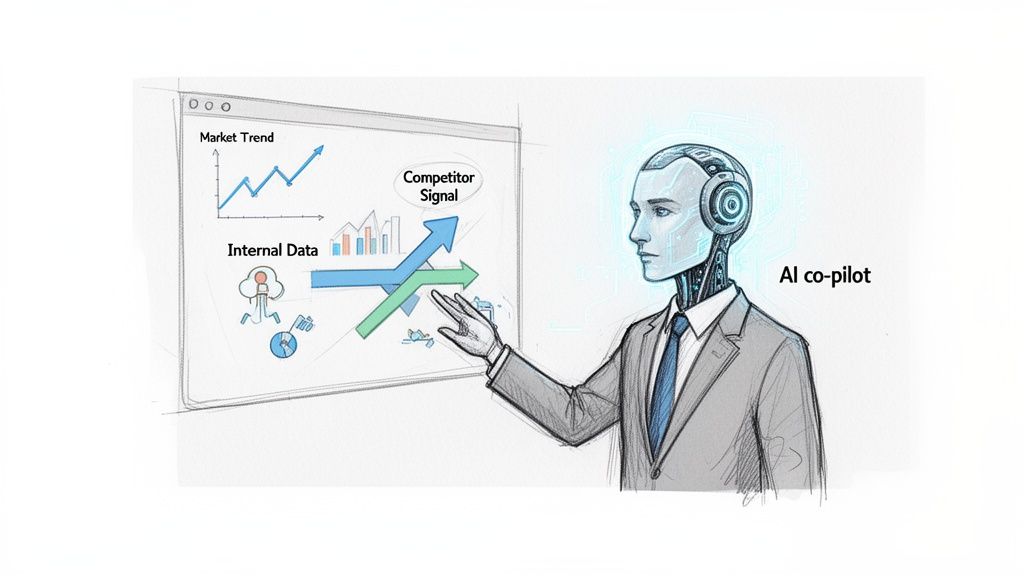
"AI-driven decision making" can sound like another piece of corporate jargon. But what it really means is giving your business a strategic co-pilot—an expert advisor that helps you see around corners instead of just staring in the rearview mirror.
What Is AI-Driven Decision Making, Really?
Forget the buzzwords for a second. Traditional business analytics is great at showing you what already happened. It packages up historical data into neat dashboards and reports. While useful, it’s always looking backward. You learn what happened, but you’re often left guessing why it happened or what strategic move to make next.
AI-driven decision making is more like a GPS for your business journey. It doesn’t just show you the map; it analyzes live market data, identifies potential roadblocks, and suggests the optimal route to reach your goals faster. It’s a fundamental shift from reacting to the past to proactively shaping the future.
This is how you turn mountains of raw data into your biggest strategic advantage. AI can sift through complex information, find hidden patterns, and deliver clear, actionable recommendations that point you toward your next best move.
Moving Beyond Basic Analytics
The real power is in the kind of answers you get. Traditional business intelligence is stuck on descriptive analytics (what happened). AI unlocks something far more potent.
Predictive Analytics: This is where the system starts telling you, "what will likely happen next?" AI models analyze past and present data to forecast future trends, anticipate customer needs, or flag operational risks before they become problems.
Prescriptive Analytics: This is the ultimate goal—the "so what should we do about it?" phase. It doesn't just predict the future; it recommends concrete actions you can take to achieve the best possible outcome. If you want to get into the nitty-gritty, we explain how prescriptive analytics works in our detailed guide.
The power of AI-driven decision making isn’t just about number-crunching at lightning speed. It’s about giving your team the confidence to make smarter, data-backed choices that actually move the needle.
An Expert Co-Pilot for Your Team
Picture this: an AI system is constantly monitoring your supply chain, keeping an eye on market shifts, and even tracking competitor activity. It doesn’t just send a generic alert about a potential inventory shortage. Instead, it simulates different scenarios and recommends a precise reordering plan to avoid a stockout while optimizing costs.
That’s what we mean by an expert co-pilot. AI isn’t here to replace human expertise; it’s here to amplify it. It handles the heavy data lifting, freeing up your people to focus on strategy, execution, and high-value problem-solving. The end result? A business that’s more agile, more resilient, and ready to seize opportunities before anyone else sees them coming.
The Real-World Payoff: Business Benefits and ROI
Let's move past the theory. AI-driven decision making isn't about fancy tech; it's about delivering a real, measurable impact on your business. When you invest in a smart AI strategy, you're not just buying software—you're building a direct line to better financial returns and a stronger market position. Think of it as switching from a paper map to a live, predictive GPS for your business.
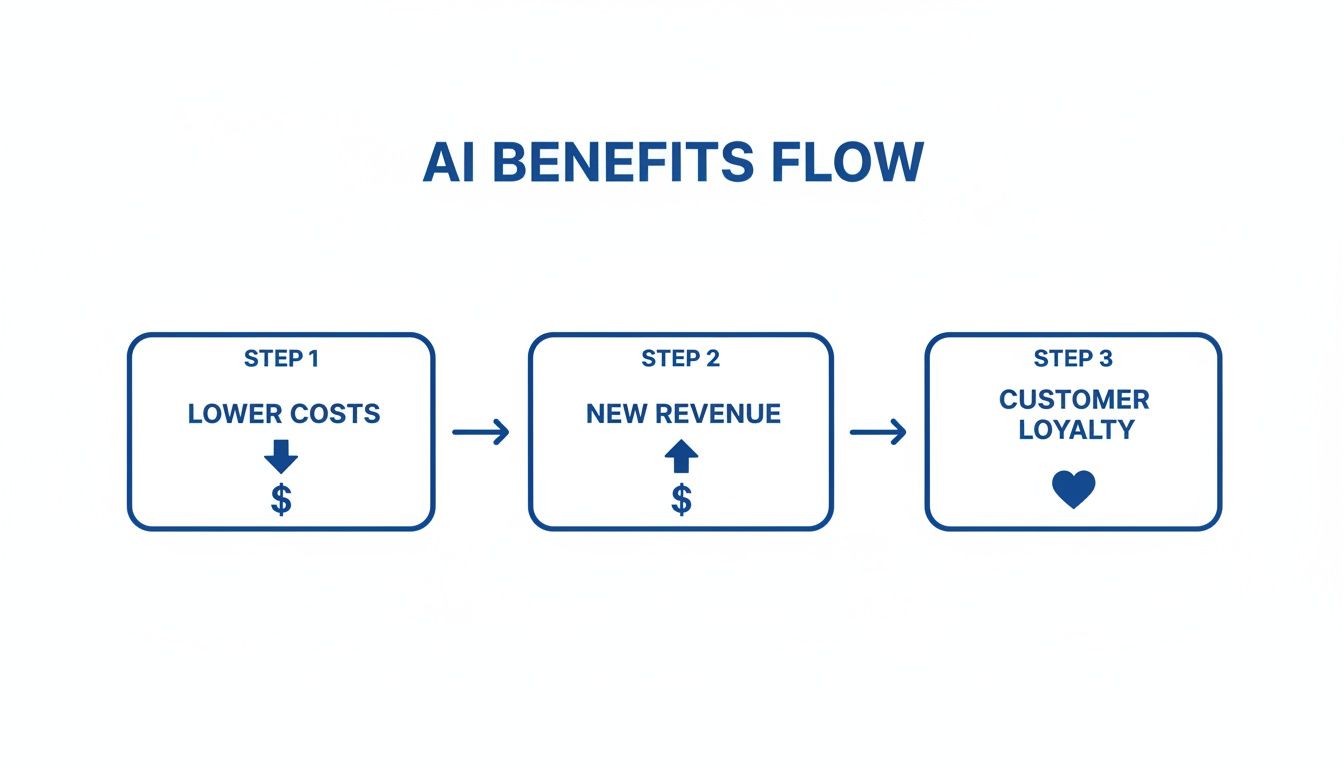
The magic happens when smarter, faster decisions start to hit your bottom line. This isn't some fuzzy, far-off promise. We're talking about concrete improvements in operational efficiency, revenue generation, and customer retention.
Slash Your Operational Costs
One of the first things you'll notice is a serious drop in operational waste. AI is a master of optimization, whether it's tightening up your supply chain, getting inventory levels just right, or predicting when a critical piece of machinery needs a tune-up before it breaks down. It's like having an efficiency expert on call 24/7, relentlessly plugging the small leaks that add up to massive savings.
For instance, an AI model can juggle thousands of factors at once—local weather, a big concert in town, historical sales data—to make sure you never have too much or too little stock. This immediately cuts down on storage costs and frees up cash that was previously tied up in unsold products. You're swapping broad guesswork for surgical precision.
Unlock New Ways to Make Money
Beyond just saving money, AI-driven decision making is a powerhouse for creating new revenue streams. Take dynamic pricing. An AI can adjust your prices on the fly based on what competitors are doing, what customers are willing to pay, and what’s happening in the market right now. This ensures you’re always getting the best possible price without scaring anyone away.
It also works wonders for product recommendations and personalization. By truly understanding what makes each customer tick, AI can suggest the perfect upsell or cross-sell that they're actually likely to buy. You can dig deeper into the strategic benefits of AI in business in our other article.
Build Unshakeable Customer Loyalty
In today's market, keeping customers happy and coming back is the name of the game. AI lets you ditch generic marketing blasts and start having genuine one-to-one conversations. By looking at every interaction—from a click on your website to a past purchase—you can figure out what a customer needs next, sometimes even before they do.
When you deliver that kind of personalized experience, customers feel seen and understood. That feeling is the absolute foundation of long-term loyalty. If you're always one step ahead of their needs, they won't have any reason to shop around, which means higher lifetime value and a much more predictable business.
This isn't just a trend; it's a fundamental shift in how successful companies operate. A whopping 50% of business owners now expect AI to significantly sharpen their strategic choices. They see its incredible power to sift through mountains of data, find patterns humans would miss, and remove personal bias from the equation. And it's not just talk— 83% of companies now say AI is a top priority in their business plans, viewing it as essential to stay competitive. The message is loud and clear: AI is no longer a "nice-to-have." It’s a core driver of modern business success.
Your Practical Roadmap for AI Adoption
Jumping into AI without a plan is like setting sail without a map. You might be moving, but you’ll probably never reach your destination. Making AI driven decision making a real, working part of your business demands a clear, deliberate strategy.
We can break this journey down into four straightforward stages. Think of it as a blueprint that guides you from a promising idea to a tangible business impact, making sure your tech, data, and people are all pointed in the same direction. Without this kind of structure, even the best AI tools end up as expensive, dusty experiments.
Stage 1: Strategy and Problem Definition
Before you even think about code, the absolute first step is to lock onto a high-impact business problem that AI can actually solve. Don't start with the shiny new tech; start with the real pain point. Are you drowning in inventory management chaos? Do you need a better way to predict which customers are about to leave?
Get specific with your goals. A fuzzy objective like "improve efficiency" is impossible to act on. A sharp goal like "cut supply chain forecasting errors by 15% in the next six months" gives your project a clear target and makes it much easier to prove its worth down the line.
A well-defined problem is the bedrock of any successful AI project. It ensures you’re building a tool that delivers real business value, not just a technical curiosity.
Stage 2: Data and Model Selection
Once you know what you’re trying to fix, it’s time to look at your data. AI is only as smart as the information you feed it. This stage is all about getting your data house in order and picking the right kind of AI for the job.
Here’s what you’ll need to do:
Data Audit: Take a hard look at your data. Is it clean, organized, and accessible? Is it even relevant to the problem you're trying to solve?
Technology Selection: Now, pick your tools. You might need machine learning for predictive tasks, natural language processing to sift through customer feedback, or other specialized models.
Partnering for Expertise: For most companies, this is where bringing in an AI and data consulting specialist makes all the difference. They can help you navigate the confusing world of AI tech and make sure you choose the most effective models without overspending.
As you start this journey, a solid foundation in AI Engineering is crucial for turning your ideas into working solutions. This discipline ensures your models are not just clever algorithms but are also scalable, reliable, and properly plugged into your business.
Stage 3: Integration and Workflow Embedding
This is where the rubber meets the road. An AI model that just sits on a developer's laptop is completely useless. The whole point of this stage is to weave AI insights seamlessly into how your team already works, without causing a massive headache.
The best AI integrations feel totally natural. If your sales team lives inside a CRM, predictive lead scores should pop up right there. If your operations crew relies on a specific dashboard, inventory alerts should appear on that screen. The trick is to make the AI's output available and actionable right when a decision needs to be made. For a deeper dive, check out our guide on how to successfully implement AI in your business.
Stage 4: Governance and Continuous Improvement
Finally, launching your AI model isn't the finish line—it's the starting gun. This governance stage is about setting the rules of the road. That means establishing ethical guidelines, making sure your models are fair, and creating a plan to monitor their accuracy over time.
AI models can "drift" as the world changes, so you need a system for regular check-ups and retraining. This keeps your AI-driven decisions sharp, relevant, and trustworthy long after the initial launch.
This infographic lays out the core benefits that a well-executed AI plan can unlock, from saving money to building stronger customer bonds. It clearly shows how a strategic plan directly ties AI adoption to real-world outcomes like lower costs and new revenue streams.
Having a clear roadmap isn't just a nice-to-have anymore. With 39% of companies now using AI in production—up from just 24% last year—the pressure is on. Yet, a major gap remains: only 25% of large organizations have a defined roadmap for their AI work. This is where getting expert guidance and training becomes essential to close that gap and ensure you're on the right path.
To bring it all together, here’s a quick overview of the key stages and actions involved in a successful AI adoption journey.
AI Adoption Roadmap Key Stages
Stage
Objective
Key Actions
1. Strategy & Problem Definition
Pinpoint a high-value business problem AI can solve.
Define a specific, measurable goal (e.g., reduce churn by 10%). Align the project with overall business objectives.
2. Data & Model Selection
Prepare data and choose the right AI technology.
Conduct a data audit for quality and relevance. Select appropriate models (ML, NLP, etc.). Engage experts if needed.
3. Integration & Workflow Embedding
Make AI insights accessible within existing tools.
Embed AI outputs into CRMs, dashboards, and daily workflows. Focus on user experience to ensure adoption.
4. Governance & Continuous Improvement
Ensure long-term accuracy, fairness, and value.
Establish ethical guidelines. Monitor model performance for "drift." Schedule regular retraining and maintenance.
This table acts as your quick-reference guide, breaking down a complex process into manageable steps. By following this structured approach, you can move from simply talking about AI to actually using it to make smarter, faster decisions that drive your business forward.
Fostering an AI-Ready Culture
Let's be honest: the most powerful technology on the planet is worthless if your team won't touch it. Even a perfect roadmap for AI-driven decision-making will crash and burn if the people who need to use it aren't on board. This is where the human side of AI adoption comes into play—creating a culture that sees AI not as a threat, but as a powerful new teammate.
Successfully bringing AI into your business is less about algorithms and much more about psychology. As soon as employees hear "AI," their minds often jump straight to "replacement." Your first job is to flip that narrative. Frame AI as a tool that supercharges human expertise, taking over the mind-numbing data crunching so your team can focus on what they do best: strategy, creativity, and solving complex problems.
This kind of shift has to start at the top. When executives are visibly excited about the change and clearly explain how AI will empower everyone, it builds an essential foundation of trust. Without that consistent support from leadership, any AI initiative will struggle to get off the ground.
Building Trust Through Communication and Upskilling
Vague corporate announcements won't cut it here. You have to be radically transparent about what you’re implementing, why you’re doing it, and how it will actually make someone's job better. People need to see the "what's in it for me" right away.
But talking is only half the battle. The single most effective way to build genuine confidence is to empower people with new skills. This is where upskilling and corporate training become non-negotiable.
An AI-ready culture is a learning culture. When you invest in training, you're sending a powerful message: "We are investing in you and your future here."
Training pulls back the curtain on AI, turning it from an intimidating black box into a practical, everyday tool. It gives everyone, from the front lines to the C-suite, the ability to use and interpret AI-generated insights with confidence. Once people understand how the AI got to its recommendation, they're far more likely to trust it and act on it.
Creating Collaborative AI Partnerships
The real goal is to get to a place where people see AI as a collaborative partner—almost like giving every employee their own personal data analyst. This partnership doesn't just boost internal morale; it has a massive impact on your external credibility, too.
When your team is empowered by AI, they make smarter, faster decisions, which directly improves customer relationships and business outcomes. This approach actually builds a surprising amount of trust with consumers. A recent study found that 65% of consumers trust companies that use AI, with only 14% feeling any distrust. For 47% of business owners, this makes AI a genuine credibility booster.
This public confidence comes from the belief that AI improves the customer experience with smarter, more personalized service—a feeling shared by 54% of consumers. For managers, this means AI-powered automations, like those developed by specialized AI and data consulting businesses, can seriously strengthen client relationships and reinvent how you work. For a deeper dive, check out the research on how executives are thinking about AI.
Actionable Strategies for Change Management
Getting your organization ready for AI takes more than a company-wide email. You need a deliberate, thoughtful strategy for managing the change.
Here are a few practical steps you can take to get started:
Find Your AI Champions: Look for enthusiastic people at every level of the company who can advocate for the new tools and help their colleagues get comfortable.
Start with Small, High-Impact Wins: Don't try to boil the ocean. Pick an initial project that solves a real, nagging problem for a specific team. A quick, visible success is the best internal marketing you could ask for.
Create Feedback Loops: Set up clear channels where employees can ask questions, voice concerns, and give feedback on the AI tools. Acting on that feedback shows you're listening and that their input truly matters.
By focusing on the human element—tackling fears head-on, communicating openly, and empowering your people with new skills—you can build a culture that doesn't just put up with AI, but actually embraces it as a way to work smarter and make better decisions.
Measuring Success and Avoiding Common Pitfalls
Putting an AI-driven decision-making framework in place is a huge step. But how do you know if it's actually working? Proving the value of your AI projects means looking beyond a simple ROI calculation. It’s about measuring the real, tangible changes in how your business runs and the quality of the choices you make every single day.
Success isn't just about the number on the final balance sheet. It's about building a smarter, faster, and more resilient organization from the inside out.
Key Metrics That Truly Matter
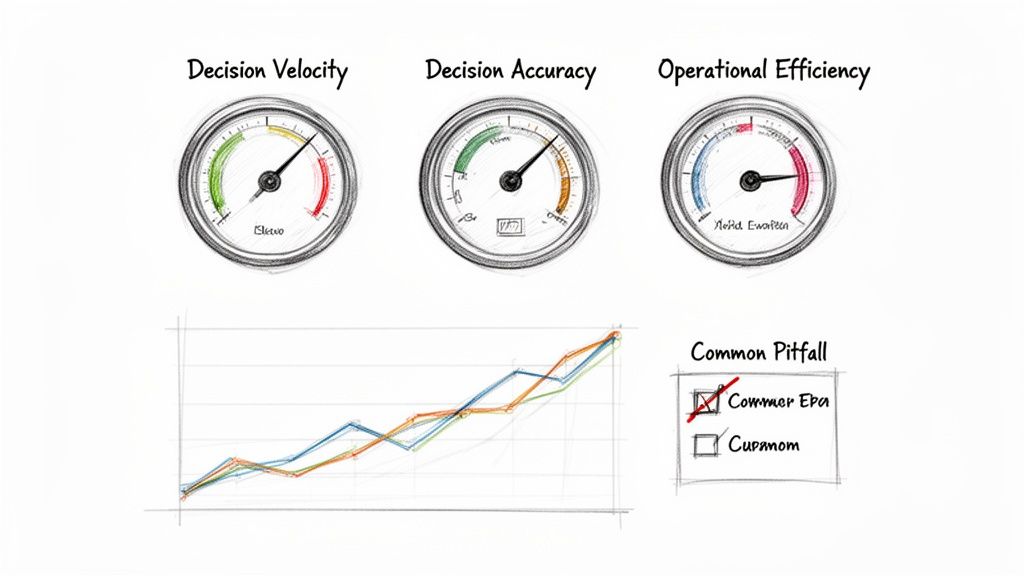
To get the full picture of your AI's impact, you need to track metrics that cover both speed and quality. Think of it like tuning a high-performance engine—you’re not just checking horsepower, but also fuel efficiency and overall reliability.
These are the core indicators that prove your AI strategy is paying off for the long haul:
Decision Velocity: How much faster are you making critical calls? Measure the time it takes to get from spotting a problem to rolling out a solution. A well-designed AI system can shrink this cycle from weeks down to minutes.
Decision Accuracy: Are your outcomes improving? Keep an eye on the KPIs tied directly to your AI's recommendations. For instance, if an AI is managing your inventory, you should see a measurable drop in both stockouts and overstock.
Operational Efficiency: Are you cutting down on waste and freeing up your team? This can be seen in lower operating costs, better use of equipment, or simply the hours your team gets back from automating tedious analysis.
The real magic happens when you create a positive feedback loop. Faster, more accurate decisions lead to better business outcomes. Those outcomes generate more high-quality data, which in turn makes your AI models even smarter. This cycle of continuous improvement is where you’ll find your competitive edge.
Sidestepping the Most Common AI Pitfalls
The road to adopting AI is, of course, littered with potential traps. Even the most exciting projects can get derailed by a few common—and completely avoidable—mistakes. Knowing what to watch out for is half the battle.
So many companies get excited about the tech and just dive in without a clear map. This reactive approach usually leads to expensive experiments that don't actually move the needle on business goals.
Let's break down the most frequent stumbles we see and how you can sidestep them.
Common Pitfalls in AI Implementation and How to Avoid Them
Getting AI right often comes down to avoiding a few key missteps. Below is a quick guide to the most common issues and how to build a strategy that avoids them from the start.
Common Pitfall
Why It Happens
Strategic Solution
Starting with a Vague Problem
The team gets caught up in using a shiny new technology instead of solving a specific, nagging business problem.
Start with a clear business question. Before you even think about code, define a measurable goal like, "reduce customer churn by 15%."
Using Poor-Quality Data
Everyone rushes into building a model without making sure the data is clean, accurate, and actually relevant.
Make data governance a priority. You have to invest time in cleaning and organizing your data. Remember: an AI model is only as good as the data you feed it.
Ignoring Workflow Integration
The AI tool is built in a vacuum and doesn't fit into how the team already works, which tanks adoption rates.
Design for the end-user. Weave AI insights directly into the tools your team uses every day, whether it's their CRM or an operations dashboard.
Neglecting Model Maintenance
There's a flawed assumption that an AI model, once built, will work perfectly forever without any tune-ups.
Plan for continuous improvement. Business conditions are always changing, and your models need to keep up. Schedule regular monitoring and retraining to prevent "model drift."
By keeping these points in mind, you can build a far more robust and resilient plan, ensuring your AI-driven decision-making initiatives deliver real, lasting value.
How NILG.AI Can Fast-Track Your Journey
The roadmap to smart, AI-driven decision-making isn't a path you have to walk alone. While having a map is great, having an expert guide can make all the difference. That's where we come in.
Partnering with an AI and data consulting specialist like NILG.AI helps you turn ambitious plans into real-world business results, faster. We live and breathe this stuff, so we can bridge the gap between your business goals and the often-complex world of AI technology.
Think of it this way: you know your destination, but we have the all-terrain vehicle and the expert driver who knows every shortcut and pothole to avoid. Our services are built to snap right into each stage of your AI adoption journey, helping you sidestep common traps and get more value right from the start.
From Strategy to Execution
It all begins with a rock-solid plan. Too many AI projects crash and burn because they start with a cool piece of technology instead of a real-world business problem. Our AI Strategy workshops are designed to prevent exactly that. We sit down with your leaders to find the opportunities that will make the biggest dent in your operations, making sure every single initiative is tied to a result you can actually measure.
Once we have a clear "why," we get our hands dirty with the "how." This is where our technical skills really come into play:
Predictive Analytics: We don't just use off-the-shelf tools. We build and launch custom models that can forecast sales trends, predict what your customers will do next, and spot risks before they blow up into full-blown problems. This is the engine that powers your ability to see around corners.
Process Automation: Our team then builds solutions to inject these AI insights directly into your day-to-day operations. We automate the boring analytical work and deliver clear recommendations straight to the people on the front lines, right when they need them.
Partnering with an expert isn't about handing over the steering wheel. It’s about bringing in a specialist co-pilot to de-risk the journey and make sure what you’re building actually delivers lasting value.
Getting Your Team Ready for Lasting Change
Let's be honest—the tech is only half the battle. A successful shift to AI needs a company culture that’s ready to work in a new way. This is often the hardest part, and it’s where our Corporate Training programs really shine.
We create hands-on training that pulls back the curtain on AI for everyone, from the C-suite to the sales floor. By building up AI literacy across your entire organization, we help give your people the confidence and skills to trust the data and act on the insights.
This focus on people is what makes the change stick. It ensures your investment in AI-driven decision-making builds a truly different kind of company—one that’s smarter, faster, and ready for whatever comes next.
Got Questions? We've Got Answers
Stepping into the world of AI-driven decision-making can feel like learning a new language. It's only natural to have a few questions. We hear these all the time, so let's clear them up.
How Long Until I Actually See Results from an AI Project?
That's the million-dollar question, isn't it? The honest answer is: it depends.
If you start with a focused pilot project—tackling one specific, well-understood problem—you can see real, tangible results in as little as three to six months. Getting that first quick win is a huge deal. It builds momentum and gets everyone else in the company excited.
But if you're talking about a massive, company-wide overhaul, that’s more of a marathon than a sprint. The timeline hinges on things like how complex your business problem is, the state of your current data, and how quickly your team can get comfortable with new ways of working.
The trick is to think in small, iterative steps. Don't try to boil the ocean. Pick one high-impact area, prove the value, and then build on that success.
What Kind of Team Do I Need to Pull This Off?
You can relax—you don't need to go out and hire a dozen data scientists with PhDs. A great AI initiative usually starts with a small, nimble team that brings different skills to the table.
While every project is a little different, your starting lineup should probably include:
The Champion: A leader from the business side who gets the "why" behind the project and can clear roadblocks.
The Data Guru: Someone who lives and breathes your data. They know where it is, what it really means, and where the skeletons are buried.
The AI Pro: This is where a specialist partner, like NILG.AI, comes in. We bring the deep technical know-how in data science and building models, filling any gaps you might have internally.
The secret sauce is getting your business experts and the technical folks talking and working together. That’s where the magic happens.
So, How Much Is This Going to Cost?
There’s no simple price tag for adopting AI-driven decision-making. Think of it less like a fixed price and more like a spectrum. Your investment is tied directly to what you want to achieve.
A small pilot program that uses the data you already have and some off-the-shelf cloud tools can be surprisingly cost-effective. On the other hand, a massive project that involves a ton of data cleanup, building custom AI from scratch, and plugging it into multiple legacy systems is obviously going to require a bigger budget.
Working with an AI consulting firm can often save you money in the long run compared to building an entire data science team from the ground up. You get access to world-class experts without the long-term overhead. A good partner will help you map out a phased plan that respects your budget and delivers a clear return on investment every step of the way.
Ready to stop wondering and start doing? At NILG.AI, we’re all about creating clear, practical roadmaps that turn business headaches into real opportunities for growth. We'll handle the strategy and the technical heavy lifting to bring your AI vision to life.
We use cookies on our website to give you the most relevant experience by remembering your preferences and repeat visits. By clicking “Accept All”, you consent to the use of ALL the cookies. However, you may visit "Cookie Settings" to provide a controlled consent.
This website uses cookies to improve your experience while you navigate through the website. Out of these, the cookies that are categorized as necessary are stored on your browser as they are essential for the working of basic functionalities of the website. We also use third-party cookies that help us analyze and understand how you use this website. These cookies will be stored in your browser only with your consent. You also have the option to opt-out of these cookies. But opting out of some of these cookies may affect your browsing experience.
Necessary cookies are absolutely essential for the website to function properly. These cookies ensure basic functionalities and security features of the website, anonymously.
Cookie
Duration
Description
cookielawinfo-checkbox-analytics
11 months
This cookie is set by GDPR Cookie Consent plugin. The cookie is used to store the user consent for the cookies in the category "Analytics".
cookielawinfo-checkbox-functional
11 months
The cookie is set by GDPR cookie consent to record the user consent for the cookies in the category "Functional".
cookielawinfo-checkbox-necessary
11 months
This cookie is set by GDPR Cookie Consent plugin. The cookies is used to store the user consent for the cookies in the category "Necessary".
cookielawinfo-checkbox-others
11 months
This cookie is set by GDPR Cookie Consent plugin. The cookie is used to store the user consent for the cookies in the category "Other.
cookielawinfo-checkbox-performance
11 months
This cookie is set by GDPR Cookie Consent plugin. The cookie is used to store the user consent for the cookies in the category "Performance".
viewed_cookie_policy
11 months
The cookie is set by the GDPR Cookie Consent plugin and is used to store whether or not user has consented to the use of cookies. It does not store any personal data.
Functional cookies help to perform certain functionalities like sharing the content of the website on social media platforms, collect feedbacks, and other third-party features.
Performance cookies are used to understand and analyze the key performance indexes of the website which helps in delivering a better user experience for the visitors.
Analytical cookies are used to understand how visitors interact with the website. These cookies help provide information on metrics the number of visitors, bounce rate, traffic source, etc.
Advertisement cookies are used to provide visitors with relevant ads and marketing campaigns. These cookies track visitors across websites and collect information to provide customized ads.