"Digital transformation" gets thrown around a lot, often feeling more like a buzzword than a practical strategy. It’s not just about adopting new technology; it's a fundamental shift in how a company operates, delivers value to its customers, and drives efficiency. But what does that actually look like on the ground? How do you move from theory to tangible results?
This article cuts through the noise. We're skipping the generic success stories and diving deep into real-world digital business transformation examples. You won't find high-level overviews here. Instead, you'll get a strategic breakdown of how companies like Starbucks, Siemens, and DBS Bank re-engineered their processes from the inside out. We'll explore the specific challenges they faced, the technology stacks they implemented, and the key performance indicators that proved their investments paid off. To truly grasp what real transformation entails, it's essential to consider the power of digital transformation through automated workflows and how they drive fundamental change.
Our focus is on actionable insights and replicable strategies, the kind that specialized AI and data consulting firms help businesses implement every day. Each example serves as a detailed playbook, offering behind-the-scenes details and practical takeaways you can adapt for your own organization. Let’s explore how these companies turned ambitious visions into measurable, market-leading success.
1. Amazon's Retail Operations Automation
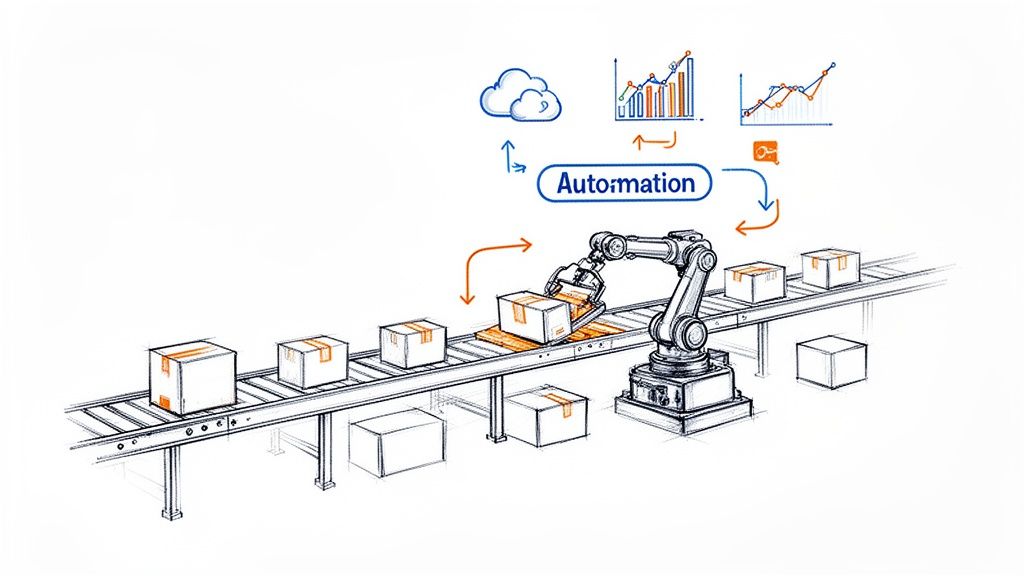
When you think of massive operational scale, Amazon is often the first name that comes to mind. Their journey is a textbook case of leveraging technology not just to support a business, but to fundamentally redefine what's possible in retail and logistics. This digital business transformation example is built on a foundation of extensive automation, AI-driven inventory management, and predictive analytics that power their entire e-commerce empire.
At the heart of Amazon’s strategy is the systematic removal of friction from every process. From the moment you click "buy" to the package arriving at your door, a complex web of automated systems is at work. Their fulfillment centers use thousands of robots to move inventory, while machine learning algorithms predict customer demand with stunning accuracy, ensuring products are stocked in the right warehouses before you even know you want them. This deep integration of AI and robotics minimizes manual effort, slashes delivery times, and optimizes the supply chain for maximum efficiency.
Key Strategies and Actionable Takeaways
Start with High-Impact Processes: Amazon didn’t automate everything at once. They targeted core bottlenecks like warehouse picking and sorting first. Your takeaway: Identify the most time-consuming or error-prone part of your operation and start there.
Invest in Data Infrastructure Upfront: Clean, accessible data is the fuel for AI and automation. Amazon built a robust data pipeline to power its algorithms. Your takeaway: Prioritize data quality and create a solid infrastructure before deploying complex AI models.
Leverage Cloud-Based AI: Amazon Web Services (AWS) provides the AI and machine learning tools that power its own operations and those of its customers. Your takeaway: Use cloud services to lower the barrier to entry and accelerate implementation without massive upfront hardware costs.
Plan for Workforce Transition: Automation changes job roles. Amazon focuses on reskilling employees to manage and maintain automated systems. Your takeaway: Develop a clear strategy for training and transitioning your workforce alongside your technology roadmap.
This approach demonstrates how intelligent process automation can dramatically improve efficiency and customer experience. By combining physical robotics with sophisticated AI, Amazon has created a powerful, scalable model for modern commerce. To dive deeper into the nuts and bolts of this approach, you can explore the concepts behind intelligent process automation.
2. Microsoft's Cloud-First Digital Strategy
Under Satya Nadella's leadership, Microsoft executed one of the most successful digital business transformation examples in corporate history, pivoting from a software-centric model to a "cloud-first, AI-first" powerhouse. This transformation wasn't just about launching a new product; it was a fundamental shift in culture, operations, and business strategy. The core of this change was the development and scaling of Microsoft Azure, which evolved from a cloud service into a comprehensive platform for enterprise innovation.
This strategy involved deeply embedding AI and machine learning capabilities across their entire product suite, from Azure AI services to the integration of Copilot in everyday applications like Office 365. By doing so, Microsoft enabled organizations to not only migrate their legacy systems to the cloud but also to build, deploy, and manage intelligent applications that unlock new revenue streams and operational efficiencies. This created a powerful ecosystem where cloud infrastructure and intelligent tools work in tandem.
Key Strategies and Actionable Takeaways
Reinvent the Core Business Model: Microsoft shifted from one-time software license sales to a recurring revenue, subscription-based model with Azure and Microsoft 365. Your takeaway: Evaluate your own revenue model. Can you transition from transactional sales to a service-based subscription that offers continuous value?
Embed AI Everywhere: Instead of treating AI as a separate product, Microsoft integrated it as a core feature (like Copilot) across its ecosystem. Your takeaway: Look for ways to embed intelligence into your existing products and services to enhance user value, rather than building standalone AI tools.
Empower Customer Modernization: Azure was designed to help businesses modernize, not just lift-and-shift their old systems. Your takeaway: Position your solutions as tools for transformation. Help your clients use your tech to fundamentally improve their processes. For businesses exploring this, understanding the steps to a successful Microsoft Dynamics 365 implementation success can be a practical starting point.
Prioritize Developer and Partner Ecosystems: Microsoft invested heavily in tools, training, and programs (like the FastTrack program) to support developers and partners building on their platform. Your takeaway: A strong ecosystem multiplies your impact. Invest in supporting the partners and developers who use your technology.
Microsoft’s journey showcases how an established giant can reinvent itself by embracing the cloud and integrating AI at its core. A well-defined digital transformation roadmap is critical for orchestrating such a monumental shift.
3. Netflix's Personalization and Content Recommendation Engine
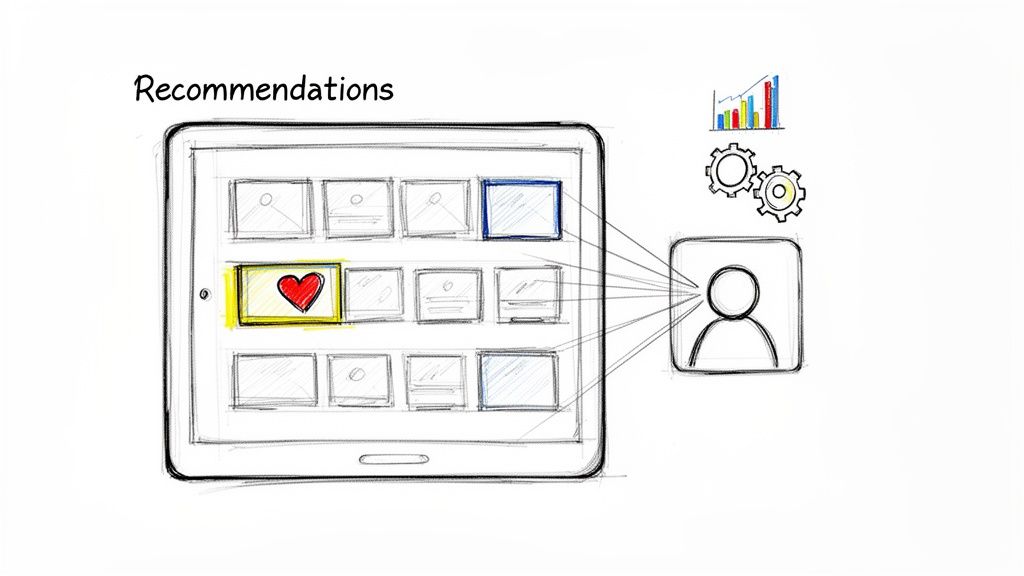
Netflix didn't just disrupt video rentals; it completely reshaped the entertainment industry by placing data at the core of its business. Their digital business transformation example is a masterclass in using AI and predictive analytics to create a deeply personalized user experience. The company’s powerful recommendation engine analyzes viewing habits, ratings, and even the time of day to suggest content, making the platform feel uniquely tailored to each of its millions of subscribers.
This transformation goes beyond simple content suggestions. Netflix famously uses its vast dataset to inform high-stakes business decisions, including which shows to greenlight. For example, predictive analytics reportedly played a key role in the decision to produce Stranger Things, identifying a potential audience based on user affinity for 80s nostalgia, sci-fi, and specific actors. This data-driven approach minimizes risk and maximizes the potential for a hit, shifting content creation from a purely creative gut-feel process to a strategic, analytical one.
Key Strategies and Actionable Takeaways
Build a Robust Data Collection Framework: Netflix’s success hinges on gathering granular data about user interactions. Your takeaway: Start by identifying key customer touchpoints and implement a system to collect and organize that behavioral data effectively.
Invest in Scalable ML Infrastructure: As their user base grew, so did the complexity of their models. Your takeaway: Prioritize a machine learning infrastructure, potentially cloud-based, that can scale with your data volume and business growth.
Use Analytics for Strategic Decisions: The real power of Netflix's data isn't just in recommendations, but in using it for major investments like content production. Your takeaway: Look beyond operational improvements and ask how predictive analytics can inform your core business strategy.
Continuously Test and Refine: The Netflix algorithm is not static; it's constantly being A/B tested and improved. Your takeaway: Adopt a culture of experimentation. Continuously test and refine your models to improve accuracy and business impact.
Netflix’s model showcases how deep customer understanding, powered by AI, can create a powerful competitive advantage. By transforming data from a simple byproduct into a core strategic asset, they have set a new standard for customer engagement and content strategy in the digital age.
4. Starbucks' Digital Payments and Customer Loyalty Integration
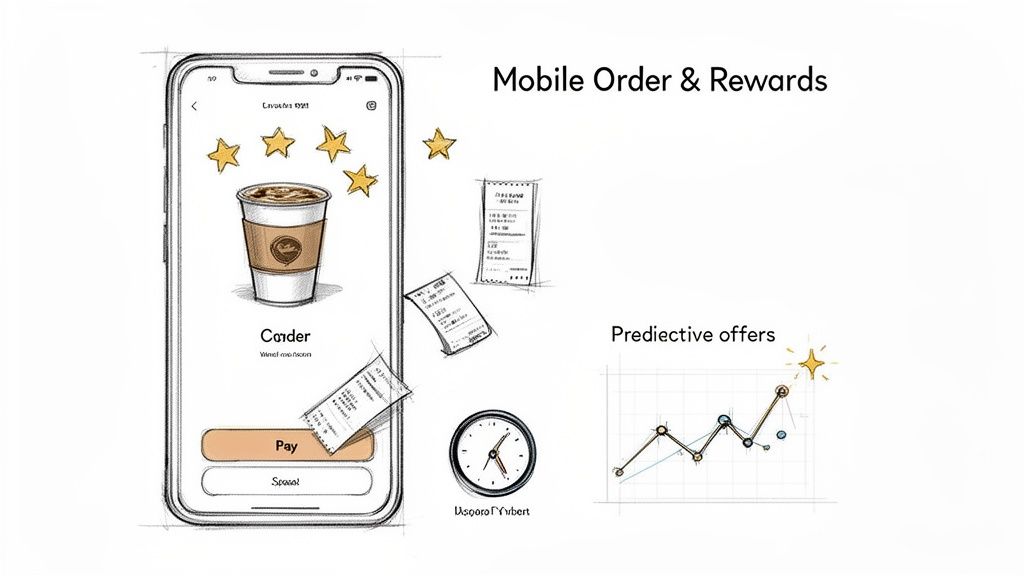
Starbucks didn't just sell coffee; it sold an experience, and its digital transformation is a masterclass in enhancing that experience. The company’s success lies in creating a seamless ecosystem that merges digital payments, mobile ordering, and a highly personalized loyalty program. This digital business transformation example showcases how to build a powerful flywheel where customer convenience and data-driven marketing feed each other.
The core of this strategy is the Starbucks mobile app, which goes far beyond a simple payment tool. It integrates ordering, payment, and rewards into one fluid motion, dramatically reducing friction for on-the-go customers. Behind the scenes, every transaction feeds a powerful analytics engine that tracks purchase history and customer behavior. This data is then used to generate hyper-personalized offers and recommendations, making customers feel understood and valued, which in turn drives repeat business and higher lifetime value.
Key Strategies and Actionable Takeaways
Build an Omnichannel Ecosystem: Starbucks connected its physical stores with its digital app, creating a consistent experience everywhere. Your takeaway: Ensure your digital tools enhance, not just replace, your physical customer interactions.
Make Loyalty Effortless: The rewards program is seamlessly integrated into the payment process, making it incredibly easy for customers to earn and redeem. Your takeaway: Reduce the friction in your loyalty program so participation becomes a natural part of the customer journey.
Leverage Data for Hyper-Personalization: The app uses purchase history to suggest new drinks or offer targeted discounts, increasing engagement. Your takeaway: Use customer data to move beyond generic marketing and create personalized interactions that build a stronger connection.
Prioritize a Mobile-First Experience: The entire system was designed around the convenience of a mobile device. Your takeaway: For any consumer-facing initiative, design for the mobile experience first, as it is the primary touchpoint for most customers today.
By turning a simple coffee run into a personalized and efficient digital interaction, Starbucks built one of the most successful loyalty programs in the world. Their approach proves that a deep focus on the customer experience, powered by integrated technology, is a winning formula.
5. DBS Bank's AI-Powered Banking Transformation
In a sector often seen as traditional and slow-moving, DBS Bank’s evolution stands out as a powerful digital business transformation example. The Singaporean banking giant reimagined its operations from the ground up, embracing AI to become a "27,000-person startup" rather than a legacy institution. Their transformation wasn't just about adding a digital layer; it was about fundamentally changing the core of their business model, with AI driving everything from customer service to critical risk management.
At the heart of DBS's strategy was a commitment to making banking invisible and seamless for the customer. They deployed AI-powered chatbots to handle over 70% of routine inquiries, freeing up human agents to tackle more complex issues. Internally, machine learning models were integrated to revolutionize credit assessment and fraud detection, allowing for faster, more accurate decisions that prevented millions in potential losses. This deep integration of AI automated thousands of manual processes, dramatically improving operational efficiency and allowing the bank to scale services like its "Digibank" platform to millions of users with unprecedented speed.
Key Strategies and Actionable Takeaways
Embed AI into Core Functions: DBS didn't treat AI as a separate project. It was integrated directly into high-value areas like fraud detection and credit scoring. Your takeaway: Identify core business functions where AI can deliver the most significant impact on efficiency or risk reduction and start there.
Prioritize Customer-Facing Automation: The bank first focused on improving the customer experience with tools like chatbots and a seamless digital onboarding process. Your takeaway: Use AI to solve your customers' most common pain points first to build momentum and demonstrate value.
Invest in Workforce Reskilling: DBS launched a massive internal program to upskill its employees, equipping them with data and AI literacy. Your takeaway: A technology transformation is also a people transformation. Invest heavily in training to ensure your team can leverage the new tools effectively.
Build a Data-First Culture: The entire transformation was powered by data. DBS created a robust data infrastructure and fostered a culture where decisions are driven by analytics. Your takeaway: Establish a strong data governance framework and make data accessible across the organization to fuel your AI initiatives.
This holistic approach proves that even heavily regulated, traditional industries can undergo a successful digital overhaul. By making AI central to its operating model, DBS not only improved its bottom line but also set a new standard for what a modern bank can be.
6. Siemens' Industrial IoT and Predictive Maintenance Platform
Siemens, a titan of industrial manufacturing, provides a powerful digital business transformation example of how a legacy company can reinvent itself for the digital age. By pivoting to an Industrial Internet of Things (IIoT) model, Siemens didn't just optimize its own factories; it built a platform, MindSphere, to help other manufacturers do the same. This transformation is centered on using IoT sensors, cloud analytics, and machine learning for predictive maintenance.
At its core, this strategy connects physical machinery to the digital world. Sensors on equipment constantly stream operational data like temperature, vibration, and output to a central cloud platform. Machine learning algorithms analyze this data to identify patterns that precede equipment failure. Instead of waiting for a critical machine to break down and halt production, operators receive alerts to perform maintenance proactively, saving millions in downtime and repair costs. This shift from a reactive to a predictive model has resulted in manufacturers reducing downtime by 20-30% and cutting emergency repairs by over 40%.
Key Strategies and Actionable Takeaways
Start with Critical Assets: Siemens first applied IIoT to high-value, production-critical machinery where failure would be most costly. Your takeaway: Identify your most crucial operational assets and target them for your initial IoT and predictive maintenance pilot.
Build a Secure Data Foundation: Connecting industrial equipment to the internet introduces security risks. Siemens invested heavily in creating a secure and scalable data infrastructure. Your takeaway: Prioritize robust data governance and cybersecurity protocols from day one to protect your operations.
Embrace a Platform Ecosystem: Rather than building every component from scratch, Siemens partnered with technology providers and encouraged third-party app development on its MindSphere platform. Your takeaway: Collaborate with technology partners for platform integration to accelerate development and tap into specialized expertise.
Focus on Workforce Upskilling: The best data is useless if no one can interpret it. Siemens focused on training technicians to understand data insights and act on them. Your takeaway: Develop a training program to equip your team with the skills to use data analytics tools effectively.
By turning operational data into a strategic asset, Siemens demonstrates how industrial companies can enhance efficiency, create new service-based revenue streams, and lead in the era of Industry 4.0. To learn more about their approach, you can visit the Siemens Digital Industries site.
7. UPS's AI-Driven Route Optimization and Logistics Automation
When it comes to delivering millions of packages on time, every single day, efficiency isn't just a goal; it's a necessity. UPS's digital transformation journey is a powerful example of how a legacy logistics giant reinvented its core operations using artificial intelligence and predictive analytics. This digital business transformation example centers on their groundbreaking ORION (On-Road Integrated Optimization and Navigation) system, which has fundamentally changed how they manage their global delivery network.
UPS's strategy involves harnessing massive amounts of data to solve one of logistics' most complex puzzles: the "traveling salesman problem," but on an unimaginable scale. Their AI algorithms analyze billions of data points in real-time, including traffic conditions, weather forecasts, package details, and specific customer delivery windows. This allows them to generate the most efficient route for every single driver, every single day. The impact is staggering, with ORION famously saving UPS over 100 million miles annually, which translates to massive reductions in fuel consumption, emissions, and operational costs.
Key Strategies and Actionable Takeaways
Build on Clean Historical Data: The success of ORION was built on decades of meticulously collected operational data. Your takeaway: Start by collecting and cleaning your historical data. A robust, well-organized dataset is the foundation for any meaningful AI initiative.
Balance Algorithms with Human Insight: UPS found that the best routes often come from combining ORION’s suggestions with the on-the-ground experience of their drivers. Your takeaway: Treat AI as a powerful assistant, not a replacement. Create feedback loops that allow human experts to validate and improve algorithmic outputs.
Invest in Real-Time Data Infrastructure: To make dynamic adjustments for traffic or weather, UPS needed a constant stream of real-time information. Your takeaway: Prioritize building an infrastructure that can ingest and process data as events happen, not after the fact.
Iterate and Roll Out Incrementally: ORION wasn't deployed overnight. It was tested, refined, and rolled out in stages over several years. Your takeaway: Start with a pilot project to prove the concept and demonstrate value before committing to a full-scale, company-wide implementation.
By embedding AI deep within its operational fabric, UPS has created a sustainable competitive advantage, showcasing how to achieve operational excellence through intelligent automation. To better understand the mechanics behind this kind of system, you can learn more about the route optimisation algorithm.
8. GE's Digital Industrial Platform and Predictive Analytics
General Electric’s transformation from a classic industrial giant into a digital powerhouse is a landmark case study in corporate reinvention. Facing a rapidly changing market, GE pivoted by building Predix, its own cloud-based platform for the Industrial Internet of Things (IIoT). This digital business transformation example showcases how a legacy company can embed data and analytics into its core products, creating new value streams from decades of industrial expertise.
At its heart, GE's strategy was to create "digital twins" of its physical assets, like jet engines and power turbines. By equipping this machinery with sensors, GE could collect massive amounts of real-time operational data. This data was then fed into the Predix platform, where AI and machine learning models predicted equipment failures, optimized performance, and scheduled maintenance proactively. This shift from a reactive "break-fix" model to a predictive, condition-based maintenance model saved their customers billions in downtime and operational costs.
Key Strategies and Actionable Takeaways
Monetize Your Core Expertise: GE didn't just adopt technology; they built a platform based on their deep industrial knowledge. Your takeaway: Identify your unique domain expertise and explore how you can build a digital service or platform around it.
Create Digital Twins for Physical Assets: Modeling physical assets digitally allows for simulation, prediction, and optimization without real-world risk. Your takeaway: Start small by creating a digital twin for one critical piece of equipment to prove its value in predicting maintenance needs.
Build a Data-Driven Culture: This transformation required a massive cultural shift, reskilling thousands of employees to think and work with data. Your takeaway: Invest heavily in training and change management to ensure your team has the skills and mindset to embrace a data-first approach.
Start with Pilot Projects: GE tested its digital concepts in controlled environments, like with its aviation division, before a full-scale rollout. Your takeaway: Launch targeted proof-of-concept projects to demonstrate ROI and refine your strategy before committing to an enterprise-wide transformation.
GE's journey illustrates how industrial companies can leverage IIoT and predictive analytics to not only improve efficiency but also to invent entirely new business models. By transforming their products into intelligent, connected assets, they set a new standard for Industry 4.0. To learn more about the technology behind this shift, you can explore GE’s current offerings at GE Digital.
9. Walmart's Omnichannel Retail Transformation and Supply Chain Optimization
When a retail giant like Walmart decides to modernize, it's a monumental undertaking. This digital business transformation example showcases how an established brick-and-mortar leader can pivot to compete head-on with e-commerce natives. Walmart's strategy is built on integrating its vast physical footprint with a sophisticated digital ecosystem, powered by AI-driven supply chain management and predictive analytics.
At the core of Walmart's transformation is the creation of a seamless omnichannel experience. They leveraged their 4,700+ stores as fulfillment centers, blending in-store shopping, online ordering, and curbside pickup into a unified operation. This was made possible by deploying advanced technologies like machine learning for demand forecasting and computer vision for in-store inventory management. For instance, shelf-scanning robots were deployed in over 500 stores to identify out-of-stock or misplaced items, ensuring accuracy and availability.
Key Strategies and Actionable Takeaways
Leverage Existing Assets: Walmart turned its physical stores into a strategic advantage for e-commerce fulfillment. Your takeaway: Identify your unique existing assets, physical or otherwise, and think creatively about how technology can enhance their value.
Pilot, Then Scale: Innovations like shelf-scanning robots were tested in a limited number of stores before a wider rollout. Your takeaway: Start with small, controlled pilot programs to prove ROI and iron out kinks before committing to a full-scale deployment.
Focus on Customer-Facing Wins: The goal of their supply chain optimization was tangible customer benefits like reduced out-of-stocks and convenient pickup options. Your takeaway: Frame your digital transformation projects around how they will directly improve the customer experience.
Invest in Employee Training: Rolling out new technologies requires upskilling your workforce to manage and interact with them effectively. Your takeaway: Make change management and employee training a core component of your implementation plan, not an afterthought.
This approach proves that traditional retailers can successfully modernize by strategically adopting AI to enhance their core strengths. By optimizing inventory and merging physical and digital channels, Walmart has built a resilient and competitive retail model. To understand more about blending digital tools with physical operations, consider exploring the principles behind omnichannel retail strategy.
10. Telefónica's AI-Powered Customer Service and Network Optimization
For massive telecommunications giants, managing millions of customer interactions and a sprawling network infrastructure is a monumental challenge. Telefónica’s journey showcases how AI can be the linchpin in transforming both customer-facing services and core operational efficiency. This digital business transformation example is a masterclass in using artificial intelligence to create a more responsive, predictive, and cost-effective telecom business.
Telefónica's strategy targeted two of its biggest operational pressure points: customer support volume and network stability. By deploying sophisticated conversational AI, they automated a significant portion of routine inquiries, freeing up human agents for more complex issues. Simultaneously, they applied machine learning models to their network data to proactively identify potential failures and optimize energy consumption. This dual-pronged AI approach didn't just cut costs; it directly improved the customer experience by providing faster answers and a more reliable service.
Key Strategies and Actionable Takeaways
Target High-Volume, Low-Complexity Tasks First: Telefónica started by automating common customer questions about billing and service status, which accounted for a huge percentage of support tickets. Your takeaway: Identify the most frequent and repetitive tasks in your customer service workflow and automate them first for the quickest ROI.
Create a Seamless Human Handoff: The AI was designed to recognize its limits and escalate complex or sensitive issues to a human agent without friction. Your takeaway: Build clear escalation paths into your AI systems to ensure customers never feel trapped in a frustrating automated loop.
Use Data for Proactive, Not Just Reactive, Operations: Instead of just fixing network outages, Telefónica used predictive analytics to prevent them from happening. Your takeaway: Shift your operational mindset from repair to prevention by using data to anticipate future problems.
Leverage AI for Internal Efficiency: The company's network optimization efforts used AI to reduce energy consumption by over 10%, a significant internal cost saving. Your takeaway: Look for opportunities to apply AI to internal processes, like resource management and energy use, not just customer-facing ones.
Telefónica proves that a strategic application of AI can revolutionize a legacy industry, driving improvements in customer satisfaction and operational excellence. By focusing on both external and internal pain points, they created a powerful, scalable model for the modern telecommunications company.
Comparison of 10 Digital Business Transformation Examples
Initiative
🔄 Implementation complexity
⚡ Resource requirements
📊 Expected outcomes
💡 Ideal use cases
⭐ Key advantages
Amazon's Retail Operations Automation
Very high — robotics, CV, ML pipelines, legacy integration
Very high — robots, cloud, data platforms, ML teams
We've journeyed through a powerful collection of digital business anformation examples, from Amazon’s automated warehouses to Telefónica’s AI-driven customer service. It’s easy to get lost in the sheer scale of their success. However, that’s not the real story. The most important takeaway isn't the specific technology they used, but the strategic mindset they adopted.
These companies didn't just buy new software; they fundamentally re-imagined how their business could operate. They identified a core business problem—a critical inefficiency or a massive customer pain point—and then relentlessly applied the right digital tools to solve it. For them, technology was never the goal; it was the vehicle for achieving a specific business outcome.
Key Themes That Connect These Transformations
Distilling these case studies down to their essence reveals a few universal truths that apply to any business, regardless of size or industry. These are the patterns you can replicate.
Customer-Centricity is Non-Negotiable: Look at Netflix and Starbucks. Their transformations were laser-focused on creating a seamless, personalized, and more valuable customer experience. They understood that in the digital age, loyalty is earned with every single interaction.
Data is the Bedrock: Every single success story, from UPS optimizing routes to DBS Bank personalizing financial advice, was built on a foundation of high-quality, accessible data. They treat data not as a byproduct of operations but as their most critical strategic asset.
Operational Efficiency Unlocks Growth: Amazon and Walmart didn't just improve their supply chains; they reinvented them. By using automation and AI to streamline logistics, they created a competitive advantage so powerful it redefined their entire market. This operational excellence frees up capital and resources to invest in innovation and customer-facing initiatives.
Strategic Insight: The most successful transformations begin with a deep understanding of an existing business process. Instead of asking "What can we do with AI?", they ask, "What is our biggest operational bottleneck, and how can technology help us solve it?" This business-first approach ensures that digital initiatives deliver tangible ROI.
Your Actionable Roadmap: From Insight to Implementation
It’s tempting to feel that these large-scale examples are out of reach. But the principles are scalable. You don't need a multi-billion dollar budget to start your journey. You just need a clear, focused plan. Here’s how you can translate these lessons into your own strategy.
Identify Your "One Thing": Don't try to boil the ocean. What is the single most inefficient process, frustrating customer touchpoint, or untapped data source in your organization? Is it manual inventory management? A slow customer support system? A lack of visibility into your sales pipeline? Start there.
Launch a Pilot Project: The key is to start small, prove value, and build momentum. A focused pilot project allows you to test a hypothesis, measure a clear outcome, and demonstrate ROI to key stakeholders. For instance, you could pilot an AI-powered chatbot for one specific customer query or use predictive analytics on one machine to prevent downtime.
Measure What Matters: Before you start, define what success looks like. Establish clear KPIs that are directly tied to business value, like a reduction in operational costs, an increase in customer retention, or a faster time-to-market. This data will be your best advocate for scaling the project.
Find the Right Partner: The tech landscape is complex. You don't need to become an expert in machine learning overnight. The leaders in these digital business transformation examples built internal teams but also relied on specialized partners. A dedicated AI and data consulting firm can help you navigate the noise, avoid common pitfalls, and build a solution tailored to your specific business challenge, not a one-size-fits-all product.
The path to transformation is an iterative journey, not a single destination. It’s about building a culture of continuous improvement, where data-driven decisions become the norm and technology is a core enabler of your business strategy. The time to start is now, with one small, strategic step.
Ready to move from reading about digital business transformation examples to creating your own success story? The journey starts with a clear strategy and the right expertise. At NILG.AI, we specialize in translating complex business challenges into custom AI and data solutions that deliver real-world results. Request a proposal
Like this story?
Subscribe to Our Newsletter
Special offers, latest news and quality content in your inbox.
Signup single post
Recommended Articles
Article
Digital business transformation examples: 10 Real-World Case Studies
Feb 10, 2026 in
Listicle: Examples
Discover digital business transformation examples and how AI, data, and strategy fuel growth with practical, actionable insights.
Master customer retention rate calculation with this practical guide. Learn the formulas, see real-world examples, and get actionable tips for business growth.
We use cookies on our website to give you the most relevant experience by remembering your preferences and repeat visits. By clicking “Accept All”, you consent to the use of ALL the cookies. However, you may visit "Cookie Settings" to provide a controlled consent.
This website uses cookies to improve your experience while you navigate through the website. Out of these, the cookies that are categorized as necessary are stored on your browser as they are essential for the working of basic functionalities of the website. We also use third-party cookies that help us analyze and understand how you use this website. These cookies will be stored in your browser only with your consent. You also have the option to opt-out of these cookies. But opting out of some of these cookies may affect your browsing experience.
Necessary cookies are absolutely essential for the website to function properly. These cookies ensure basic functionalities and security features of the website, anonymously.
Cookie
Duration
Description
cookielawinfo-checkbox-analytics
11 months
This cookie is set by GDPR Cookie Consent plugin. The cookie is used to store the user consent for the cookies in the category "Analytics".
cookielawinfo-checkbox-functional
11 months
The cookie is set by GDPR cookie consent to record the user consent for the cookies in the category "Functional".
cookielawinfo-checkbox-necessary
11 months
This cookie is set by GDPR Cookie Consent plugin. The cookies is used to store the user consent for the cookies in the category "Necessary".
cookielawinfo-checkbox-others
11 months
This cookie is set by GDPR Cookie Consent plugin. The cookie is used to store the user consent for the cookies in the category "Other.
cookielawinfo-checkbox-performance
11 months
This cookie is set by GDPR Cookie Consent plugin. The cookie is used to store the user consent for the cookies in the category "Performance".
viewed_cookie_policy
11 months
The cookie is set by the GDPR Cookie Consent plugin and is used to store whether or not user has consented to the use of cookies. It does not store any personal data.
Functional cookies help to perform certain functionalities like sharing the content of the website on social media platforms, collect feedbacks, and other third-party features.
Performance cookies are used to understand and analyze the key performance indexes of the website which helps in delivering a better user experience for the visitors.
Analytical cookies are used to understand how visitors interact with the website. These cookies help provide information on metrics the number of visitors, bounce rate, traffic source, etc.
Advertisement cookies are used to provide visitors with relevant ads and marketing campaigns. These cookies track visitors across websites and collect information to provide customized ads.