So, what exactly is Intelligent Automation? At its core, Intelligent Automation (IA) is what you get when you combine the straightforward, workhorse power of Robotic Process Automation (RPA) with the "brains" of Artificial Intelligence (AI). Together, they create a kind of "digital workforce."
This isn't just about bots doing repetitive tasks. It's about building a digital team that can learn, adapt, and make smart decisions to run entire business processes from start to finish.
What Intelligent Automation Really Means
Let's cut through the jargon. Think of traditional automation—like basic RPA—as a very dedicated assistant who follows a script perfectly. You tell it to copy data from cell A1 to field B2, and it will do that thousands of times without a single mistake. It's incredibly efficient for simple, repetitive jobs.
But here's the catch: if anything changes, even slightly, that script breaks. The assistant gets stuck.
Intelligent Automation is a massive step up. It's like giving that assistant a brain and promoting them to lead a digital team. This team doesn't just follow instructions blindly; it can think, learn from experience, and adapt to new situations. Your operations stop being just repetitive and start becoming responsive.
From Following Scripts to Making Decisions
The real game-changer is the ability to make decisions. A basic bot is great for moving files around, but an intelligent system can understand why it's moving them and what to do when things aren't straightforward.
Let's look at a classic example: processing invoices in accounts payable.
A traditional bot can pull an invoice number from a PDF—but only if it’s always in the exact same spot on every single invoice. If the format changes, the bot fails.
An intelligent system can open an email, find the attached invoice (no matter the file type), read it using AI, actually understand the content, check it against a purchase order, approve it based on rules it has learned, and then kick off the payment.
This is the key difference. IA is built to handle the messiness and variability of real-world work. It goes beyond just doing a task to orchestrating a whole workflow. To really get it, it helps to understand the foundation of business process automation (BPA), which is the bedrock these smarter systems are built on.
Intelligent Automation isn’t just about doing the same things faster. It’s about creating systems that can handle complexity, learn from new information, and free up your people for strategic work that actually requires a human touch.
A Quick Comparison
To see how IA truly evolves automation, let's compare it side-by-side with more traditional tools.
Traditional Automation vs Intelligent Automation
Capability
Traditional Automation (e.g., RPA)
Intelligent Automation (IA)
Data Handling
Works with structured data only (e.g., spreadsheets, forms)
Handles both structured and unstructured data (e.g., emails, PDFs, images)
Decision Making
Follows predefined, "if-then" rules
Makes judgments and predictions based on learned patterns
Process Scope
Automates individual, repetitive tasks
Manages complex, end-to-end business processes
Adaptability
Rigid; requires reprogramming if the process changes
Learns and adapts to process variations over time
Core Technology
Rule-based scripts and bots
AI, Machine Learning, Natural Language Processing, RPA
This table really highlights the jump from just "doing" to "thinking and doing."
The Power of a Combined Digital Workforce
Ultimately, IA is the smart fusion of different technologies designed to mimic and enhance human skills. By blending the rule-following discipline of RPA with the cognitive horsepower of AI, machine learning, and natural language processing, we get something special.
For a deeper look, it's useful to see how this builds on simpler concepts. You can learn more about the foundational pieces in our guide on what is workflow automation.
This powerful integration lets businesses finally automate complex work that was always considered "too human" for a machine. This unlocks a whole new level of efficiency and insight, paving the way for smarter, more resilient operations.
The Three Pillars of Intelligent Automation
To really get what intelligent automation is, you have to meet the team behind it. IA isn't just one piece of tech; it's a powerful trio of core components working in sync. Think of it like a top-tier project team where every member has a critical, specific job.
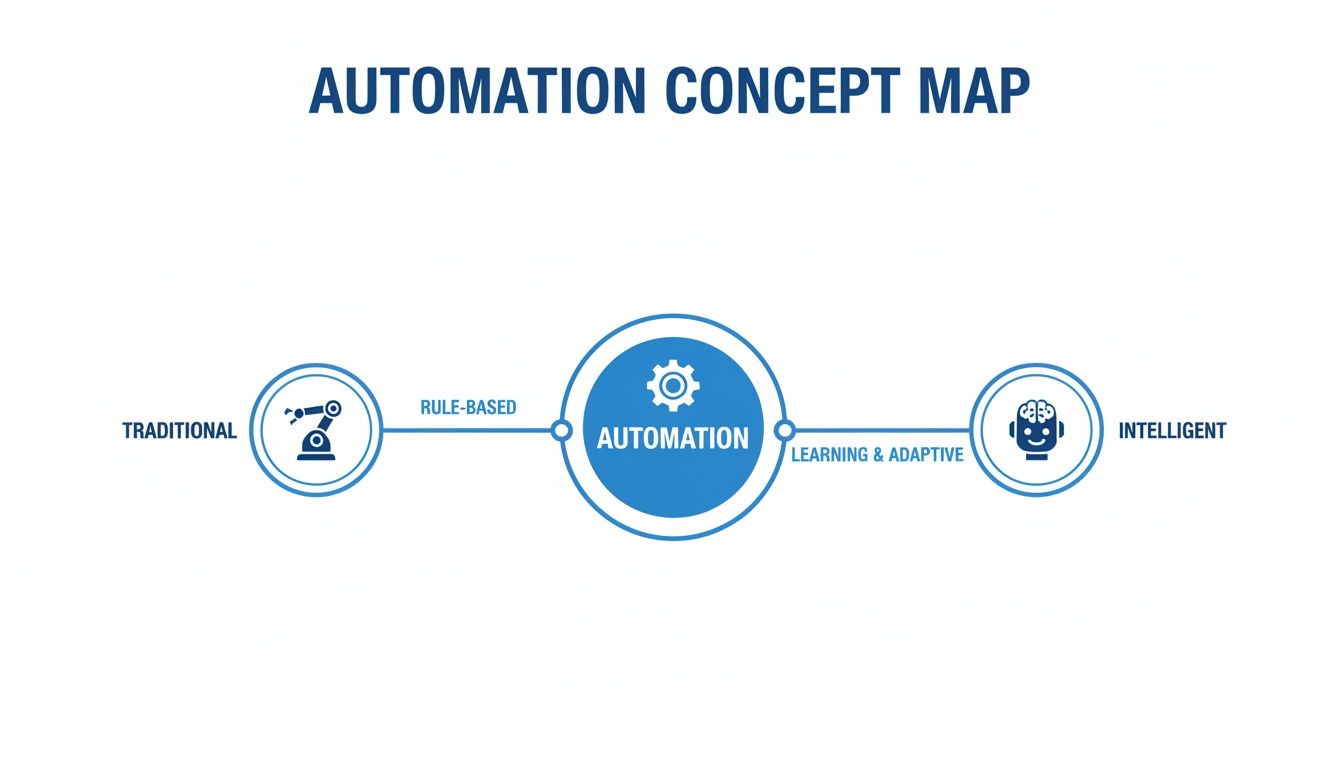
This image shows how we got here, moving from basic, old-school bots to the smart, adaptive systems we have today.
You can see the clear split between the rule-based "hands" of traditional automation and the learning "brain" of intelligent automation. It’s a genuine step up in what's possible.
Pillar 1: Robotic Process Automation (The Hands)
First on the team is Robotic Process Automation (RPA). This is the "hands" of your digital workforce. RPA bots are the doers, the specialists in getting stuff done. They thrive on high-volume, repetitive tasks that have a clear set of rules.
Picture an employee who sinks hours every day just copying customer info from an email into your CRM. An RPA bot can step in and handle that flawlessly, 24/7, without ever needing a coffee break or making a typo.
It's the perfect tool for jobs like:
Shuffling files and folders around.
Pulling structured data from spreadsheets or databases.
Filling out forms with info from another system.
RPA gives you the raw power to execute simple, structured work with incredible speed and accuracy. But that's also its limit—it needs clear instructions and tidy data to work its magic.
Pillar 2: Artificial Intelligence (The Brains)
This is where things get interesting. Enter Artificial Intelligence (AI) and Machine Learning (ML). If RPA brings the hands, AI brings the brains. This pillar gives the whole system the ability to grapple with complexity and make judgments, almost like a person would.
AI tech can make sense of unstructured data—all the messy, real-world information that makes up a staggering 80% of business data. We're talking about emails, images, scanned documents, and even customer support chats. It adds cognitive skills to the mix.
By adding AI, you upgrade your automation from simply doing to thinking and doing. The system can now analyze complex data, recognize patterns, make predictions, and learn from its experiences to get better over time.
For instance, an AI model can read an invoice, figure out what "invoice number" and "due date" mean no matter where they are on the page, and then decide whether to approve it based on past patterns.
Pillar 3: Business Process Management (The Manager)
The final piece of the puzzle is Business Process Management (BPM) and analytics. This is the "manager" of the operation, the central nervous system that keeps everything running smoothly. BPM platforms are what define, manage, and optimize the entire workflow from start to finish.
BPM acts as the conductor, telling the RPA bots when to jump in and feeding information to the AI models for decisions. More importantly, it provides the analytics and oversight you need to see how your processes are actually performing. This bird's-eye view helps businesses spot bottlenecks, measure results, and constantly tweak their automations for even better outcomes. Looking into different AI automations for business really shows how powerful this coordinated strategy can be.
It’s the combination of these three pillars that creates true intelligent automation. This fusion is why the market is exploding; the intelligent automation platform market, valued at $16.88 billion in 2024, is projected to hit $45.47 billion by 2032. This growth is all about the incredible synergy between AI and RPA, which helps companies squeeze real strategic value out of their operations. You can dig into the numbers in the full research on intelligent automation platforms.
So, Why Is Intelligent Automation Such a Big Deal?
Let's get past the technical jargon and ask the real question: "So what?" Why are so many businesses talking about intelligent automation? It's simple, really. This isn't just another tool to make things run a bit faster. It’s about making your entire operation smarter, creating a positive ripple effect that touches every corner of your company.
The first thing you’ll notice is the impact on your bottom line. IA goes straight for the high-cost, repetitive tasks that drain your team's time and your company's budget. Think about all the hours spent manually entering data, pulling reports, or processing invoices. Intelligent automation handles these jobs 24/7 with perfect accuracy, freeing up cash for projects that actually grow the business.
Moving People from Repetitive Work to High-Value Work
Beyond just saving money, IA is a fantastic way to stamp out costly human errors. A single typo on a purchase order or a misread invoice can snowball into compliance headaches, late payments, and seriously unhappy customers. When you let a digital workforce take over these detail-heavy tasks, you hit a level of accuracy that people, frankly, just can't maintain all day long.
This boost in operational quality naturally leads to happier customers. When things like order fulfillment, new client onboarding, or support tickets are handled quickly and without a hitch, customer satisfaction shoots up. And we all know that happy customers stick around, which is the bedrock of real, sustainable growth.
But the most powerful shift isn't about what IA does for the business, but what it does for your people.
By automating the tedious, soul-crushing tasks, you free up your team—your most valuable asset—to focus on what they do best: thinking strategically, coming up with new ideas, and building relationships with customers. It's a move from being buried in paperwork to becoming creative problem-solvers.
This is where the real magic happens. An engaged, empowered team is the true engine of any great business.
A Quick Story: From Manual Drudgery to Smart Logistics
Picture a mid-sized logistics company drowning in manual shipment tracking.
Before IA: They had a team of five people whose entire job was to copy and paste tracking numbers from carrier websites into the company's system. It was slow, full of mistakes, and the team was completely burned out. Customers were constantly calling for updates, which kept the support lines jammed.
After IA: The company decided to work with an AI and data consulting firm to build an intelligent automation solution. Now, a team of smart bots automatically pulls data from all the different carrier sites. The system uses AI to understand what statuses like "In Transit" or "Delayed" actually mean and updates their internal system instantly.
The change was huge. The logistics team now spends its time handling tricky shipping exceptions and working directly with major clients. Customer satisfaction jumped by 25% because people started getting proactive, automated updates on their shipments. The company didn't just save money; it built a smarter, more resilient operation.
To give you a clearer picture, here’s a breakdown of the key benefits you can expect.
Key Business Benefits of Intelligent Automation
Benefit Category
Specific Advantage
Impact on the Business
Operational
Reduced Manual Errors
Increases data accuracy, leading to fewer compliance issues and rework.
Operational
24/7 Productivity
Bots can work around the clock without breaks, dramatically increasing output.
Strategic
Employee Empowerment
Frees up staff from mundane tasks to focus on creativity and strategic planning.
Strategic
Better Customer Experience
Faster, more accurate service delivery leads to higher customer satisfaction and loyalty.
IA projects often deliver tangible cost savings and efficiency gains within months.
As you can see, the advantages aren't isolated; they build on each other to create a stronger, more competitive business.
It's a Must-Have for Growth
This isn't just a collection of nice stories; the numbers tell a compelling tale. For company leaders and IT teams, adopting IA is quickly becoming a strategic necessity. Companies that get it right and scale their automation efforts are seeing incredible results. For example, a whopping 79% of these businesses expect to blow past their competitors in revenue growth in just three years. This makes finding a partner with a clear AI strategy crucial to catching this wave. You can dig deeper into the numbers in this in-depth market report on intelligent automation.
At the end of the day, intelligent automation is a game changer because it kicks off a powerful cycle of improvement. Better efficiency leads to lower costs and happier customers. That, in turn, frees up your people to innovate and create even more value, setting your business up for long-term success.
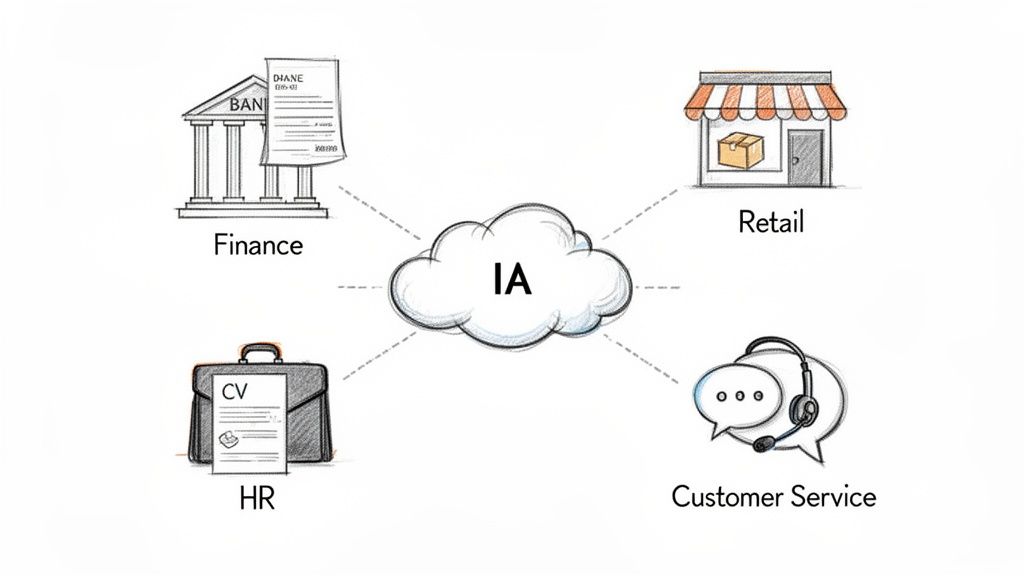
Intelligent Automation in Action Across Industries
Theory is great, but seeing intelligent automation solve real-world problems is where it all clicks. While different industries have their own unique headaches, IA is surprisingly good at adapting to all of them, boosting efficiency and opening up new doors just about everywhere.
Let's get out of the clouds and look at a few concrete examples where IA is making a real difference.
Transforming Finance with Smarter Loan Processing
The financial world is practically built on mountains of paperwork and iron-clad compliance rules, making it the perfect place for intelligent automation to shine. Just think about the old-school way of approving a business loan—it’s a grueling process that can take weeks, involving endless manual checks and a high chance of human error.
An intelligent automation system turns this entire workflow on its head. Here’s how a modern finance firm might use it:
Step 1: Data Extraction: When a loan application comes in, an AI component using computer vision and Natural Language Processing (NLP) gets to work. It actually reads and understands all the documents—financial statements, business plans, you name it—no matter the format.
Step 2: Risk Assessment: With the data pulled, a machine learning model takes over. It crunches the numbers, checks them against market data and the applicant’s credit history, and spits out a detailed risk score. The best part? It learns from every single loan, getting sharper over time.
Step 3: Decision and Communication: Based on that score and the company’s rules, the system can approve the loan instantly, flag it for a human to look over, or even send a polite rejection email.
The result is a loan process that shrinks from weeks to a matter of hours. This doesn’t just slash operational costs; it gives customers the fast answers they want. This is exactly what is intelligent automation in practice.
Optimizing Inventory in the Retail Sector
For anyone in retail, inventory is a constant balancing act. Order too little, you lose sales. Order too much, you’re stuck with costly overstock. It’s a classic problem that eats into profits. Intelligent automation gives retailers a much smarter way to manage it.
A retail company can use IA to sift through massive amounts of data—historical sales, market trends, weather forecasts, and even what people are saying about their products on social media. A predictive analytics model then takes all that information and forecasts future demand with incredible accuracy.
This isn't just about looking at last year's sales. It's about a system that understands the complex web of factors that influence what customers will buy next week, next month, and next season.
With this kind of foresight, the system can automatically place new orders when stock is low or shift inventory between stores to meet local demand. The upshot is fewer empty shelves, less money tied up in products nobody wants, and a supply chain that can actually keep up.
Streamlining the Entire Hiring Process in HR
Human Resources teams often feel like they’re drowning in repetitive tasks, especially when hiring is in full swing. Sifting through hundreds of resumes and scheduling interviews can steal time away from the more human side of the job.
Intelligent automation can help manage the entire hiring pipeline:
Resume Screening: An AI tool can scan incoming resumes and actually understand the context behind someone's skills and experience—way beyond simple keyword matching. It then ranks the best-fit candidates for the role.
Interview Scheduling: For the top candidates, an automated system can check both the applicant’s and the hiring manager’s calendars to find a good time, then send out all the invites and reminders.
Onboarding Paperwork: Once an offer is accepted, IA can automatically generate and send all the necessary onboarding documents, giving the new employee a smooth, professional start.
This frees up HR pros to focus on what they do best: conducting great interviews, building company culture, and making new hires feel welcome.
The demand for these kinds of end-to-end solutions is exploding. The intelligent process automation (IPA) market, which is all about combining AI with process management, was valued at $19.54 billion in 2025 and is projected to hit a massive $72.25 billion by 2033. That growth shows just how much businesses want this kind of efficiency. You can dig into the numbers yourself in this full market analysis on intelligent process automation.
Enhancing Customer Service with Intelligent Chatbots
Finally, let’s talk about customer service, where getting fast, accurate answers is everything. The first-generation chatbots were clumsy and could barely handle one-word questions. Today’s intelligent chatbots, powered by generative AI, are playing a whole different game.
These bots can understand the real meaning and even the frustration behind complex customer questions. They can pull up a customer's history, figure out their specific problem, and provide a personalized, step-by-step solution. If things get too tricky, the bot seamlessly passes the conversation to a human agent, along with a complete summary so the customer doesn't have to repeat a thing.
This means instant help for common issues, 24/7 availability, and a support team that can save its brainpower for the truly tough customer problems.
Your Roadmap to Intelligent Automation
Alright, so you're sold on the "what" and "why" of intelligent automation. Now for the big question: how do you actually do it? Getting started can feel like trying to boil the ocean, but it doesn't have to be.
The trick is to break it down into a practical, step-by-step game plan. This isn't some overly technical manual for your IT department; it's a strategic guide for business leaders. The whole point is to tie your automation efforts directly to real business goals right from the start.
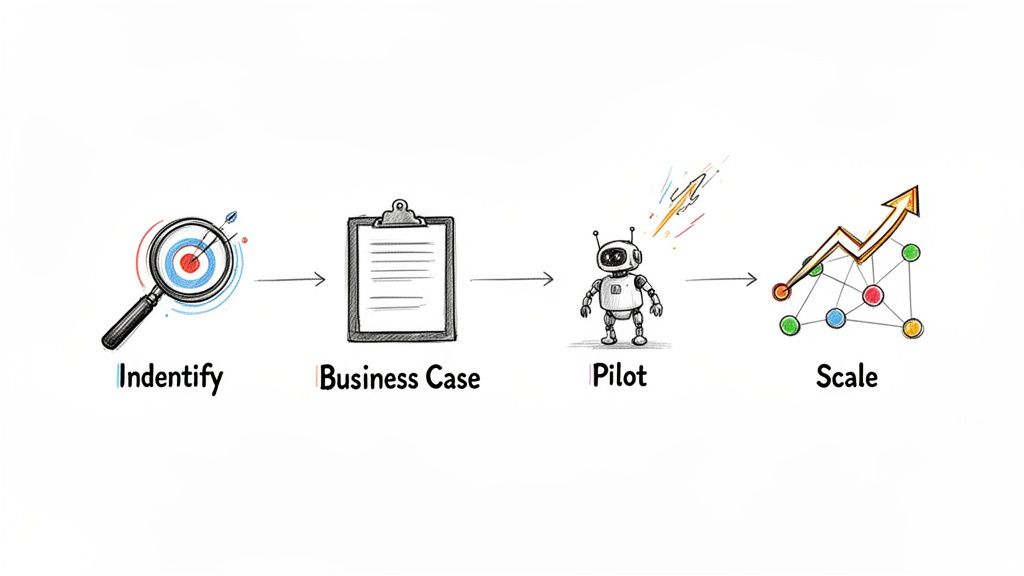
Here’s a proven, four-step approach that will get you moving in the right direction.
Step 1: Pinpoint the High-Return Opportunities
Before you even think about software or code, you need to figure out where to aim. The best place to start is by looking for the biggest sources of pain in your organization. Hunt down the bottlenecks, the mind-numbing repetitive tasks, and the workflows that are magnets for human error.
To get the ball rolling, just ask a few simple questions:
Where's the friction? Look for tasks that are high-volume, rules-based, and eat up a ton of manual effort. Think data entry, generating standard reports, or handling those first-tier customer questions.
What's the cost of doing nothing? Put a number on the inefficiency. How many employee hours are being wasted? What's the real cost of mistakes? What opportunities are you missing because things just take too long?
Is the data there? Automation tools need data to work their magic. Make sure the processes you’re eyeing have data inputs that are accessible and reasonably consistent.
When you focus on a clear, painful problem, you're not just buying tech; you're solving a real business issue. That makes it a whole lot easier to get everyone on board.
Step 2: Craft a Compelling Business Case
Once you've got your target, you need to get the green light from leadership. That means building a business case that speaks their language—focusing on results, not just the cool technology behind it.
The best business cases don't just talk about cutting costs. They tell a story about creating real strategic value—whether that's through happier customers, getting products to market faster, or freeing up your team to work on big ideas.
Your business case should lay out a few key things:
The Problem: A quick summary of the process you're targeting and the headaches it causes.
The Solution: A simple explanation of how intelligent automation will fix it.
The Expected ROI: This is crucial. Include "hard" savings like lower labor costs and fewer errors, but also "soft" benefits like higher team morale and better compliance.
The Resources Needed: Be upfront about the initial investment of time, money, and people.
Think of this document as your project's North Star. It keeps everyone aligned and focused on the prize.
Step 3: Launch a Pilot Project to Prove It Works
With approval in hand, fight the temptation to go big right away. The smartest move is to start with a focused pilot project. This is your chance to get a "first win" on the board. The goal is to show that this stuff actually works on a small scale, learn some valuable lessons, and build excitement for what's next.
A great pilot project has a few things in common:
It has a crystal-clear scope and achievable goals.
It targets a process that is visible and meaningful to the business.
It can be finished in a reasonable timeframe, like 90-120 days.
For instance, you could pilot a bot that processes one specific type of invoice or handles a single, common customer service request. Nailing even one small but annoying process is a powerful proof point. You can dive deeper into the nuts and bolts of getting a project like this running in our guide on how to implement AI in business.
Step 4: Create a Plan to Scale Your Success
That successful pilot? It's just the beginning. The final step is to figure out how to scale what you’ve learned across the rest of the company. It's about taking the lessons from your first project and creating a repeatable playbook for finding, prioritizing, and launching more automation.
To scale properly, you'll eventually want to set up a dedicated team or a "center of excellence" to oversee your automation efforts. This group will set the standards, share what works, and make sure every new project fits into the bigger picture.
This is often the point where bringing in an experienced AI and data consulting firm pays off big time. They have the expertise to help you build a program that scales, sidesteps common traps, and gets you to a serious return on your investment much faster.
Got Questions About Intelligent Automation?
Even with a solid plan, jumping into something like intelligent automation is bound to bring up some questions. That’s not just normal; it’s a good sign. Getting these things cleared up is how you build the confidence to actually move forward.
Let's dig into some of the most common questions business leaders ask about what intelligent automation really means for their teams, budget, and future.
How Is Intelligent Automation Different From Just AI or RPA?
This is a great question because it cuts right to the chase. I like to think of it like building a house.
Robotic Process Automation (RPA) is like your set of power tools—the nail gun, the circular saw, the drill. They are fantastic at doing very specific, repetitive jobs with incredible speed and accuracy. Nail this board, cut that plank, drill this hole.
Artificial Intelligence (AI), on the other hand, is the architect and the on-site project manager. It’s the "brain" of the operation. It can read the blueprints, make judgment calls when a problem crops up, and even learn from the unique challenges of the job site.
You can't build a house with just a nail gun, and an architect can't frame a wall all by themselves. Intelligent Automation is the whole construction crew, seamlessly bringing the tools (RPA) and the brains (AI) together to get the entire house built, from the foundation right up to the roof. It’s not just one piece of tech; it’s the smart combination of several, all working in sync to handle a complete process from start to finish.
Do I Need a Team of Data Scientists to Get Started?
Not necessarily, especially not right out of the gate. Many of the best intelligent automation platforms today are built with low-code or even no-code interfaces. This makes them way more approachable for your existing team, who can often start building simple automations without needing a PhD in computer science.
That said, if you're serious about building a strategic, scalable program, bringing in an AI and data consulting firm is a very smart move.
An expert partner doesn't just build a few bots and walk away. They help you nail down the right strategy, pinpoint the opportunities with the biggest bang for your buck, and manage the technical heavy lifting. This frees up your team to focus on business results, not complex code.
The goal here is to empower the people you already have with better tools, not to build a whole new department from scratch overnight.
How Do I Measure the ROI of an Automation Project?
Figuring out the return on an intelligent automation project is about much more than just dollars and cents. Of course, you absolutely have to track the hard financial metrics, but the full picture includes all the strategic wins that are just as important.
A good ROI analysis should look at a mix of things:
Financial Gains: This is the obvious one. Track things like how much less time it takes to complete a task, the drop in operational costs from fewer manual hours, and the savings you get from slashing error rates.
Operational Improvements: How much faster are your core processes now? Can you onboard a new customer in half the time? Can you close the books three days earlier every month? These are huge wins.
Customer Impact: Don't forget why you're in business. Keep an eye on customer satisfaction scores (CSAT) or Net Promoter Score (NPS). Faster, more accurate service almost always makes customers happier.
Employee Experience: This is a big one that often gets overlooked. When you take the mind-numbing, repetitive work off your team's plate, you almost always see a jump in morale and retention.
A complete ROI calculation tells a story about both cost savings and the powerful strategic advantages that set you up for success down the road.
Will Intelligent Automation Replace Our Employees?
This is probably the most common—and most important—question of them all. The honest answer is that the most successful automation initiatives are all about augmentation, not replacement.
Think about it: IA is at its absolute best when it’s tackling the high-volume, repetitive, data-entry-style tasks that most people find draining anyway. This doesn't make your employees obsolete; it actually makes them far more valuable.
By handing off the robotic work to, well, robots, you free up your people to focus on the uniquely human skills that no machine can touch. We're talking about strategic thinking, creative problem-solving, building real relationships with customers, and driving innovation.
Intelligent automation is best seen as a powerful assistant—a digital teammate that empowers your human workforce to be more effective, more engaged, and more focused on the work that truly matters.
Ready to turn these insights into action? At NILG.AI, we specialize in creating clear, actionable AI strategies that drive real business results. We partner with you to identify the best automation opportunities and build solutions that empower your team and grow your bottom line. Discover how our Request a proposal
Like this story?
Subscribe to Our Newsletter
Special offers, latest news and quality content in your inbox.
What Is Cognitive Automation? A Guide to Smarter Business
Jun 6, 2026 in
Guide: Explainer
Stuck on repetitive tasks? Discover what is cognitive automation and how it uses AI to cut costs, boost efficiency, and free up your team for what matters.
We use cookies on our website to give you the most relevant experience by remembering your preferences and repeat visits. By clicking “Accept All”, you consent to the use of ALL the cookies. However, you may visit "Cookie Settings" to provide a controlled consent.
This website uses cookies to improve your experience while you navigate through the website. Out of these, the cookies that are categorized as necessary are stored on your browser as they are essential for the working of basic functionalities of the website. We also use third-party cookies that help us analyze and understand how you use this website. These cookies will be stored in your browser only with your consent. You also have the option to opt-out of these cookies. But opting out of some of these cookies may affect your browsing experience.
Necessary cookies are absolutely essential for the website to function properly. These cookies ensure basic functionalities and security features of the website, anonymously.
Cookie
Duration
Description
cookielawinfo-checkbox-analytics
11 months
This cookie is set by GDPR Cookie Consent plugin. The cookie is used to store the user consent for the cookies in the category "Analytics".
cookielawinfo-checkbox-functional
11 months
The cookie is set by GDPR cookie consent to record the user consent for the cookies in the category "Functional".
cookielawinfo-checkbox-necessary
11 months
This cookie is set by GDPR Cookie Consent plugin. The cookies is used to store the user consent for the cookies in the category "Necessary".
cookielawinfo-checkbox-others
11 months
This cookie is set by GDPR Cookie Consent plugin. The cookie is used to store the user consent for the cookies in the category "Other.
cookielawinfo-checkbox-performance
11 months
This cookie is set by GDPR Cookie Consent plugin. The cookie is used to store the user consent for the cookies in the category "Performance".
viewed_cookie_policy
11 months
The cookie is set by the GDPR Cookie Consent plugin and is used to store whether or not user has consented to the use of cookies. It does not store any personal data.
Functional cookies help to perform certain functionalities like sharing the content of the website on social media platforms, collect feedbacks, and other third-party features.
Performance cookies are used to understand and analyze the key performance indexes of the website which helps in delivering a better user experience for the visitors.
Analytical cookies are used to understand how visitors interact with the website. These cookies help provide information on metrics the number of visitors, bounce rate, traffic source, etc.
Advertisement cookies are used to provide visitors with relevant ads and marketing campaigns. These cookies track visitors across websites and collect information to provide customized ads.